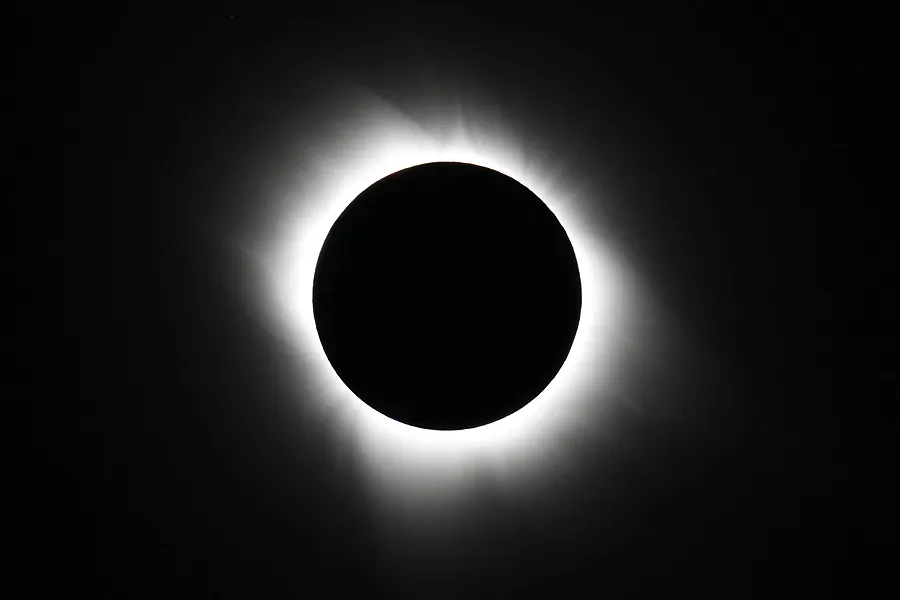
This view of the sun’s extremely hot outer atmosphere, called the corona, was captured by Edwin Aguirre and Imelda Joson from the South Pacific during the total solar eclipse on July 11, 2010. Note the moon’s pitch-black silhouette and the corona’s fine structural details.
(Image credit: Imelda B. Joson and Edwin L. Aguirre)
The total solar eclipse on Tuesday (Nov. 13) may only be visible from slivers of northern Australia and a swathe of open ocean, but you don't have to make an epic journey to see the dramatic celestial event.
Several different organizations will webcast live views of the total solar eclipse, which begins at 3:35 p.m. EST (2035 GMT) on Tuesday (Nov. 13; however, it will actually be Nov. 14 local time in Australia).
The online Slooh Space Camera is one such outfit. It will broadcast a live feed of the 2012 total solar eclipse from a site near the city of Cairns, in the Australian state of Queensland, starting at 2:30 p.m. EST (1930 GMT) Tuesday. The eclipse will commence around sunrise local time, making for a particularly memorable spectacle, Slooh officials said.
"We are ecstatic to have a world-class team on-site in Cairns bringing the power and beauty of this spectacular event live to our worldwide audience," Slooh president Patrick Paolucci said in a statement. "We are ramped up and ready to go to handle millions of viewers." [Video: Watch Path of Nov. 13-14 Total Solar Eclipse]
Another webcast event will be streamed by Tourism Tropical North Queensland, which will also provide live views from Cairns here: http://www.ustream.tv/cairnseclipse2012.
The path of totality for tomorrow's solar eclipse will be 108 miles (174 kilometers) wide and will traverse about 9,000 miles (14,500 km) over a three-hour period, Slooh officials said. Most of the path will be over the South Pacific Ocean, making the eclipse tough for most folks to view.
Sign up for the Live Science daily newsletter now
Get the world’s most fascinating discoveries delivered straight to your inbox.
Solar eclipses occur when the moon lines up with the sun in the sky, blotting out the solar disk from a viewer's perspective on Earth. There are three main types: total, partial and annular (in which the outer edges of the sun shine like a ring around the moon in the sky).
Parts of Asia, the Pacific and western North America experienced an annular or "ring of fire" eclipse in May. The next total solar eclipse darkens the North Atlantic region in March 2015, though a "hybrid" eclipse — which shifts between total and annular at different points on the globe — will come to parts of the Atlantic and central Africa in November 2013.
Warning: If you are planning to watch the total solar eclipse in person, be extremely careful. Never look directly at the sun, either with the naked eye or through telescopes or binoculars without the proper filters. To safely view solar eclipses, you can purchase special solar filters or No. 14 welder's glass to wear over your eyes. Standard sunglasses will NOT provide sufficient protection.
The eclipse isn't the only skywatching treat on tap this week. The annual Leonid meteor shower peaks overnight Saturday (Nov. 17).
Michael was a science writer for the Idaho National Laboratory and has been an intern at Wired.com, The Salinas Californian newspaper, and the SLAC National Accelerator Laboratory. He has also worked as a herpetologist and wildlife biologist. He has a Ph.D. in evolutionary biology from the University of Sydney, Australia, a bachelor's degree from the University of Arizona, and a graduate certificate in science writing from the University of California, Santa Cruz.