














Mars Clays Could Preserve Signs of Life

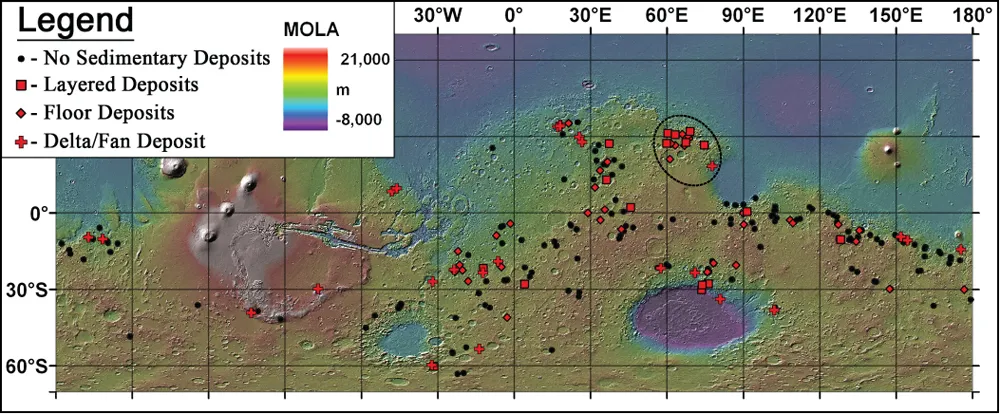
The mud and clays ideal for preserving fossil records are less common around Martian lakes than on Earth. A new survey of 226 ancient lakebeds on the Red Planet reveals that only a third show evidence of such deposits on the surface today.
A team of scientists from Brown University pored over surface images from the Mars Reconnaissance Orbiter, the Mars Odyssey Spacecraft, and the Mars Express spacecraft in search of lakes that once boasted water rushing out as well as in. They then analyzed the reflected light from each lake to determine their chemical composition, hoping to identify the muds and clays found in such systems on Earth.
They found that only 79 of the beds contained deposits of minerals that hint at clays on the surface. This scarcity could be a result of the chemistry of mixing Martian water and the surrounding land, or it could be another sign that water on the Red Planet only stuck around for a brief period of time, scientists say.
Capturing fossil records
If life evolved on Mars, deposits of clay and sediment could contain evidence of its existence.
When Curiosity, the rover for NASA's Mars Science Laboratory mission, lands on Mars this summer, it will search clays and sediments in the Gale Crater for indications of past environments that could have supported microbial life. [Photos: The Search for Water on Mars]
"Clay minerals on Earth are a very well known preserver of the signatures of life," primary investigator Timothy Goudge told SPACE.com.
Get the world’s most fascinating discoveries delivered straight to your inbox.
Because these deposits formed in large bodies of water, they are particularly promising.
"On Earth, pretty much all of the lakes we see have some form of life living within the sediment, or in the lake itself. Of the possible candidates, lakes are a very good one."
The survey was published online in the journal Icarus.
Shaken, not stirred
Water rushing over mineral grains stirs and mixes them, chemically altering their structure as it moves along.
But if the water only flowed briefly for a given lake, there may not have been time for the creation of large quantities of clay.
"Presently on Mars, there's a lot of water-ice, but not really a lot of flowing surface water like we think it was like in the ancient past," Goudge said. "If the lakes themselves had short lifetimes, it makes sense that the flowing surface water was not long-lived."
According to the team, all of the examined lakes have undergone some form of resurfacing since they became inactive more than 3.7 billion years ago. Lava flowing from volcanoes covered some of the beds, and icy glaciers crept down from the poles to hide others. In some cases, weathering eroded these new layers, exposing the clay sediments.
This is particularly apparent in the Nili Fossae region, where exposed sediments in lakes are particularly dense. The area has undergone substantial erosion, revealing crusts as old as 4.1 billion years, which leads the team to favor such a process as a driving cause for peeling away layers and exhuming clay deposits from the past. This hypothesis is only tentative, but it could mean more deposits are hidden beneath the surface on other parts of Mars, waiting to be unveiled.
Like their exposed counterparts, the buried clays could contain records of the planet's past. And they aren't limited by size.
"The great thing about clay minerals is that they can preserve the signature of life for a variety of different scales," Goudge said.
This story was provided by SPACE.com, a sister site to LiveScience. Follow SPACE.com for the latest in space science and exploration news on Twitter @Spacedotcom and on Facebook.

Nola Taylor Tillman is a contributing writer for Live Science and Space.com. She loves all things space and astronomy-related, and enjoys the opportunity to learn more. She has a Bachelor’s degree in English and Astrophysics from Agnes Scott college and served as an intern at Sky & Telescope magazine. In her free time, she homeschools her four children.