
-
 The universe may end trillions of years sooner than we thought
Recent surveys hint that the rate of cosmic expansion changes dramatically over time; if that's true, then the universe could end much sooner than we thought, new research suggests.
16 Comments -
 The earliest black holes in the universe may still be with us, surprising study claims
The earliest black holes in the universe may not have disappeared from Hawking radiation after all, new research hints. Instead, they fed on the energy of the ancient cosmos to grow supermassive.
4 Comments -
 Our leading theory of dark matter may be wrong, huge new gravity study hints
New research using a space-time phenomenon predicted by Einstein presents evidence that the invisible backbone of the universe may be much "fuzzier" than we realized.
8 Comments -
 Our model of the universe is deeply flawed — unless space is actually a 'sticky' fluid
Our best models of the cosmos don't add up — but that could change if the universe is actually made of a viscous 'fluid,' a new paper suggests.
31 Comments -
 Some objects we thought were planets may actually be tiny black holes from the dawn of time
Scientists have discovered more than 6,000 planets beyond our solar system. What if some of them aren't planets at all, but tiny black holes in disguise?
-
 30 models of the universe proved wrong by final data from groundbreaking telescope
The Atacama Cosmology Telescope (ACT) in Chile has released its final batch of data after 15 years — and it proves that the Hubble tension, a rift in our understanding of the universe, is very real.
30 Comments -
 Scientists spot 2 black holes that took turns slaughtering 1 unlucky star
A strange X-ray signal spotted decades ago may be the result of a star that got attacked by two black holes, one after the other.
-
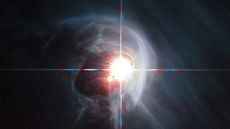 Two stars spiraling toward catastrophe are putting Einstein's gravity to the test
The two stars in the nearby system ZTF J2130 are spiraling toward a catastrophic supernova. In the meantime, scientists are using the pair's slow orbital decay to put Einstein's theory of gravity to the test.
-
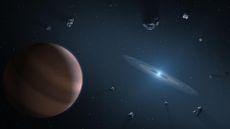 Einstein's relativity could rewrite a major rule about what types of planets are habitable
Planets that orbit white dwarf stars should be too hot to host alien life, theories suggest. But a new study accounting for Einstein's general relativity may rewrite that rule.
5 Comments -
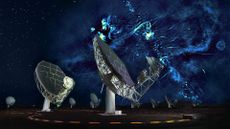 Giant radio telescope in the Nevada desert could reveal hidden corners of the cosmos — and brand-new physics
Scientists say that the construction of a vast new radio telescope array in the Nevada desert — known as the Deep Synoptic Array 2000 — could uncover some of the biggest outstanding mysteries in astronomy.
3 Comments -
 ChatGPT could pilot a spacecraft shockingly well, early tests find
In a recent contest, teams of researchers competed to see who could train an AI model to best pilot a spaceship. The results suggest that an era of autonomous space exploration may be closer than we think.
3 Comments -
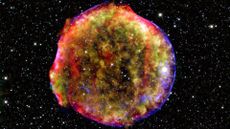 Scientists discover most powerful particle collider in the universe
Scientists may have discovered the most powerful particle colliders in the universe — and they're strewn throughout our galaxy just waiting to blow.
-
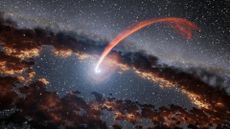 The rarest black holes in the universe may be 'wandering' our galaxy
Dozens of 'wandering' black holes could be tumbling through our galaxy right now, new simulations hint. Their existence could help solve a longstanding cosmic puzzle.
4 Comments -
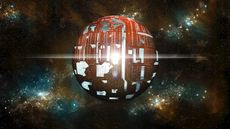 Dyson spheres could really exist — but there's a catch
Is it possible to build a Dyson sphere that isn't catastrophically unstable? New research says yes, but only in one type of star system.
14 Comments -
 Mysterious Antikythera Mechanism may have been an ancient Greek toy, new study hints
The mysterious Antikythera Mechanism is 2,000 years old and has long puzzled scientists. New research into its triangle-shaped teeth may finally reveal its intended purpose.
12 Comments -
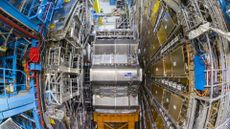 The world's largest atom smasher is getting a powerful new upgrade
Physicists are finalizing plans for MATHUSLA, a powerful new addition to CERN's Large Hadron Collider that will detect long-lived particles and potentially open the door to new physics.
-
 James Webb telescope could find signs of life on alien 'hycean' ocean worlds
If such worlds exist, they could be among the most common life-bearing planets in the galaxy.
-
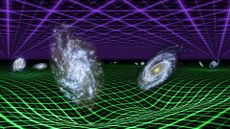 Could the universe ever stop expanding? New theory proposes a cosmic 'off switch'
Dark energy, the mysterious phenomenon that powers the expansion of the universe, may undergo periodic 'violent transitions' that reverse the growth of the cosmos, a new pre-print study hints.
13 Comments -
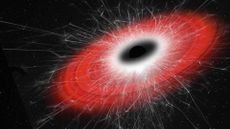 Evidence for Stephen Hawking's unproven black hole theory may have just been found — at the bottom of the sea
The recent discovery of a stupendously powerful neutrino has left scientists scratching their heads. New research suggests it could be evidence that Stephen Hawking was right about the nature of black holes and the early universe.
14 Comments -
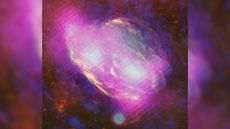 Most powerful cosmic rays in the universe start shockingly close to Earth, paper claims
The most powerful cosmic rays in the universe currently have no explanation. New research suggests that exotic, self-annihilating particles in our own galaxy may hold the answer.
4 Comments -
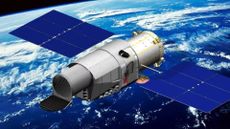 China is building a space telescope to rival the JWST — and it could survive in orbit decades longer
Chinese scientists have announced details on the upcoming China Space Station Telescope (CSST), a cutting-edge observatory that will rival the JWST.
3 Comments -
 Could we travel to parallel universes?
Let's explore the possibility of traveling to universes beyond our own — if they so exist, that is.
3 Comments -
 'Heavy' dark matter would rip our understanding of the universe apart, new research suggests
Because we haven't found anything yet, we've started to wonder if dark matter might be lighter or heavier than we thought.
-
 Something invisible and 'fuzzy' may lurk at the Milky Way's center, new research suggests
The cores of galaxies may not be made of what we thought, new research suggests — they could hold one giant, invisible star made of mysterious "fuzzy" matter.


