

-
 Gravity can transform into light, mind-bending physics paper suggests
In the early universe, gravity may have been capable of creating light, a new theoretical paper finds.
particle-physics -
 The most elusive black holes in the universe could lurk at the Milky Way's center
Astronomers have a plan for using ripples in space-time to hunt for elusive intermediate-mass black holes around the Milky Way's center.
black-holes -
 Newly discovered 'einstein' tile is a 13-sided shape that solves a decades-old math problem
A new 13-sided shape is the first example of an elusive "einstein" — a single shape that can be tiled infinitely without repeating a pattern.
mathematics -
 What's the biggest black hole in the universe?
What's the biggest black hole in the universe, and is there a limit to how big black holes can get?
black-holes -
 There may have been a second Big Bang, new research suggests
Within a month of the Big Bang, a second cosmic explosion may have given the universe its invisible dark matter, new research suggests.
quantum-physics -
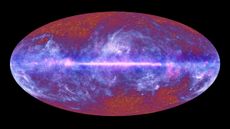 The universe might be shaped like a doughnut, not like a pancake, new research suggests
The universe may be flat, but could still be shaped like a doughnut, weird patterns in leftover light from the Big Bang suggest.
astronomy -
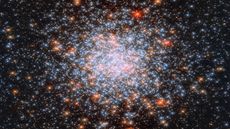 Dark energy could lead to a second (and third, and fourth) Big Bang, new research suggests
Scientists have proposed a way that the universe could stop expanding, ending in a 'Big Crunch' that resets space and time as we know it.
cosmology -
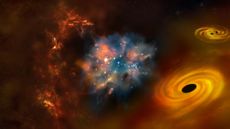 The early universe was crammed with stars 10,000 times the size of our sun, new study suggests
When the universe's first stars emerged from the cosmic dark ages, they ballooned to 10,000 times the mass of Earth's sun, new research suggests.
astronomy -
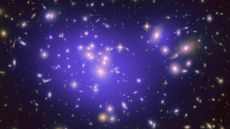 The universe is slightly hotter than it should be. 'Dark photons' could be to blame.
Intergalactic gas clouds are slightly hotter than they should be, new research claims, and theoretical particles called 'dark photons' could explain it.
cosmology -
 Alien life could be turning harsh planets into paradises — and astronomers want to find them
Early life made an inhospitable Earth more habitable, and aliens could be doing the same thing on their worlds, new research proposes.
extraterrestrial-life -
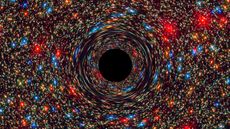 Elusive 'Buchdahl stars' are black holes without event horizons. But do they really exist?
These hypothetical stars are the densest objects in the universe that can exist without becoming full-fledged black holes.
black-holes -
 Does reality exist when we're not looking?
In quantum physics, particles exist in many states at once until you measure them. Can reality really work that way?
quantum-physics -
 Do quantum universes really exist?
In some interpretations of quantum mechanics, such as the Many-Worlds interpretation or the Pilot Wave Theory, parallel universes may form every time a subatomic particle goes through any interaction.
quantum-physics -
 Does consciousness explain quantum mechanics?
A wild theory suggests that consciousness may explain quantum mechanics, by forcing the subatomic particles to choose one concrete outcome.
quantum-physics -
 Is all matter made up of both particles and waves?
According to quantum mechanics, the physics theory that describes the zoo of subatomic particles, all matter can be described as both particles and waves. But is it real?
quantum-physics -
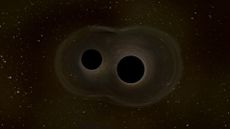 How gravitational waves can 'see inside' black holes
What lurks at the center of a black hole? Studying the space-time ripples from black hole collisions could reveal an answer.
black-holes -
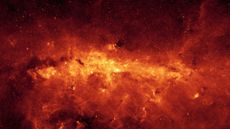 How did the Milky Way form?
Our 13 billion-year-old galaxy has gone through many growing pains — usually to the detriment of its smaller neighbors.
space -
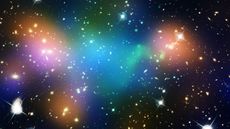 How much of the universe is dark matter?
Most matter in the universe cannot be seen — but its influence on the largest structures in space can.
space -
 How was the universe created?
Short answer: We don't really know how the universe was created, though most astrophysicists believe it started with the Big Bang.
space -
 Breaks in the Perfect Symmetry of the Universe Could Be a Window Into Completely New Physics
If this fundamental symmetry of the universe doesn’t hold, it could break open new physics.
physics-mathematics -
 Physicists get closer than ever to measuring the elusive neutrino
Scientists used a 200-ton "neutrino scale" to measure the elusive particles.
physics-mathematics -
 The Quantum World May Have a Favorite Flavor, Tantalizing Results Suggest
The world of the teensy-tiny, the quantum realm, could have a favorite flavor. Here's why that's a big deal.
quantum-physics -
 Oddly heavy particle may have just broken the reigning model of particle physics
An ultraprecise measurement of the mass of the W boson may diverge from the Standard Model, a long-reigning framework that governs the strange world of quantum physics.
particle-physics -
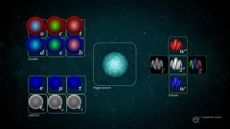 What is the Standard Model, the subatomic physics theory that has been tested more than any other?
The Standard Model is the modern physical understanding of three of the four forces of nature: electromagnetism, the strong nuclear force and the weak nuclear force.
particle-physics


