

-
 Never-before-seen 'strange quark star' may have formed after cosmic collision, physicists say
A team of physicists has found that the remnant of a neutron star merger observed in 2019 has just the right mass to be a strange hypothetical quark star.
astronomy -
 Are black holes wormholes?
And can we use them to traverse the universe?
black-holes -
 Giant voids of nothingness may be flinging the universe apart
Dark energy could be caused by pressure from giant voids of nothingness that may be flinging the universe apart.
cosmology -
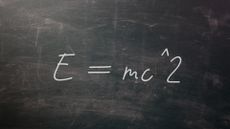 Why does E=mc^2?
Albert Einstein's famous equation E = m^2 connects energy to mass via the speed of light. Find out why E = m^2.
physics-mathematics -
 Where do electrons get energy to spin around an atom's nucleus?
Quantum mechanics explains why the electrons can keep spinning indefinitely.
particle-physics -
 Physicists link two time crystals in seemingly impossible experiment
New time crystal achievement could help bridge classical and quantum physics.
physics-mathematics -
 The aliens are all hanging out on Dyson spheres circling white dwarfs, physicist argues
If aliens exist, they do exist, they might be hanging out on Dyson spheres circling the husks of sunlike stars called white dwarfs.
extraterrestrial-life -
 Physicists predict Earth will become a chaotic world, with dire consequences
Humans aren't just making Earth warmer, they are making the climate chaotic, a stark new study suggests.
climate-change -
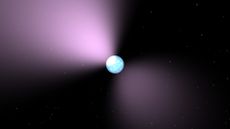 What are pulsars?
Reference Pulsars are the ultradense cores of gigantic stars that emit beams of radio waves in regular pulses, like cosmic lighthouses.
Reference -
 Humans could become a truly interplanetary species within 200 years, physicists claim
Harness renewable energy to explore the cosmos or risk planetary doom, new physics study argues
planets -
 What is the universe?
Reference It's quite a big question and a lot is still unknown about the universe, but we'll tell you everything that we do know, from how the universe was created, how old it is and what it's even made of.
Reference -
 What is time?
Reference From the beginning of the universe to the present day, it's one of the few things we regard as regular and unchanging. But is it really so constant? We take a look at the physics of time.
Reference -
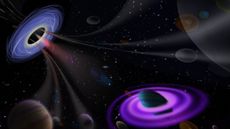 A spiderweb of wormholes could solve a fundamental paradox first proposed by Stephen Hawking
A seemingly intractable black hole paradox first proposed by physicist Stephen Hawking could finally be resolved — by wormholes through space-time.
physics-mathematics -
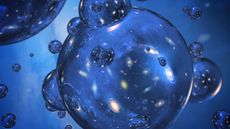 Our universe may have a twin that runs backward in time
A mirror universe that runs backward in time sprouted up before the Big Bang.
physics-mathematics -
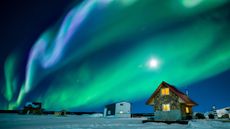 Northern Lights: What are the aurorae borealis?
REFERENCE The northern lights appear in the sky when charged particles from the sun slam into molecules in the atmosphere, releasing energy in the form of colorful lights.
REFERENCE -
 What are photons?
Reference Photons carry the electromagnetic force, and act as both particles and waves.
Reference -
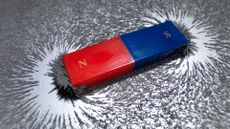 What is magnetism? Facts about magnetic fields and magnetic force
Reference Magnetism is a force of nature produced by moving electric charges.
Reference -
 The first life on Earth depended on a deadly poisonous gas, study suggests
Toxic hydrogen cyanide gas, used in chemical weapons today, may have been involved in the early stages of life's evolution, a new study suggests.
planet-earth -
 Do we live in a simulation? Here's why we may never know.
Does the simulation hypothesis offer a compelling argument, or is it just interesting food for thought? Let's find out.
space -
 The Higgs boson could have kept our universe from collapsing
The Higgs boson particle could have kept our universe from collapsing within a larger multiverse, physicists say.
cosmology -
 Astronomers propose building a neutrino detector out of the Pacific Ocean
The Pacific Ocean Neutrino Experiment would turn a massive swath of the Pacific Ocean into nature's own neutrino detector.
astronomy -
 'Diamond rain' on Uranus and Neptune seems likely
Hiding beneath the outer layers of some planets, there may be something spectacular: a constant rain of diamonds.
neptune -
 We may finally be able to test one of Stephen Hawking's most far-out ideas
The recently launched James Webb Telescope should help determine if dark matter is made up of primordial black holes.
astronomy -
 How real is the multiverse?
A multiverse may be a natural prediction of the physical theories that define the beginning of the universe.
cosmology


