

-
 'Emergent gravity' could force us to rewrite the laws of physics
The idea of emergent gravity is still new and requires a lot of assumptions in its calculations to make it work. But if experimental evidence ever proves it real, we would need to totally rewrite the laws of physics.
physics-mathematics -
 There may be a 'dark mirror' universe within ours where atoms failed to form, new study suggests
The invisible substance called dark matter remains one of the biggest mysteries in cosmology. Perhaps, a new study suggests, this strange substance arises from a 'dark mirror universe' that's been linked to ours since the dawn of time.
cosmology -
 Einstein's predictions mean rare 'gravitational lasers' could exist throughout the universe, new paper claims
A new study combining two of Albert Einstein's famous predictions suggests that ripples in space-time can combine into 'gravitational lasers', firing out of black holes in random directions across the cosmos.
black-holes -
 Scientists may finally know where the biggest, oldest black holes in the universe came from
The presence of supermassive black holes in the earliest epochs of the universe has scientists stumped — but repeated explosions from tiny black holes may offer an explanation.
black-holes -
 Cosmic strings can break — and when they do, they shake the universe
Many models of the universe predict the existence of countless invisible strings stretching across space. New research finds a way these strings might snap — and how we could feel the fallout.
black-holes -
 Turbulent 1st moments of a black hole's life captured in new simulations
Scientists modeled how black holes and neutron stars form after dying stars collapse, and explained why some get a hard 'kick' into interstellar space.
black-holes -
 Millions of invisible 'mirror stars' could exist in the Milky Way, and astronomers know how to find them
An entire universe made of 'dark' particles could exist within our own, and astronomers may know the first place to look: In the mysterious hearts of supposed 'mirror stars'.
cosmology -
 The 1st life in the universe could have formed seconds after the Big Bang
The first life-forms capable of evolution could have appeared just moments after the Big Bang, a physicist explains.
space -
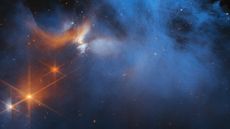 Building blocks of life may have formed on dust in the cold vacuum of space
Far from any galaxy, icy grains of dust in deep space may be able to form organic molecules, a new preprint study finds.
chemistry -
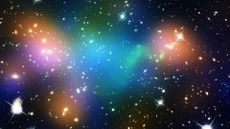 Dark matter may have its own 'invisible' periodic table of elements
Dark matter may come in multiple particles and weights, similar to the ordinary elements on the periodic table, a new theory suggests.
cosmology -
 11 sci-fi concepts that are possible (in theory)
Some of the most common and unlikely sci-fi tropes could one day be science fact.
space -
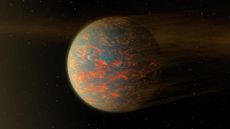 Mysterious signals from 'hell planet' 40 light-years from Earth could finally be solved by James Webb Space Telescope
The hellish super-Earth '55 Cancri e' may be constantly losing and re-growing its atmosphere, a new study of the planet's strange transit signals suggests.
exoplanets -
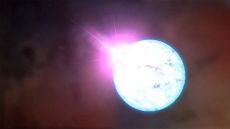 Ultra-powerful plasma 'blades' could slice entire stars in half, new paper suggests
Stars could be sliced in half by "relativistic blades," or ultra-powerful outflows of plasma shaped by extremely strong magnetic fields, an unpublished paper claims.
astronomy -
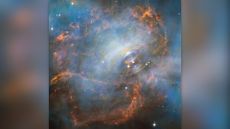 Nuclear 'pasta' cooked up by dead stars could unravel the secrets of stellar afterlife
In the extreme hearts of neutron stars, fundamental particles are twisted into strange 'pasta' shapes that could reveal untold secrets about how dead stars evolve.
cosmology -
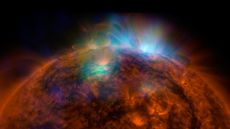 'Ghost' particles from the sun could lead us straight to an invisible trove of dark matter
New research suggests that the sun may hold dark matter in its fiery heart, and ghostly particles called neutrinos could lead us to it.
the-sun -
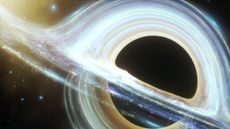 'Twisty' new theory of gravity says information can escape black holes after all
Einstein's theory of relativity say black holes are 'bald', but a new tweak to his research may give the mysterious objects their long-sought 'hair.'
black-holes -
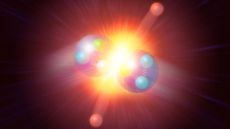 What is the strong force?
Reference The strong force is one of the four fundamental forces of nature. Learn how it fits into the Standard Model of particle physics.
Reference -
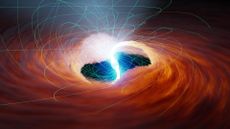 Dark matter could be building up inside dead stars — with potentially explosive consequences
Invisible dark matter may be gathering in the ultra-dense innards of neutron stars, potentially causing them to detonate in massive explosions.
cosmology -
 Giant 'bubbletrons' shaped the forces of the universe moments after the Big Bang, new study suggests
Meet the 'bubbletrons' — theoretical particle accelerators that may have helped build the universe as we know it.
cosmology -
 Invisible supernovas called 'bosenovas' may be exploding all around us, new research suggests
What happens when an invisible star dies? It erupts in an invisible explosion, of course. New research describes how these unseen 'bosenovas' may behave.
cosmology -
 Scientists think they saw an asteroid crash into a dead star — and release one of the brightest explosions in the universe
Astronomers proposed a new mechanism behind mysterious fast radio bursts (FRBs), and it involves unlucky asteroids crashing into neutron stars.
cosmology -
 5 fascinating facts about the Big Bang, the theory that defines the history of the universe
From the Catholic priest who pioneered it, to how we can (almost) see it, here are 5 fascinating facts about the Big Bang.
cosmology -
 Mathematicians end decades-long quest to find elusive 'vampire einstein' shape
Researchers have discovered a new 14-sided shape called the Spectre that can be used to tile a surface without ever creating a repeating pattern, ending a decades' long mathematical hunt.
mathematics -
 Strange star system may hold first evidence of an ultra-rare 'dark matter star'
In a distant star system, a sunlike star orbits an invisible object that may be the first example of a 'boson star' made of dark matter, new research suggests.
black-holes


