













'Twisty' new theory of gravity says information can escape black holes after all
Einstein's theory of relativity say black holes are 'bald', but a new tweak to his research may give the mysterious objects their long-sought 'hair.'

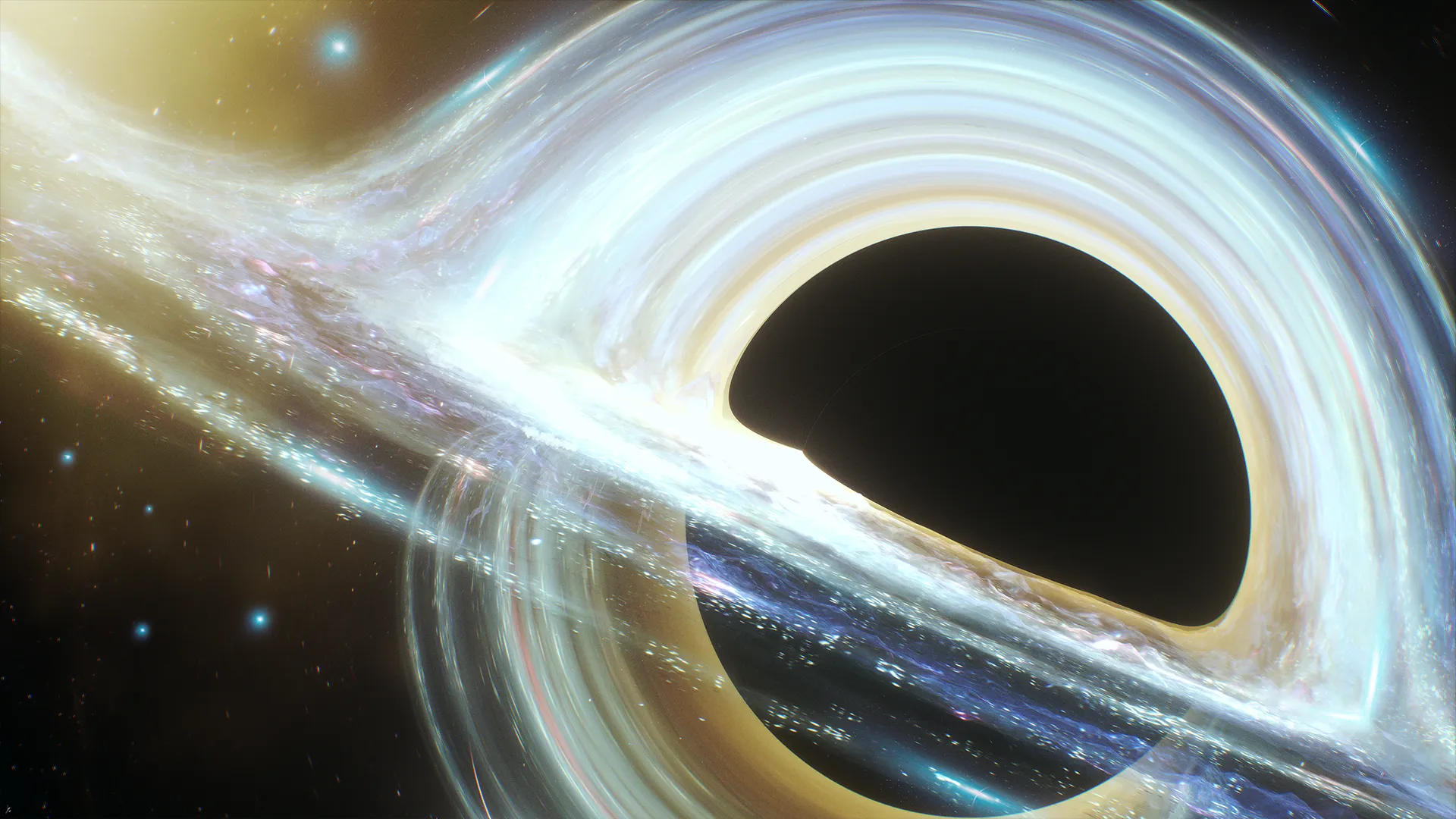
In astrophysics, there's a saying that "black holes have no hair." This means that, in the theory of general relativity, black holes are exceptionally simplistic objects. All you need to describe a black hole is its mass, its electric charge and its spin rate. With those three numbers alone, you have everything you could ever know about black holes. In other words, they're bald — they have no extra information.
This aspect of black holes is extremely frustrating to astrophysicists, who desperately want to understand how these cosmic behemoths work. But because black holes have no "hair," there's no way to learn more about them and what makes them tick. Alas, black holes remain some of the most puzzling and mysterious objects in the universe.
Related: Stephen Hawking's famous black hole paradox may finally have a solution
But this concept of "no-hair" black holes relies on our current understanding of general relativity, as originally formulated by Albert Einstein. This picture of relativity focuses on the curvature of space-time. Any entity with mass or energy will bend space-time around it, and that bending instructs those entities how to move.
This is not the only way to construct a theory of relativity, however. There's an entirely different approach that instead focuses on the "twistiness," rather than on the curvature, of space-time. In this picture, any entity with mass or energy twists up space-time around it, and that twisting instructs other objects how to move.
The two approaches, one based on curvature and the other based on twistiness, are mathematically equivalent. But because Einstein developed the curvature-based language first, it's much more widely used. The twistiness approach, known as "teleparallel" gravity for its mathematical use of parallel lines, offers a lot of room for intriguing theoretical insights that aren't obvious in the curvature approach.
As an example, a team of theoretical physicists recently explored how teleparallel gravity could approach the problem of black hole hairiness. They detailed their work in a paper published to the preprint database arXiv in July. (The research has yet to be peer-reviewed.)
Get the world’s most fascinating discoveries delivered straight to your inbox.
The team examined potential extensions of general relativity using what's called a scalar field — a quantum object that inhabits all of space and time. A famous example of a scalar field is the Higgs boson, which is responsible for giving many particles their masses. There may be additional scalar fields that inhabit the universe and subtly alter how gravity works, and physicists have long used these scalar fields in attempts to explain the nature of cosmic mysteries such as dark matter and dark energy.
In regular curvature-based general relativity, there are only so many ways to add scalar fields. But in teleparallel gravity, there are many more options. This research team discovered a way to add scalar fields to general relativity using the teleparallel framework. Then, they used that approach to investigate if these scalar fields, which would otherwise be invisible, might show up near black holes.
RELATED STORIES
The end result: The scalar fields added to general relativity, when explored through the teleparallel lens, gave black holes some hair.
The "hair" in this case is the presence of a strong scalar field near the event horizon of a black hole. Crucially, this scalar field carries information about the black hole inside it, which would allow scientists to understand more about black holes without having to plunge inside them.
Now that the researchers have identified how to give black holes some hair, they next need to work on the observational consequences of these results. For example, future gravitational wave observations might reveal subtle signatures of these scalar fields in the collisions of black holes.

Paul M. Sutter is a research professor in astrophysics at SUNY Stony Brook University and the Flatiron Institute in New York City. He regularly appears on TV and podcasts, including "Ask a Spaceman." He is the author of two books, "Your Place in the Universe" and "How to Die in Space," and is a regular contributor to Space.com, Live Science, and more. Paul received his PhD in Physics from the University of Illinois at Urbana-Champaign in 2011, and spent three years at the Paris Institute of Astrophysics, followed by a research fellowship in Trieste, Italy.