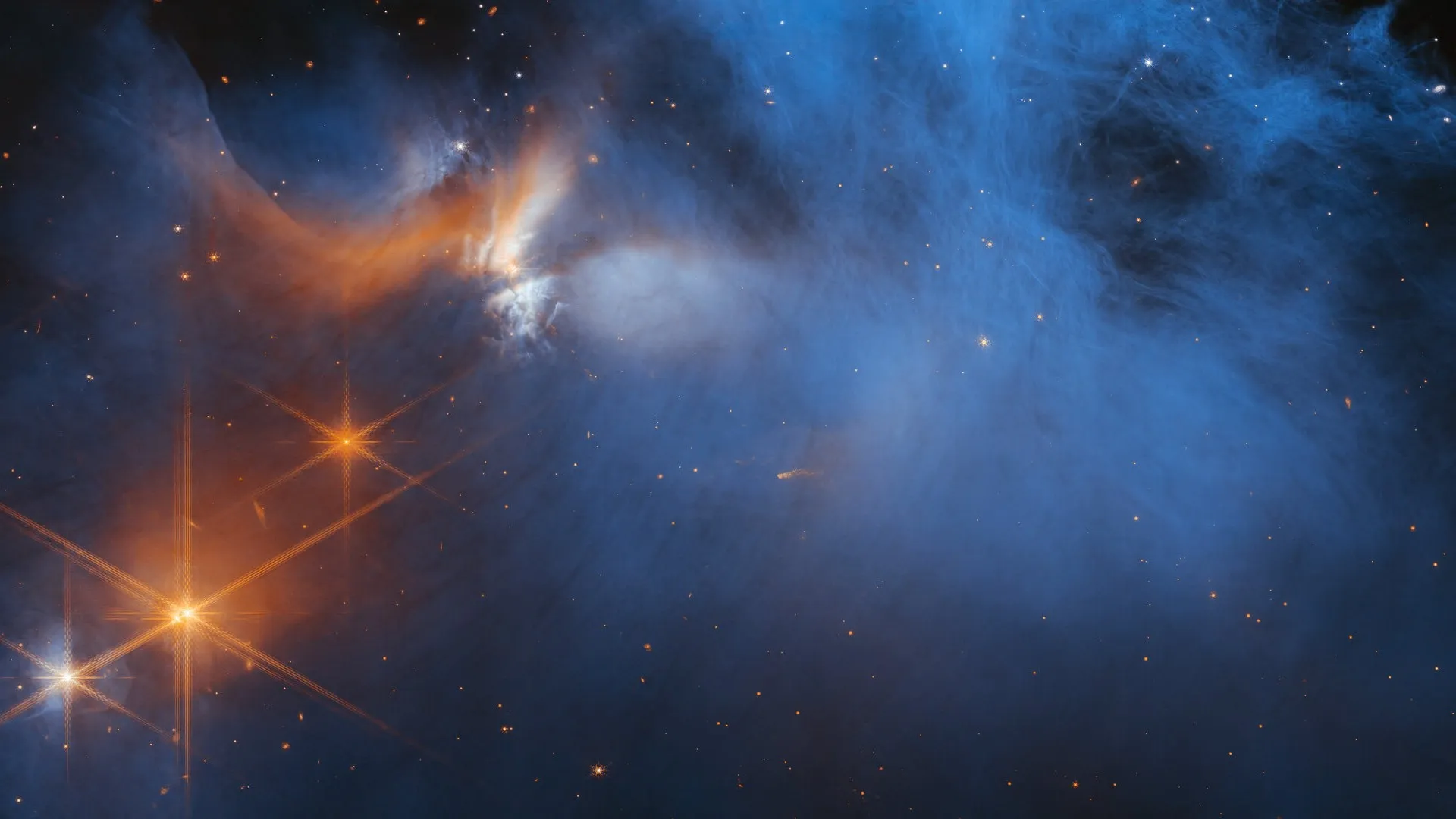
A wispy blue cloud of molecular gas glows from the light of distant stars in this James Webb Space Telescope image. This cloud contains the coldest ice ever detected.
(Image credit: NASA, ESA, CSA, and M. Zamani (ESA/Webb))
Complex organic molecules, like those that act as the building blocks of life, may form in the vast, cold depths of space on tiny grains of dust, a new study suggests.
These enriched dust grains are then swept up into newly forming stars and solar systems, eventually becoming part of planets like Earth. The new study shows that the complex chemistry that fuels life doesn’t require an injection of energy or an exotic process to get going.
Galaxies are great at building the fundamental elements. Hydrogen and helium have been around since the first few minutes of the Big Bang. Sun-like stars fuse hydrogen into more helium, and near the ends of their lives these stars turn that helium into carbon and oxygen. Larger stars keep the fusion chain going, producing potassium, nickel, iron and more. And lastly, titanic supernova explosions fill out the rest of the periodic table.
Some elements bind together easily and naturally. For example, hydrogen and oxygen are both very common and enjoy binding together, even in the depths of space, making water an incredibly common molecule. But creating a living creature requires far more complex molecules than just water. Now, many of those molecules on Earth are made as byproducts of biological reactions, but for life to get started on our planet billions of years ago, there must have been at least some complexity in that primordial soup to get going.
Samples collected from asteroid Ryugu were rich in organic molecules, NASA and international researchers found.
(Image credit: Yada, et al.; Nature Astronomy)
Astronomers have recently identified complex organic molecules — molecules rich in carbon and oxygen — in many unexpected places. Saturn's moon Titan contains vast seas of hydrocarbons. Dust grains pulled from comets and asteroids are rich in organic molecules. We've even observed traces of organic molecules embedded deep within interstellar gas clouds.
Now, in a new paper, uploaded Oct. 23 to the preprint server arXiv, a team of astronomers is discovering the origins of these organic molecules. Unlike previous work, which looks to higher-energy events and locations as a source of synthesizing new molecules, the team examined whether the conditions of deep space would be enough to create the molecules.
Sign up for the Live Science daily newsletter now
Get the world’s most fascinating discoveries delivered straight to your inbox.
The team ran computer simulations of the chemical relationships between elements found in the depths of space. There, tiny grains of dust get cold enough that they enshroud themselves in a layer of ice. Floating among this dust are carbon atoms, ejected from stellar explosions thousands of light-years away. The team found that the carbon atoms quickly react with frozen water, forming a simple molecule containing carbon, oxygen and hydrogen, designated as carbonous acid. Because this molecule has open electron spots, it is highly reactive and immediately begins combining and reacting with other elements and molecules in the dust.
For example, the reactive carbons can find nitrogen to make the base for cyanides, or oxygen to make carbon monoxide. These can then go on to form methanol, considered the "mother" of organic molecules, the researchers wrote. Other reactions can produce ethanol, methanimine and methanediol, which play a variety of roles in biological chemistry.
In other words, all that's needed to jump-start life is incredibly cold atoms interacting with each other in the vacuum of space.
Paul M. Sutter is a research professor in astrophysics at SUNY Stony Brook University and the Flatiron Institute in New York City. He regularly appears on TV and podcasts, including "Ask a Spaceman." He is the author of two books, "Your Place in the Universe" and "How to Die in Space," and is a regular contributor to Space.com, Live Science, and more. Paul received his PhD in Physics from the University of Illinois at Urbana-Champaign in 2011, and spent three years at the Paris Institute of Astrophysics, followed by a research fellowship in Trieste, Italy.