Get the world’s most fascinating discoveries delivered straight to your inbox.
You are now subscribed
Your newsletter sign-up was successful
Want to add more newsletters?
Join the club
Get full access to premium articles, exclusive features and a growing list of member rewards.
An account already exists for this email address, please log in.
James Webb Space Telescope discovers oldest organic molecules in the known universe, 12 billion light-years from Earth
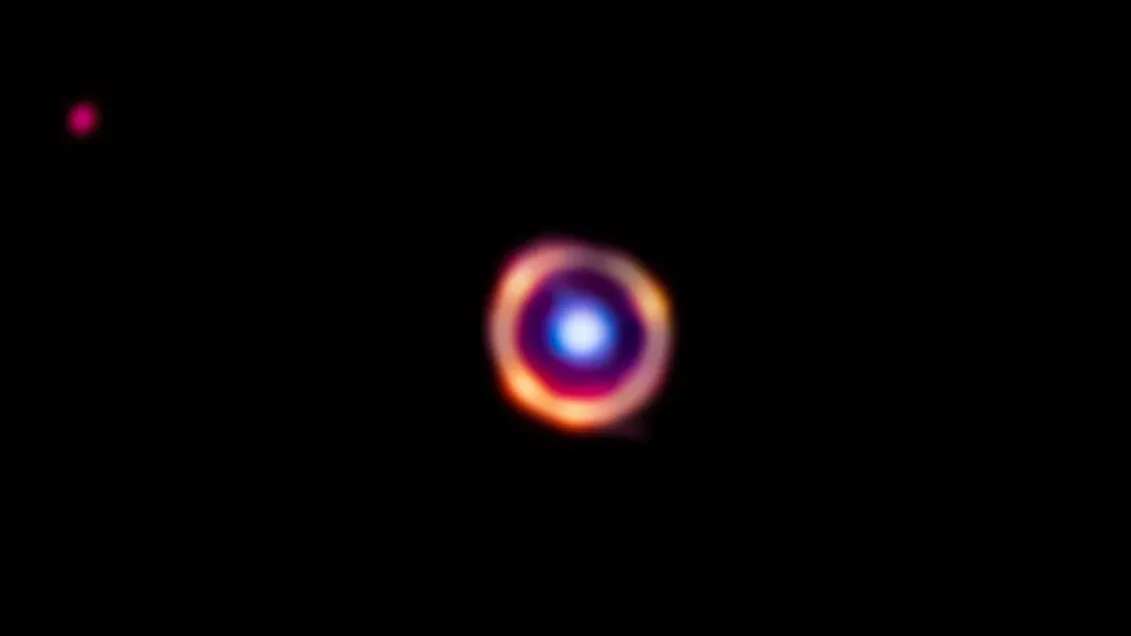
Astronomers using the James Webb Space Telescope discovered evidence of complex organic molecules in a galaxy 12.3 billion light-years away — the furthest and oldest ever detected.
Scientists using the James Webb Space Telescope (JWST) have spotted a cloud of complicated organic molecules in a galaxy 12.3 billion light-years away — the farthest from Earth that molecules of this kind have ever been detected. The discovery, which was published on June 5 in the journal Nature, might help astronomers piece together a clearer picture of how galaxies develop.
"We didn't expect this," Joaquin Vieira, an astronomer at the University of Illinois Urbana-Champaign and co-author of the new study, said in a press release. "Detecting these complex organic molecules at such a vast distance is game-changing."
The complex molecules in question are called polycyclic aromatic hydrocarbons (PAHs). On Earth, PAHs are commonly found in wildfire smoke and car exhaust. In space, they might play a crucial role in star formation. Scientists suspect that they help regulate the temperature of gas clouds in stellar nurseries, thereby managing when and where stars develop, Nature reported.
Researchers first detected the galaxy, dubbed SPT0418-47, in 2020 using the National Science Foundation's ground-based South Pole Telescope. The distant mass of stars was only visible thanks to a trick of physics known as gravitational lensing. This effect occurs when light from a faraway object bends around a massive, nearby object, due to the closer object's gravity. In the process, the faraway light is distorted and magnified; in SPT0418-47's case, it appeared 30 times brighter.
The team studied this light, and their initial analysis indicated that SPT0418-47 was rich in heavy elements. But the scientists couldn't get a good look at its organic, carbon-containing components using the South Pole Telescope, which doesn't pick up the right wavelength of light.
An illustration showing how astronomers use gravitational lensing to view distant galaxies that should be far beyond our sight.
(Image credit: S. Doyle / J. Spilker)
JWST, however, can peer into exactly the right infrared range to detect PAHs. Sure enough, when the team trained the space-based telescope on the galaxy last August, a mess of complex organic molecules stood out.
"Everywhere we see the molecules there are stars forming," Justin Spilker, an astronomer at Texas A&M University and co-author of the study, told Nature. This supports the hypothesis that organic molecules help to birth stars.
Sign up for the Live Science daily newsletter now
Get the world’s most fascinating discoveries delivered straight to your inbox.
But weirdly, there were also patches of the galaxy that lacked PAH clouds — and the team observed stars forming in those spots as well. "That’s the part we don’t understand yet," Spilker said. Understanding why and how stars form in these regions, and how they interact with organic molecules, will require further study.
"This work is just the first step," Vieira said. "We are very excited to see how this plays out."
Joanna Thompson is a science journalist and runner based in New York. She holds a B.S. in Zoology and a B.A. in Creative Writing from North Carolina State University, as well as a Master's in Science Journalism from NYU's Science, Health and Environmental Reporting Program. Find more of her work in Scientific American, The Daily Beast, Atlas Obscura or Audubon Magazine.