

-
 Black holes could become massive particle accelerators
Physicists suggest harnessing the gravitational pull of black holes to create ferocious particle accelerators. The trick? Carefully set everything up so the particles don't get lost forever.
black-holes -
 A mini fractal universe may lie inside charged black holes (if they exist)
In one upside-down, hypothetical version of the universe, a bizarre type of black hole could exist that is stranger than an M.C. Escher sketch: charged black holes.
black-holes -
 Black holes so big we don't know how they form could be hiding in the universe
Black holes can get big … really big. But just how big? It's possible they could top out at over a trillion times more massive than the sun.
black-holes -
 Black hole 'hair' could be detected using ripples in space-time
Hair may record the information swallowed by the gravitational monsters.
black-holes -
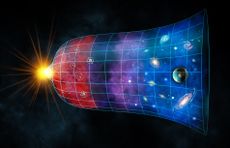 Could the universe collapse into a singularity? New study explains how.
All you need is some string.
cosmology -
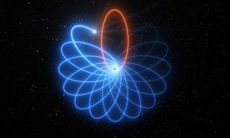 What's the most amazing thing about the universe?
A few scant equations can explain a variety of phenomena in our universe, over vast gulfs of space and time. Here's a taste of just how powerful modern physics can be.
cosmology -
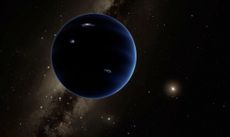 Does Planet Nine really exist?
For the past few years, the possibility of a new (and big!) planet hanging around in the far outer solar system has tantalized scientists and the public alike. Is "Planet Nine" out there or not?
planets -
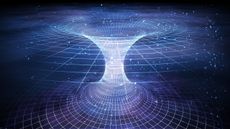 Weirdly-shaped wormholes might work better than spherical ones
Otherwise, they'd be ferociously unstable.
physics-mathematics -
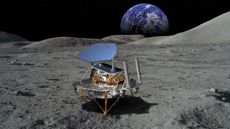 Why a physicist wants to build a particle collider on the moon
A physicist proposes that the moon is a great place to build a particle collider and conduct high-energy physics experiments.
particle-physics -
How close can you get to a black hole?
Physicists are figuring out how close you can get to a black hole before you are unlikely to escape. That threshold is called the innermost stable circular orbit (ISCO).
black-holes -
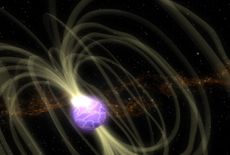 Where do baby magnetars come from? Mysterious 'fast radio bursts' may provide clues.
Magnetars — highly magnetized, rapidly rotating super-dense stars — are among the most enigmatic creatures to inhabit the cosmos and their origins are shrouded in mystery.
astronomy -
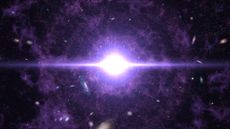 What happened before the Big Bang?
Has our universe cycled through numerous "big crunches" and "big bounces?"
cosmology -
 Hunting for dark matter — inside the Earth
The answer to the dark-matter mystery may be under our feet.
cosmology -
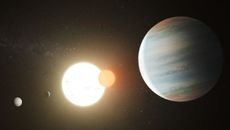 How common are Tatooine worlds?
We all know that iconic scene: Luke Skywalker staring forlornly — and perhaps wistfully — at the double sunset of his home planet, Tatooine.
astronomy -
 The universe could possibly have more dimensions. Here's how.
String theory is a purported theory of everything that physicists hope will one day explain … everything.
cosmology -
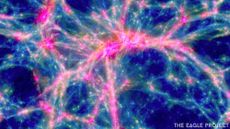 How dark is the cosmic web?
A dark web ties the universe together. Now, we can see it.
cosmology -
 To find alien life, we should focus on white dwarf stars
As far as we can tell, we're alone. But it could be that we're looking in the wrong places.
extraterrestrial-life -
 When did the universe 'wake up'?
It was a big moment for our cosmos when the first stars awoke, but it's an elusive one for scientists.
cosmology -
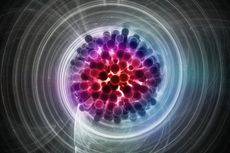 Oddball sexaquark particles could be immortal, if they exist at all
These supremely stable particles could explain dark matter.
particle-physics -
 Why Has String Theory Persisted?
String theory is a powerful idea, unfinished and untested, but one that has persisted for decades despite inauspicious beginnings.
physics-mathematics -
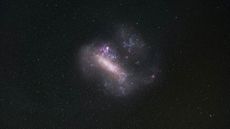 Cosmic Rays Are Starting to Tear Apart This Milky Way Satellite Galaxy
Researchers recently released simulations of the Large Magellanic Cloud — a satellite galaxy of the Milky Way — and found that cosmic rays from a starburst event are starting to rip it apart.
space-exploration -
The Universe May Be Flooded with a Cobweb Network of Invisible Strings
We may soon find out whether we live in an axiverse.
cosmology -
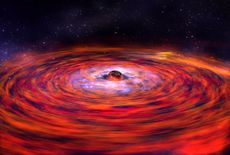 The Most Energetic Flashes of Light in the Universe Produce Deadly Nuclear Reactions
Gamma-ray bursts are even worse than we thought.
cosmology -
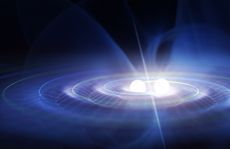 The Universe Remembers Gravitational Waves — And We Can Find Them
Gravitational waves leave behind a memory — a permanent bend in space-time — as they pass through.
cosmology


