What is the Standard Model, the subatomic physics theory that has been tested more than any other?
The Standard Model is the modern physical understanding of three of the four forces of nature: electromagnetism, the strong nuclear force and the weak nuclear force.
The Standard Model is the most complete description of the subatomic world that has ever been created in modern physics. The model was built through the 20th century on the foundations of quantum mechanics, the strange theory that describes how particles behave at the tiniest scales. The Standard Model explains three of the four forces of nature: electromagnetism, the strong nuclear force and the weak nuclear force. The theory has been tested thousands of times to incredible precision and, despite its shortcomings, remains one of the most important achievements of modern science.
"It's the dominant paradigm for thinking about how things interact at the most basic level," and it's been "tested to a phenomenal degree of precision," Chad Orzel, a physicist at Union College and the author of a number of popular physics books, including "How to Teach Quantum Physics to Your Dog" (Scribner, 2009), told Live Science in an email.
How was the Standard Model developed?
Physicists began developing the Standard Model in the 1950's, following a series of groundbreaking theoretical and experimental developments. On the theory side, physicists had just extended quantum mechanics — originally developed to understand only subatomic particles — to explain the electromagnetic force. On the experimental side, physicists had just developed the atom bomb and were aware of the strong and weak nuclear forces but did not yet have complete descriptions of them
The Standard Model reached its modern form in the 1970's, once a few key elements were in place: a quantum theory to explain the strong force, the realization that the electromagnetic and weak nuclear forces could be unified, and the discovery of the Higgs mechanism that gave rise to particle masses, according to the U.S. Department of Energy (DOE).
"I think it stands as one of the greatest intellectual triumphs in the history of human civilization, both for the sheer range of phenomena it encompasses and also for the degree of difficulty involved in putting it all together," Orzel said.
How is the Standard Model organized?
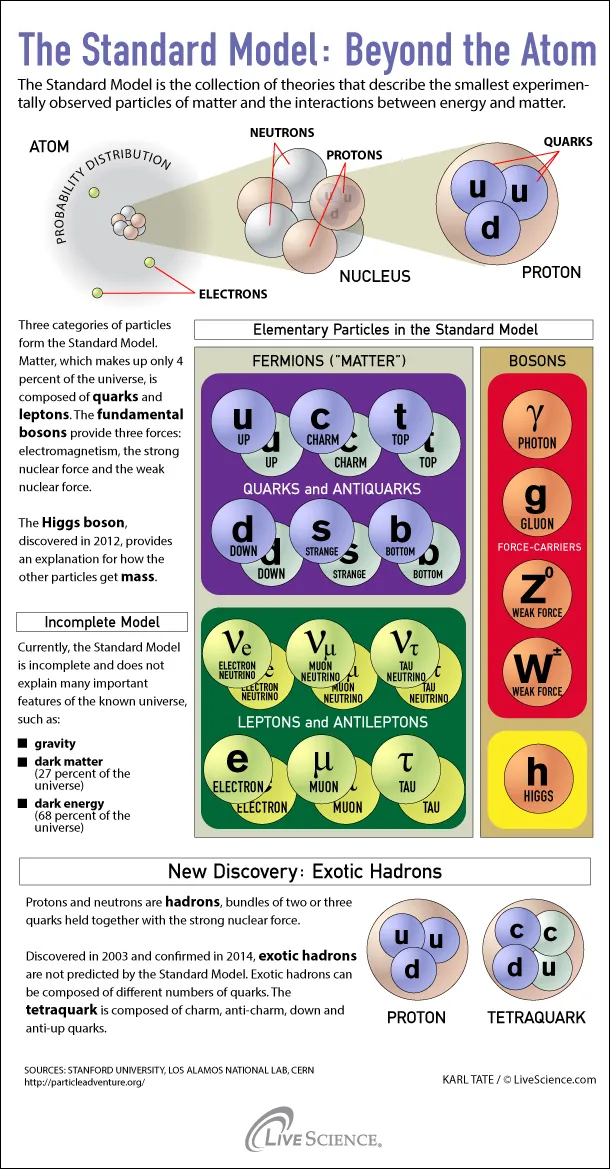
Infographic showing the subatomic particles of the Standard Model.
(Image credit: Karl Tate, Livescience.com Infographics Artist)
The Standard Model organizes the subatomic world into two broad categories of particles, known as fermions and bosons, according to the University of Tennessee, Knoxville. Roughly speaking, fermions cannot share the same quantum state (e.g., the same energy level inside an atom). Fermions are the "building blocks" of ordinary matter, which combine in different ways to form some of the well-known subatomic particles, such as protons, electrons and neutrons
There are two kinds of fermions: leptons, which respond to the electromagnetic and weak nuclear forces, and quarks, which respond to the strong nuclear force. The leptons include the familiar electron, as well as its heavier cousins the muon and the tau. These two particles have the exact same properties as the electron but are more massive.
Sign up for the Live Science daily newsletter now
Get the world’s most fascinating discoveries delivered straight to your inbox.
Each of these leptons is paired with a corresponding neutrino. Neutrinos are ultralight particles that rarely interact with matter but are generated in nuclear reactions. So there are the electron-neutrinos, muon-neutrinos and tau-neutrinos.
In addition to these six leptons, there are quarks, which come in six types, or "flavors": up, down, charm, strange, top and bottom. The up and down quarks are the lightest and most stable, and they bind together in triplets to form protons and neutrons.
On the other hand, bosons can share the same energy state. The most commonly known boson is the photon, the force carrier of the electromagnetic force. Other force-carrying bosons include the three carriers of the weak nuclear force (called the W+, W- and Z bosons) and the eight carriers of the strong nuclear force, called gluons, according to the DOE.
The last boson, called the Higgs boson, is special and plays a very important role in the Standard Model.
What is the role of the Higgs mechanism in the Standard Model?
Conceptual illustration of the Higgs particle being produced by colliding two protons.
(Image credit: Mark Garlick/Science Photo Library via Getty Images)
The Higgs boson performs two important jobs in the Standard Model. At high energies, the electromagnetic and weak nuclear forces merge into a common, unified force called the electroweak force. At low energies (that is, the typical energies of everyday life), the two forces split into their familiar forms. The Higgs boson is responsible for keeping these two forces separate at low energies, as the weak nuclear and electromagnetic forces interact differently with the Higgs boson, according to the Institute of Physics.
All other quarks and leptons (with the exception of neutrinos) also interact with the Higgs boson. This interaction gives those particles their individual masses, which depend on how strongly the particle interacts with the Higgs. Thus, the presence of the Higgs boson allows for many particles in our universe to acquire a mass.
How is the Standard Model tested?
Here we see an image of the Large Hadron Collider. Physicists and engineers replaced the heart of the CMS experiment in 2017 to improve its ability to make precise measurements.
(Image credit: CERN)
Testing the Standard Model is extremely difficult, because all the particles involved are extremely tiny.
"None of these particles, other than maybe the electron, are directly observable, and yet their existence is proven almost incontrovertibly thanks to the accumulation of work by generations of physicists probing ever deeper into the nature of reality," Orzel said."
That said, the Standard Model has survived a battery of high-precision experiments carried out over decades. Almost all of those experiments incorporate the use of particle colliders, such as the Large Hadron Collider near Geneva, which slam particles together at nearly the speed of light. Those collisions release tremendous amounts of energy, allowing physicists to study the fundamental interactions of nature, according to CERN, the European Organization for Nuclear Research, which is home to the Large Hadron Collider.
"To me, the most impressive feature is that it allows us to determine real-world parameters to an astonishing precision — something like 13 to14 decimal places in the case of something like the anomalous magnetic moment of the electron," Orzel said.
What are the problems with the Standard Model?
Despite its enormous successes in explaining a wide variety of natural phenomena under a single mathematical framework, physicists know that the Standard Model is not complete. Most important, attempts to incorporate gravity into the Standard Model have consistently failed.
"The inability to merge gravity with the Standard Model framework for the rest of fundamental physics is the biggest challenge facing theoretical particle physicists, and has driven them into some fairly baroque areas of speculation," Orzel said. "It's not at all clear how this will be resolved, or even if it's possible to resolve it with plausible near-future technology."
Besides missing gravity, the model does not include a mechanism for giving neutrinos their masses, and does not incorporate dark matter or dark energy, which are the dominant forms of mass and energy in the universe.
However, even though the Standard Model is not complete, physicists have no widely agreed-upon theory of how to extend it, and so it remains the best working description of subatomic physics ever devised.
Paul M. Sutter is a research professor in astrophysics at SUNY Stony Brook University and the Flatiron Institute in New York City. He regularly appears on TV and podcasts, including "Ask a Spaceman." He is the author of two books, "Your Place in the Universe" and "How to Die in Space," and is a regular contributor to Space.com, Live Science, and more. Paul received his PhD in Physics from the University of Illinois at Urbana-Champaign in 2011, and spent three years at the Paris Institute of Astrophysics, followed by a research fellowship in Trieste, Italy.