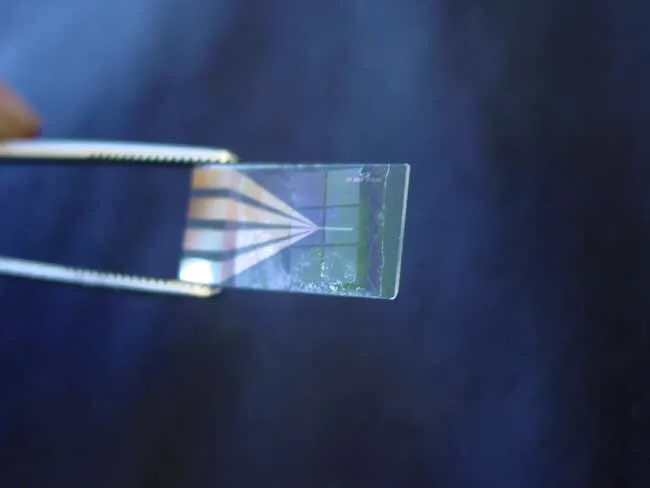
Tiny futuristic batteries will be half the size of a human cell and built with viruses, researchers announced today.
Engineers at MIT have developed two of the three parts of such microbatteries. They could be used to power implantable medical sensors or laboratories the size of computer chips, among other small things. The could also be integrated with other living things in ways not yet envisioned.
The tiny power packs would be stamped or printed right onto the surface of a device.
Latest Videos From
"To our knowledge, this is the first instance in which microcontact printing has been used to fabricate and position microbattery electrodes and the first use of virus-based assembly in such a process," write MIT professors Paula T. Hammond, Angela M. Belcher, Yet-Ming Chiang and colleagues in the Proceedings of the National Academy of Sciences.
The team has built and tested two of the three components needed. The technique itself "does not involve any expensive equipment, and is done at room temperature," Belcher said. Batteries consist of two opposite electrodes — an anode and cathode — separated by an electrolyte. In the current work, the MIT team created both the anode and the electrolyte. First, on a clear, rubbery material the team used a common technique called soft lithography to create a pattern of tiny posts either four or eight millionths of a meter in diameter. On top of these posts, they then deposited several layers of two polymers that together act as the solid electrolyte and battery separator. Next came viruses that self-assemble atop the polymer layers on the posts, ultimately forming the anode. The result: a stamp of tiny posts, each covered with layers of electrolyte and the cobalt oxide anode.
"Then we turn the stamp over and transfer the electrolyte and anode to a platinum structure," that, together with lithium foil, is used for testing , Hammond explained. The team now aims to create the third part of a full battery — the cathode — using the viral assembly technique.
"We're also interested in integrating [the batteries] with biological organisms," Belcher said.
This work was funded by the Army Research Office and the David and Lucille Packard Foundation.

 Live Science Plus