













New Thinking on When the Arctic Froze

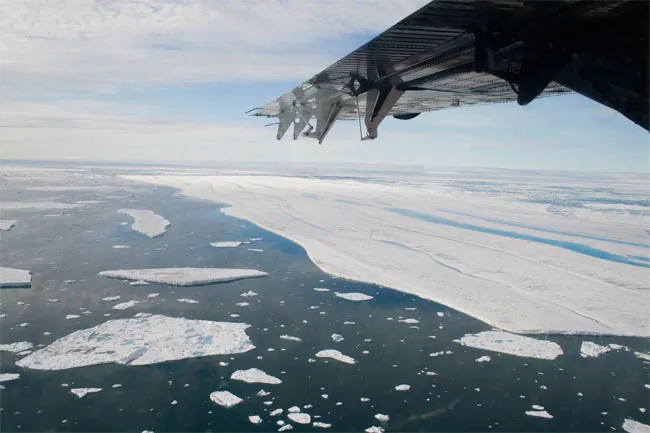
The Arctic may be a frigid, ice-covered area today, but it hasn't always been quite so cold.
Scientists have long wondered when the Arctic first transitioned to its ice-covered state; a new study suggests this could have happened millions of years earlier than was previously thought.
The standard view of the formation of the huge ice sheets that cover Earth's poles was that continental-scale glaciation of Antarctica occurred about 34 million years ago, while the Arctic wasn't covered by ice until some 31 million years later — much more recently geologically-speaking.
But the new findings hint that Arctic ice may not have taken quite as long to form, with evidence placing its formation closer in time to that of Antarctic ice. Now researchers say Arctic ice could have formed about 23 million years ago.
A group of U.S. and U.K. climatologists, led by Robert DeConto of the University of Massachusetts, used a model to test the idea that Arctic ice formed much earlier than thought. Their work was funded by the U.S. National Science Foundation, and the results are detailed in the Oct. 2 issue of the journal Nature.
The model took into account the long-term decline in carbon dioxide — a heat-trapping greenhouse gas — known to have occurred over about the past 65 million years or so. It also included the effect of variations in Earth's orbit with respect to the sun, which can affect temperatures on Earth.
The model showed that for ice to form in the Arctic, carbon dioxide levels had to reach a much lower level than needed for ice to form over Antarctica, or it would be too warm for the ice to freeze out. This is because polar continents in the Northern Hemisphere are at lower latitudes than in the Southern Hemisphere and receive more warmth (from incoming sunlight) in the summer.
Get the world’s most fascinating discoveries delivered straight to your inbox.
With the evidence that scientists currently have, it is clear that carbon dioxide levels were too high for Arctic ice to have formed at the same time as Antarctic ice, but the levels dipped down below the needed threshold about 23 million years ago, meaning that Arctic ice could have first formed 20 million years earlier than expected, the authors said.
Understanding how the past formation of ice was influenced by carbon dioxide levels can help scientists better predict what will happen in the future, as Earth's temperature continues to rise with global warming. The last time carbon dioxide levels were as high as they're predicted to be by the end of this century was some 45 million to 25 million years ago.
Some records of past climate suggest large changes in the volume of ice when carbon dioxide (CO2) reached present-day levels, which could "suggest that small variations in CO2 might have large effects on ice volume," Stephen Pekar of Queens College in N.Y. wrote in an editorial, also in Nature, about the new study.
- Video: Learn How Ice Melts
- North vs. South Poles: 10 Wild Differences
- Images: Ice of the Antarctic

Andrea Thompson is an associate editor at Scientific American, where she covers sustainability, energy and the environment. Prior to that, she was a senior writer covering climate science at Climate Central and a reporter and editor at Live Science, where she primarily covered Earth science and the environment. She holds a graduate degree in science health and environmental reporting from New York University, as well as a bachelor of science and and masters of science in atmospheric chemistry from the Georgia Institute of Technology.