













Expedition Seeks Primordial Life Beneath the Arctic
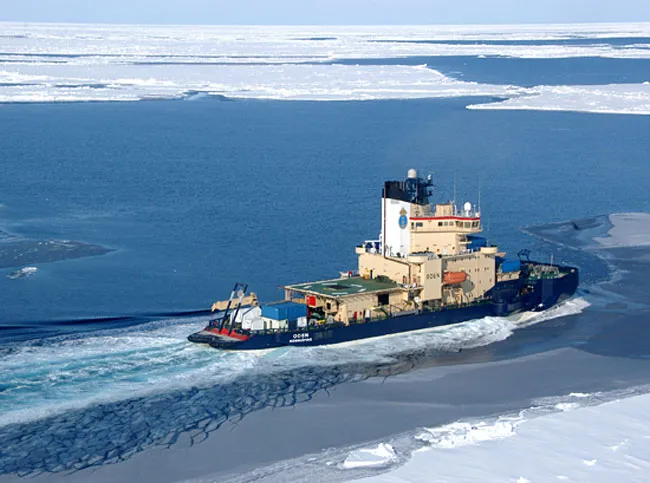
Explorers are setting out to see if a hydrothermal vent system near the North Pole could harbor never-seen-before life forms that have remained isolated for tens of millions of years.
On July 1, an international research team is expected to depart from the Arctic archipelago of Svalbard aboard the icebreaker “Oden” for a 40-day expedition to hunt for life along the Gakkel Ridge, an underwater mountain range extending 1,100 miles from north of Greenland toward Siberia and marking the boundary between two tectonic plates.
“This is an exciting opportunity to explore and study a portion of Earth’s surface that has been largely inaccessible to science,” said expedition chief scientist Robert Reves-Sohn, a geophysicist at Woods Hole Oceanographic Institution (WHOI) in Massachusetts.
Primordial life
The Gakkel Ridge is part of the mid-ocean ridge system, which transects the globe like seams on a baseball. Ocean ridges resemble underwater mountains and occur between Earth’s tectonic plates that creep apart as fiery hot fluid that’s chock-full of minerals spews through the gap. For the organisms that can take the heat, zero sunlight and bizarre diet, it’s an oasis.
The Arctic waters where the Gakkel Ridge lies, however, have been relatively isolated from other ocean basins for some 28 million years.
“The region has been mostly separated from the Atlantic and Pacific oceans for millions of years, so whatever lives there has since been evolving in relative isolation—much the way animals in Australia did,” said expedition scientist Tim Shank, a hydrothermal vent biologist at WHOI. “We are likely to find completely new suites of species with never-before seen adaptations.”
Get the world’s most fascinating discoveries delivered straight to your inbox.
Sluggish spreading
The Gakkel Ridge spreads at the snail’s pace of one-third of an inch annually, 20 times slower than other ridges. The sluggish spreading leads to a unique vent system, the scientists say, because material deep in Earth’s mantle (below the crust) gets exposed on the seafloor.
That means the vent fluid will have a different chemical make-up from other hydrothermal vents. That, combined with eons of isolation, means the region could support life forms similar to those of primordial Earth or other watery planets.
“The origin of life discussion comes up because the rocks that are exposed on this very slow spreading ridge are not volcanic, but instead come directly from Earth’s mantle,” said expedition scientist Susan Humphris, a WHOI geochemist who studies hydrothermal vents. “The chemistry is very much like the volcanism that occurred on the primordial Earth.”
Research robots
A trio of robotic underwater vehicles, named Puma, Jaguar and Camper, will be the eyes and “noses” for the researchers, peering 1.8 to 3 miles beneath the ice cap where the ridge lies. The autonomous underwater vehicles (AUVs) were developed specifically for the Arctic.
- First, the Puma will pinpoint any hydrothermal vents by sniffing out the chemical and temperature signals.
- Second, the Jaguar will image that portion of the seafloor.
- Finally, the Camper will scoop up rocks, sediments, and any living creatures.
NASA and the National Science Foundation (NSF) provided the major funding for the expedition and the development of the underwater vehicles.
- Video: Black Smoker
- Image Gallery: Extreme Living: Scientists at the Ends of the Earth
- Video: If a volcano erupts under water...
Jeanna Bryner is managing editor of Scientific American. Previously she was editor in chief of Live Science and, prior to that, an editor at Scholastic's Science World magazine. Bryner has an English degree from Salisbury University, a master's degree in biogeochemistry and environmental sciences from the University of Maryland and a graduate science journalism degree from New York University. She has worked as a biologist in Florida, where she monitored wetlands and did field surveys for endangered species, including the gorgeous Florida Scrub Jay. She also received an ocean sciences journalism fellowship from the Woods Hole Oceanographic Institution. She is a firm believer that science is for everyone and that just about everything can be viewed through the lens of science.