













Finally, a Solid Look at Earth's Core

Scientists have long thought Earth's core is solid. Now they have some solid evidence.
The core is thought to be a two-part construction. The inner core is solid iron, and that's surrounding by a molten core, theory holds. Around the core is the mantle, and near the planet's surface is a thin crust — the part that breaks now and then and creates earthquakes.
The core was discovered in 1936 by monitoring the internal rumbles of earthquakes, which send seismic waves rippling through the planet. The waves, which are much like sound waves, are bent when they pass through layers of differing densities, just as light is bent as it enters water. By noting a wave's travel time, much can be inferred about the Earth's insides.
Yet for more than 60 years, the solidity of the core has remained in the realm of theory.
A study announced today involved complex monitoring of seismic waves passing through the planet. The technique is not new, but this is the first time it's been employed so effectively to probe the heart of our world.
First, some jargon:
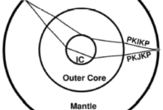
P is what scientists call the wave K stands for the outer core J is the inner core
Path of a PKJKP wave. ? Science
So a wave that rolls through it all is called PKJKP.
Get the world’s most fascinating discoveries delivered straight to your inbox.
An earthquake sends seismic waves in all directions. The surface waves are sometimes frighteningly obvious. Seismic waves passing through the mantle and traversing much of the planet's interior are routinely studied when they reach another continent. But no PKJKP wave has ever been reliably detected until now.
Aimin Cao of the University of California-Berkeley and colleagues studied archived data from about 20 large earthquakes, all monitored by an array of German seismic detectors back in the 1980s and '90s.
The trick to detecting a PKJKP wave is in noting the changes it goes through as it rattles from one side of the planet to the other. What starts out as a compression wave changes to what scientists call a shear wave (explanations and animations of these are here).
"A PKJKP traverses the inner core as a shear wave, so this is the direct evidence that the inner core is solid," Cao told LiveScience, "because only in the solid material the shear wave can exist. In the liquid material, say water, only the compressional wave can travel through."
The arrival time and slowness of the waves agree with theoretical predictions of PKJKP waves, which indicates a solid core. The results were published today online by the journal Science.
- Hole Drilled to Bottom of Earth's Crust, Breakthrough to Mantle Looms
- Ancient Impact Turned Part of Earth Inside-Out
- Earth as a Giant Pinball Machine
- Mission Proposed to Earth's Core
What's Down There
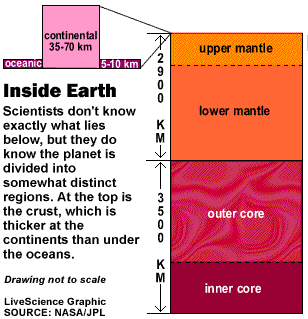
The crust thickness averages about 18 miles (30 kilometers) under the continents, but is only about 3 miles (5 kilometers) under the oceans. It is light and brittle and can break. In fact it's fractured into more than a dozen major plates and several minor ones. It is where most earthquakes originate.
The mantle is more flexible - it flows instead of fractures. It extends down to about 1,800 miles (2,900 kilometers) below the surface.
The core consists of a solid inner core and a fluid outer core. The fluid contains iron, which, as it moves, generates the Earth's magnetic field. The crust and upper mantle form the lithosphere, which is broken up into several plates that float on top of the hot molten mantle below.
SOURCE: LiveScience reporting

Robert is an independent health and science journalist and writer based in Phoenix, Arizona. He is a former editor-in-chief of Live Science with over 20 years of experience as a reporter and editor. He has worked on websites such as Space.com and Tom's Guide, and is a contributor on Medium, covering how we age and how to optimize the mind and body through time. He has a journalism degree from Humboldt State University in California.