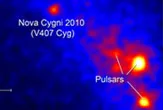
An unexpected and powerful new kind of star explosion has been discovered in the heavens — a so-called gamma-ray nova that radiates the most energetic form of light in the universe.
A nova is a massive thermonuclear explosion from a white dwarf star fueled by mass from a companion star. Unlike supernovas, novas do not result in the destruction of their stars. Researchers had expected and seen X-rays from the resulting waves of expanding gas in prior novas. But unlike with supernovas, they had not seen gamma-rays emitted by novas.
Now researchers have discovered a nova that shed gamma rays, which are even more powerful than X-rays, by using the Fermi Large Area Telescope in orbit around the Earth, the most sensitive gamma-ray space telescope ever flown. [Photo of the gamma-ray nova.]
Latest Videos From
"This is the first gamma-ray nova seen," said researcher Teddy Cheung, an astrophysicist at the Naval Research Laboratory in Washington.
Gamma-ray star explosion
The gamma rays in question emerged from the binary system known as V407 Cygni some 8,800 light-years away, which consists of a white dwarf and a pulsating red giant star. They came after a nova spotted by amateur Japanese astronomers in March, which at its peak was just below the level of naked-eye visibility, brighter than at any other point in the nearly 75 years scientists had watched the system.
The researchers suggest the gamma rays were generated when the blast waves from the nova collided with the very dense winds from the red giant.
"As the blast wave propagates outward, it acts like a snowplow, sweeping up material from the stellar wind, and a shock front forms," explained researcher Adam Hill, an astrophysicist at the University of Joseph Fourier-Grenoble in France.
Protons and electrons get accelerated to very high energies at this shock front. In turn, they produce gamma rays.
An expected find
In many novas, the white dwarf's companion is a normal main sequence star, and as such has a much less dense stellar wind compared to the red giant in V407 Cygni, for less material to generate gamma rays with. Very few binary systems are expected to combine the kind of white dwarf stars that burst with novas with red giant companions, and as such the researchers expect gamma-ray novae to be quite rare.
"It is always exciting to discover something new and unanticipated," Hill said. "It is occasions such as this which is why I enjoy being a scientist."
The researchers at the Fermi-LAT Collaboration detailed their findings in the August 13 issue of the journal Science.

 Live Science Plus