 Live Science Plus






Archaeologists Uncover Another Branch of the Silk Road
You are now subscribed
Your newsletter sign-up was successful
Want to add more newsletters?

Delivered Daily
Daily Newsletter
Sign up for the latest discoveries, groundbreaking research and fascinating breakthroughs that impact you and the wider world direct to your inbox.

Once a week
Life's Little Mysteries
Feed your curiosity with an exclusive mystery every week, solved with science and delivered direct to your inbox before it's seen anywhere else.

Once a week
How It Works
Sign up to our free science & technology newsletter for your weekly fix of fascinating articles, quick quizzes, amazing images, and more

Delivered daily
Space.com Newsletter
Breaking space news, the latest updates on rocket launches, skywatching events and more!
Once a month
Watch This Space
Sign up to our monthly entertainment newsletter to keep up with all our coverage of the latest sci-fi and space movies, tv shows, games and books.

Once a week
Night Sky This Week
Discover this week's must-see night sky events, moon phases, and stunning astrophotos. Sign up for our skywatching newsletter and explore the universe with us!
Join the club
Get full access to premium articles, exclusive features and a growing list of member rewards.
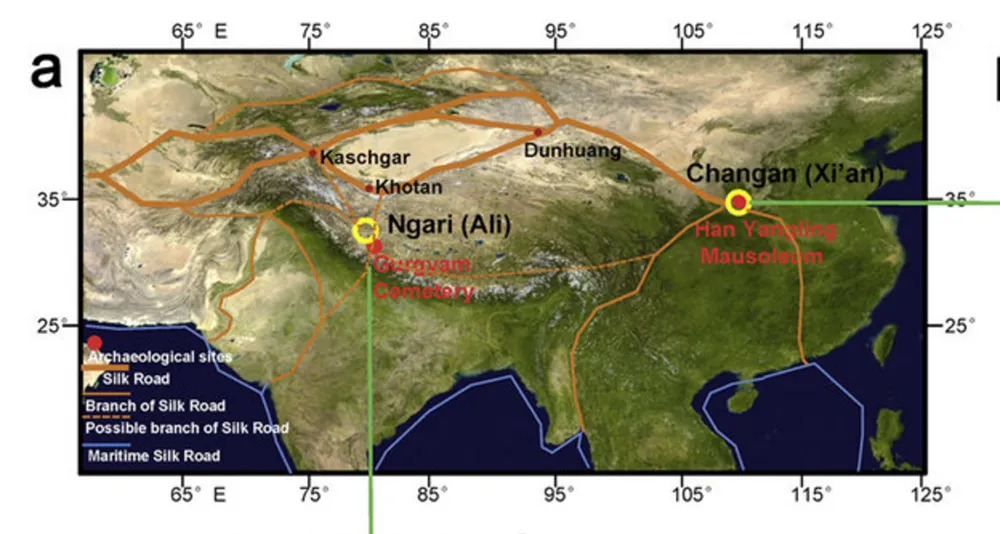
Famous for facilitating an incredible exchange of culture and goods between the East and the West, the ancient Silk Road is thought to have meandered across long horizontal distances in mountain foothills and the lowlands of the Gobi Desert. But new archaeological evidence hidden in a lofty tomb reveals that it also ventured into the high altitudes of Tibet—a previously unknown arm of the trade route.
Discovered in 2005 by monks, the 1,800-year-old tomb sits 4.3 kilometers above sea level in the Ngari district of Tibet. When excavations began in 2012, the research team examining the site was surprised to find a large number of quintessential Chinese goods inside. The haul lends itself to the idea that merchants were traveling from China to Tibet along a branch of the Silk Road that had been lost to history.
"The findings are astonishing," says Houyuan Lu, an archaeobotanist at the Chinese Academy of Sciences' Institute of Geology and Geophysics in Beijing. Among other artifacts, archaeologists unearthed exquisite pieces of silk with woven Chinese characters wang hou (meaning "king"and "princes"), a mask made of pure gold, and ceramic and bronze vessels.
They also were taken aback by what looked like tea buds. The earliest documentation of tea in Tibet dates to the seventh century A.D., but these buds would be 400 to 500 years older. To confirm the identification, Lu and his colleagues analyzed the chemical components of the samples and detected ample amounts of caffeine and theanine, a type of amino acid abundant in tea. Moreover, the chemical fingerprints of the tea residues were similar to those of tea found in the tomb of a Chinese emperor of the Han Dynasty dated to 2,100 years ago, and both could be traced to tea varieties grown in Yunnan in southern China. "This strongly suggests that the tea [found in the Tibetan tomb] came from China," Lu says. The findings were recently published in Scientific Reports.
Such early contacts between Tibet and China "point to a high-altitude component of the Silk Road in Tibet that has been largely neglected," says Martin Jones, an archaeobotanist at the University of Cambridge. The evidence contributes to the emerging picture that the Silk Road—which the Ottoman Empire closed off in the 15th century—was a highly three-dimensional network that not only traversed vast linear distances but also scaled tall mountains.
Other studies, too, have documented signs of trade along mountain trails in Asia from around 3000 B.C.—routes now known as the Inner Asia Mountain Corridors. "This suggests that mountains are not barriers," says Rowan Flad, an archaeologist at Harvard University. "They can be effective conduits for the exchange of cultures, ideas and technologies."
This article was originally published with the title "Silk Road Heads for the Hills."
This article was first published at ScientificAmerican.com. ©ScientificAmerican.com. All rights reserved.
Follow Scientific American on Twitter @SciAm and @SciamBlogs. Visit ScientificAmerican.com for the latest in science, health and technology news.
