













SAN FRANCISCO — A new explanation for colliding faults could help explain mysterious fault lines that have mystified geologists for decades. The new explanation could explain everything from the quake-prone faults of Southern California to dynamic crust beneath the snow-capped peak of K2 in the Himalayas.
The theory is deceptively simple: When two faults collide, instead of one breaking past another, they may just merge, like a zipper zipping up, said John Platt, a geologist at the University of Southern California in Los Angeles, here at the annual meeting of the American Geophysical Union. [Photo Journal: The Gorgeous San Andreas Fault]
"It may solve some long-standing and intractable problems concerning the timing and displacement on faults," Platt said in the presentation.
Strange rocks
Platt and his colleague Cees Passchier, a technophysicist at the University of Mainz in Germany, were looking at a strange rock formation called Cap de Creus in Spain. To a geologist's eyes, the rocks make no sense, with rocks on one side of the fault showing signs of shear in one direction and those on the other side having the opposite shear orientation. Normally, the direction of motion revealed in the rocks should be the same on either side of the fault. (At Cap de Creus, the textural lines in the rocks make a "V" shape around the fault, while normally that texture would look more like diagonal lines that cross the fault.)
Passchier "showed it to me in the field; it just blew my mind. I thought 'There's just no way, it's completely impossible,'" Platt told Live Science.
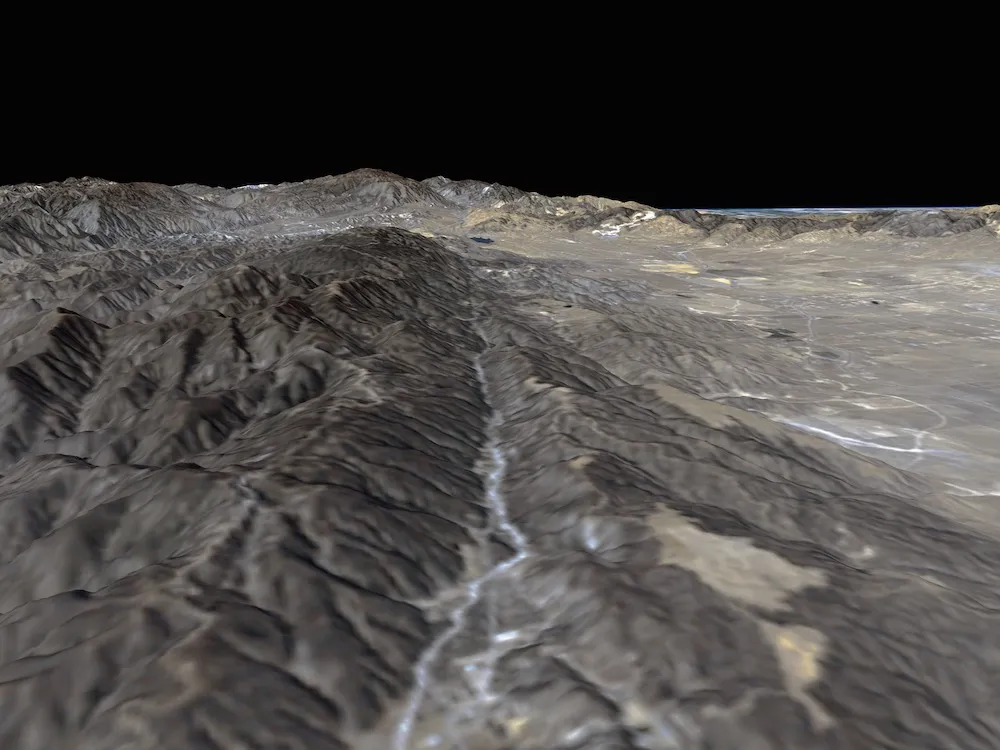
But seeing Cap de Creus got him thinking about another fault junction closer to home. About 60 miles (97 kilometers) north of Los Angeles, in a little mountain town called Gorman, the San Andreas Fault collides with the Garlock Fault, which then heads east into the Mojave Desert. (The San Andreas Fault formed 30 million years ago when the North American and Pacific plates first met and began to slide past each other, forming a strike-slip fault that snakes about 800 miles (1,287 km) north along the California coast, from the Salton Sea to the Mendocino Coast.)
Get the world’s most fascinating discoveries delivered straight to your inbox.
Based on traditional conceptions of faults, either the Garlock Fault should have cut through the San Andreas Fault and deactivated it, or vice versa. But the San Andreas Fault has about 150 miles (241 km) of slip between either side, meaning that volcanic rocks in Pinnacles National Park match those much farther south, in Los Angeles County. The Garlock Fault, by contrast, has 18 miles (30 km) of slip.
So if the San Andreas Fault had cut the Garlock Fault, it should have offset the Garlock Fault by a whopping 150 miles (241 km), deactivating it, and if the Garlock Fault had cut the San Andreas Fault, it would have shoved the San Andreas over by 18 miles (30 km). And yet clearly, neither has happened, and no one really thought to wonder why.
"It's a classic paradox," Platt said.
Simple solution
So Platt wondered whether the two simply joined. In that case, the slip between the two would be added (in this case, because the two slip in opposite directions, the slip of one would be subtracted from the other.) The faults, in essence, would act more like a zipper being closed.
When he and his colleagues thought about it, the concept of "zipper faults" could explain many of extremely confusing spots around the world. All told, the team came up with about 27 different versions of the zipper fault, depending on whether the junctions are "unzipping" or "zipping," and whether the fault collisions include dextral, sinistral or wedge faults. (In this instance, sinistral means leftward, while dextral means rightward.)
For instance, the Altyn-Tagh and Karakoram faults, which sit on the Tibetan plateau, have long inspired furious debate among plate tectonics researchers, because rocks on either side of each fault make the resulting slip difficult to reconcile. For instance, some have suggested that the Karakoram Fault moved as much as 30 mm per year, whereas others said the fault moved just 3 mm a year. [The World's Tallest Mountains]
"You wouldn't believe the arguments about those faults," Platt said.
Scientists could go to the region to see if zippering could explain the confusing rocks, though it's difficult to survey in the region because of the forbidding terrain, he said.
Platt noted that earlier geologists have even used the word "zipper" to explain a few other faults, such as one in the Alps, but they never connected the dots to create a comprehensive theory.
Simple but powerful
One way to test the idea is to place sophisticated global positioning system (GPS) devices around the faults to measure how much they are moving at a given time and see if they match with proposed slip based on the zipper model, he said. At the San Andreas/Garlock Fault intersection, the slip rate north of the junction should be less than that south of the intersection, if his zippering theory is correct.
"I really like it, the idea," said Ivanka Mitrovic, a geodynamics researcher at the National History Museum and the University of Vienna in Austria, who was not involved in the study but who attended the talk. The idea is "very simple, but it's that simple brilliance," she said.
If the notion of zipper faults proves true, it "would help connect opposing opinions," Mitrovic told Live Science.
Follow Tia Ghose on Twitter and Google+. Follow Live Science @livescience, Facebook & Google+. Original article on Live Science.

Tia is the editor-in-chief (premium) and was formerly managing editor and senior writer for Live Science. Her work has appeared in Scientific American, Wired.com, Science News and other outlets. She holds a master's degree in bioengineering from the University of Washington, a graduate certificate in science writing from UC Santa Cruz and a bachelor's degree in mechanical engineering from the University of Texas at Austin. Tia was part of a team at the Milwaukee Journal Sentinel that published the Empty Cradles series on preterm births, which won multiple awards, including the 2012 Casey Medal for Meritorious Journalism.