













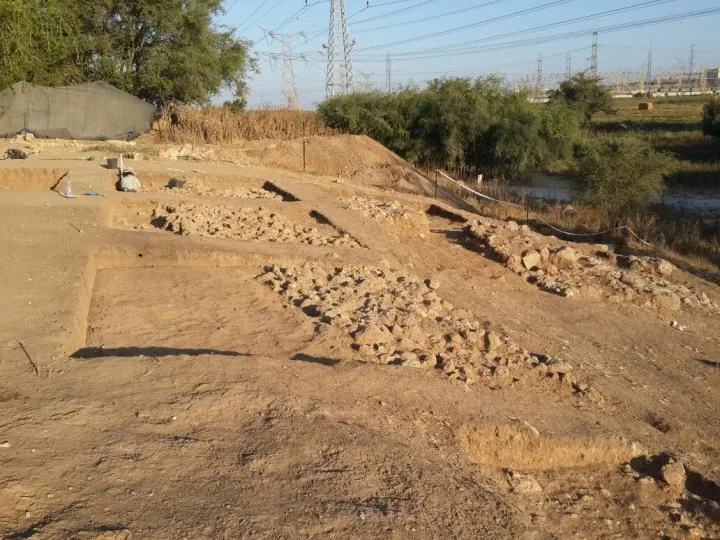
A massive gate unearthed in Israel may have marked the entrance to a biblical city that, at its heyday, was the biggest metropolis in the region.
The town, called Gath, was occupied until the ninth century B.C. In biblical accounts, the Philistines — the mortal enemies of the Israelites — ruled the city. The Old Testament also describes Gath as the home of Goliath, the giant warrior whom the Israelite King David felled with a slingshot.
The new findings reveal just how impressive the ancient Philistine city once was, said lead archaeologist of the current excavation, Aren Maeir, of Bar-Ilan University in Israel.
"We knew that Philistine Gath in the 10th to ninth century [B.C.] was a large city, perhaps the largest in the land at that time," Maeir told Live Science in an email. "These monumental fortifications stress how large and mighty this city was." [The Holy Land: 7 Amazing Archaeological Finds]
Ancient site
The gates were uncovered in Tell es-Safi, which was occupied almost continuously for nearly 5,000 years, until the Arab village at the site was left in 1948, Maeir said. Though archaeologists have been excavating at the site since 1899, it wasn't until the past few decades that they realized how massive the Iron Age remains really were.
Both the impressive settlement size and mentions in biblical accounts suggest to scholars that the site is the historic city of Gath, which was ruled by the Philistines, who lived next to the Jewish kingdoms of Judah and Israel. Most scholars think that Gath was besieged and laid to waste by Hazael, King of Aram Damascus, in 830 B.C., Maeir said.
Get the world’s most fascinating discoveries delivered straight to your inbox.
The team was digging trenches to look for the ancient city's fortifications when they found the top surface of a monumental gate and fortifications. Because the remaining walls are so massive, it may take several seasons to fully uncover them, Maeir said. So far, only the top surface of the structures are visible, but based on the size and shape of the stones used to make them, the city walls must have been quite large. The mighty fortifications would have formed a rather imposing boundary that prevented the Kingdom of Judah from expanding westward, he added.
The team also found ironworks and a Philistine temple near the monumental gate, with some pottery and other finds typically associated with Philistine culture. Though the pottery represents a distinctive Philistine style, it also shows elements of Israelite technique, suggesting the cultures did influence each other in ways unrelated to war.
"This mirrors the intense and multifaceted connections that existed between the Philistines and their neighbors," Maeir said. Though the Philistines were often seen as the absolute enemies of the Israelites and Judahites, he added, in reality, "it was much more complex."
Follow Tia Ghose on Twitterand Google+. Follow Live Science @livescience, Facebook & Google+. Original article on Live Science.

Tia is the editor-in-chief (premium) and was formerly managing editor and senior writer for Live Science. Her work has appeared in Scientific American, Wired.com, Science News and other outlets. She holds a master's degree in bioengineering from the University of Washington, a graduate certificate in science writing from UC Santa Cruz and a bachelor's degree in mechanical engineering from the University of Texas at Austin. Tia was part of a team at the Milwaukee Journal Sentinel that published the Empty Cradles series on preterm births, which won multiple awards, including the 2012 Casey Medal for Meritorious Journalism.