













Atlantis' Legendary Metal Found in Shipwreck
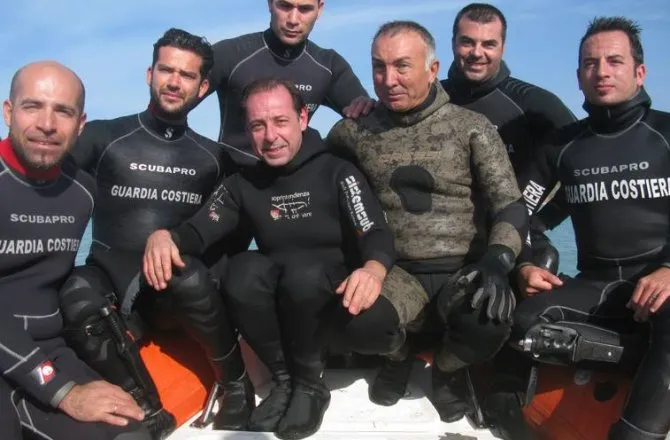
Gleaming cast metal called orichalcum, which was said by Ancient Greeks to be found in Atlantis, has been recovered from a ship that sunk 2,600 years ago off the coast of Sicily.
The lumps of metal were arriving to Gela in southern Sicily, possibly coming from Greece or Asia Minor. The ship that was carrying them was likely caught in a storm and sunk just when it was about to enter the port.
"The wreck dates to the first half of the sixth century," Sebastiano Tusa, Sicily's superintendent of the Sea Office, told Discovery News. "It was found about 1,000 feet from Gela's coast at a depth of 10 feet."
BLOG: Atlantis Found Off Brazil? Erm...
He noted that the 39 ingots found on the sandy sea floor represent a unique finding.
"Nothing similar has ever been found," Tusa said. "We knew orichalcum from ancient texts and a few ornamental objects."
Indeed orichalcum has long been considered a mysterious metal, its composition and origin widely debated.
Get the world’s most fascinating discoveries delivered straight to your inbox.
According to the ancient Greeks, it was invented by Cadmus, a Greek-Phoenician mythological character. The fourth century B.C. Greek philosopher Plato made orichalcum a legendary metal when he mentioned it in the Critias dialogue.
PHOTOS: New World Heritage Sites
Describing Atlantis as flashing "with the red light of orichalcum," he wrote that the metal, second only in value to gold, was mined in the mythical island and was used to cover Poseidon's temple interior walls, columns and floors.
Today most scholars agree orichalcum is a brass-like alloy, which was made in antiquity by cementation. This process was achieved with the reaction of zinc ore, charcoal and copper metal in a crucible.
Analyzed with X-ray fluorescence by Dario Panetta, of TQ - Tecnologies for Quality, the 39 ingots turned to be an alloy made with 75-80 percent copper, 15-20 percent zinc and small percentages of nickel, lead and iron.
"The finding confirms that about a century after its foundation in 689 B.C., Gela grew to become a wealthy city with artisan workshops specialized in the production of prized artifacts," Tusa said.
The 39 ingots recovered from the wreck were indeed destined to these workshops and were used in high quality decorations.
NEWS: Stone Mystery in Sea of Galilee
According to Enrico Mattievich, a retired professor of physics who taught at the Federal University of Rio de Janeiro (UFRJ), the ingots are not properly made from orichalcum.
"It appears they are lumps of latone metal, an alloy of copper, zinc and lead," he told Discovery News.
Mattievich, who has led a number of studies in physics applied to mineralogy, paleontology and archaeology, is one of the scholars who disagree on the brass-like nature of orichalcum.
While other scholars equated the mysterious metal to amber and to other copper based alloys, Mattievich believes orichalcum has its roots in the Peruvian Andes and in the Chavín civilization that developed there from 1200 B.C. to 200 B.C.
PHOTOS: NOAA Salutes the Ocean
According to the scholar, who claimed in his book "Journey to the Mythological Inferno" that the ancient Greeks had discovered America, a metallic alloy "with fire-Iike reflections" similar to Plato's description was found in a set of metallic jaguars of Chavin style, which turned to be made of 9 percent copper, 76 percent gold and 15 percent silver.
Whatever the origins and nature of orichalcum, Tusa's team plans to excavate the shipwreck and bring to light the entire cargo.
"It will provide us with precious information on Sicily's most ancient economic history," Tusa said.
Originally published on Discovery News.