















Finland's largest Viking Age silver hoard discovered by metal detectorist — and it has thousands of coins and pieces of jewelry
The largest Viking Age silver hoard ever found in Finland was unearthed by a metal detectorist north of Helsinki.

The largest hoard of Viking Age silver ever found in Finland — which contains almost 10 pounds (4.5 kilograms) of coins and jewelry — has been unearthed by a metal detectorist about 95 miles (150 kilometers) north of Helsinki.
The hoard had been divided into two deposits and buried in birch-bark containers. Although the coins and jewelry likely date to between A.D. 1000 and 1050, it's unknown exactly when they were buried, Esko Tikkala, an archaeologist at the Lahti Historical Museum who excavated the hoard, told Live Science in an email.
The hoard has not yet been fully cleaned, separated and counted yet, but there are thousands of pieces, Tikkala said. "There are quite a lot of coins in this hoard," he said. "I have not had time to go through them."
Metal detectorist Kalle Lappinen found the two deposits Sept. 3 and immediately contacted the museum. Archaeologists inspected and properly excavated the finds the next day, according to a translated statement.
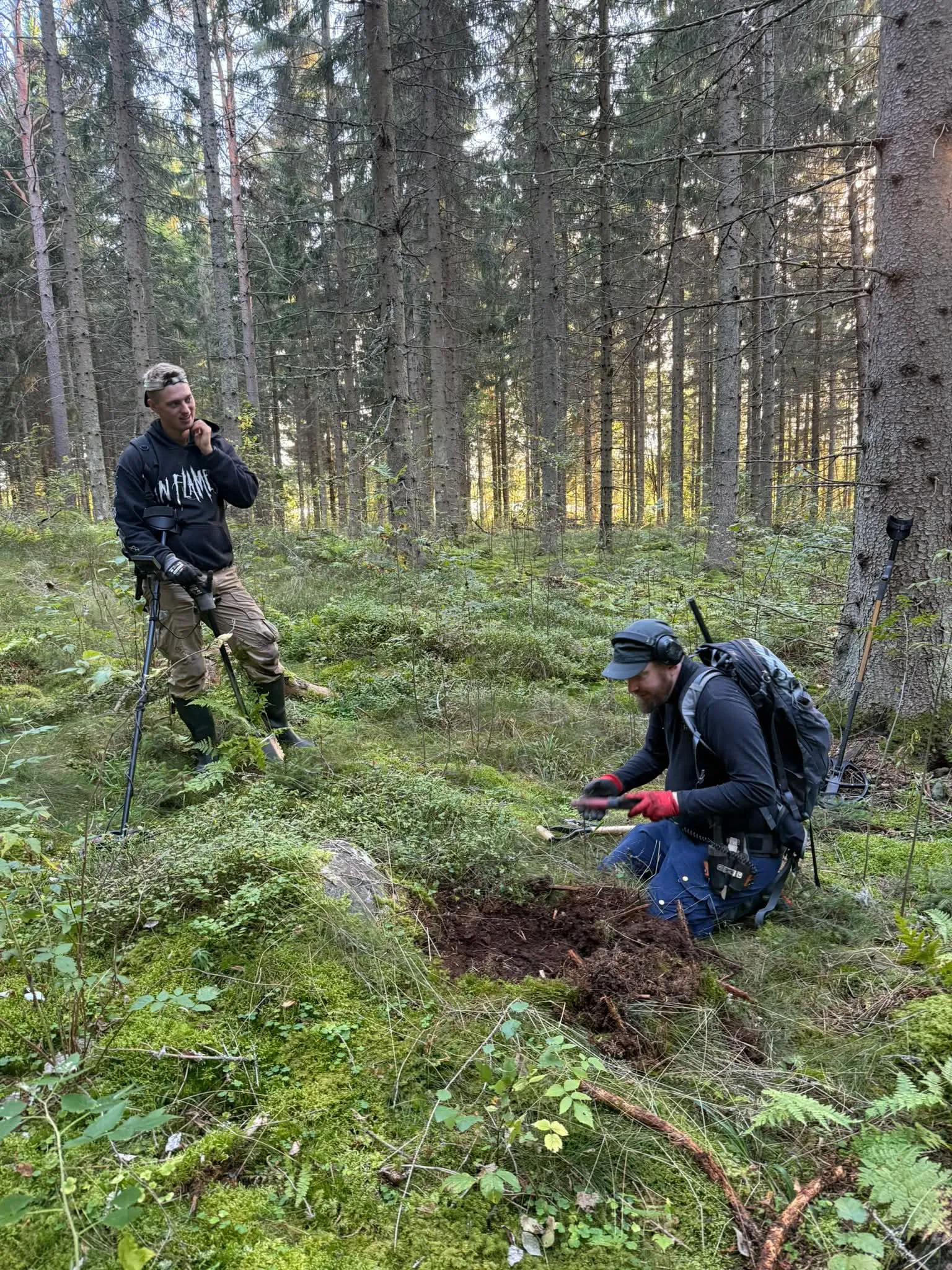
The coins were discovered in early September by metal detectorist Kalle Lappinen (right).
Tikkala described the hoard site as beside a rock outcrop in a forest near the town of Sysmä. Several other buried hoards had been found in the same region of Finland over the past 10 years, Tikkala said.
Although it's challenging to determine why specific hoards were buried, a recent study of more than 15,000 Roman-era (the eighth century B.C. to the fifth century A.D.) hoards found that they were hidden for multiple reasons, including for tax evasion, votive offerings, and safe storage in times of uncertainty.
Tikkala said the two deposits of the silver hoard were buried between two stones about 18 inches (45 centimeters) below ground and about 39 feet (12 meters) apart. There were no signs of any burials nearby, but the surrounding area had not been properly studied, he said.
Get the world’s most fascinating discoveries delivered straight to your inbox.
Tikkala added that the coins came from areas that corresponded to present-day Germany, Sweden and Great Britain. There were also some dirhams — silver coins made in the Islamic world. Dirhams previously found in Finland generally date to between about 800 and 1050, he said.

In addition to the silver coins from many places, the hoard contains items of silver jewelry and "hack silver" used for payments.
The hoard also contains several pieces of jewelry, including a silver bracelet, and "payment silver" in the form of hack silver (also called hacksilber) — pieces of silver that could be cut into smaller pieces for payments according to their weight.
The weight of the precious metal alone would make the hoard worth almost $10,000 today.
From the Viking Age, but not from Vikings
Although the hoard is from the Viking Age (traditionally, from the 793 attack on Lindisfarne until the 1066 defeat of a Viking army at Stamford Bridge in England), that doesn't mean it was buried by Vikings, Tikkala said.
"The term Viking Age does not imply that there were Vikings in Finland," he said. "We have no sources suggesting that Finland was 'Viking' in the same sense as regions of present-day Sweden, Norway, and Denmark."
Instead, Finnish historians and archaeologists had adopted the term to designate the period, he said. But the area now known as Finland was not culturally or politically part of Viking Scandinavia.

The hoard had been placed in two bark containers that were then buried several feet apart.
The next stage of the archaeological investigation will be to properly study the site where the two deposits were found, as well as their surroundings, Tikkala said; after that, specialists in Viking Age coins will try to identify the coins and prepare a detailed report.
Related stories
- Dirty 'button' unearthed by metal detectorist turns out to be a rare 900-year-old coin from Norway's last Viking king, Magnus Barefoot
- Gold coin discovered by a metal detectorist in the UK may have been dropped by a Viking invader from the Great Heathen Army
- 7 myths about the Vikings that are (almost) totally false
"There will definitely be scientific articles published on the hoard as a whole, as well as more detailed studies of the coins themselves," he said.
Until now, Finland's largest Viking Age hoard was found in 1895. Buried at Nousiainen, about 130 miles (210 km) southwest of Sysmä, it contained more than 1,700 silver coins but weighed only about half as much as the newfound hoard.
Other Nordic countries have also recently reported their largest Viking Age hoards. A cache of more than 4,700 coins was found in Norway this past spring, and a homeowner in Denmark unexpectedly discovered a hoard of more than 700 silver objects weighing more than 40 pounds (18.5 kg) in their backyard, also in the spring.
See how much you know about ancient norsemen with our Viking quiz!
Tom Metcalfe is a freelance journalist and regular Live Science contributor who is based in London in the United Kingdom. Tom writes mainly about science, space, archaeology, the Earth and the oceans. He has also written for the BBC, NBC News, National Geographic, Scientific American, Air & Space, and many others.
You must confirm your public display name before commenting
Please logout and then login again, you will then be prompted to enter your display name.