Growing Antarctic Ice Sheets May Have Sparked Ice Age

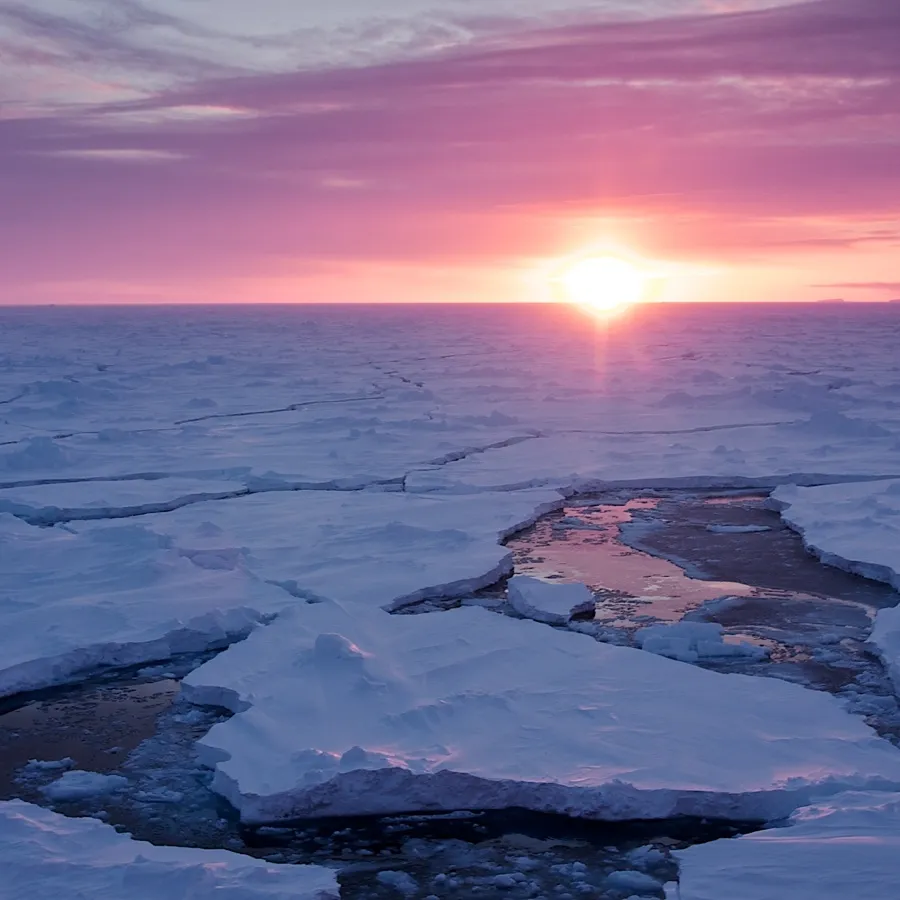
The origins of the last major ice age, which cloaked the Northern Hemisphere in colossal glaciers, might have had a surprising cause: the buildup of ice sheets on the other side of the planet, in Antarctica, researchers say.
At the end of the Pliocene epoch about 2.6 million years ago, ice sheets began covering Europe and North America. Since then, such ice sheets have regularly grown and shrunk more than 50 times, causing sea levels to rise and fall by more than 330 feet (100 meters).
But the exact trigger of the cooling during the Late Pliocene that led these glaciers to form is a mystery. Some researchers have suggested that tectonic events, such as the closure of the Panama Seaway and the uplift of the Rocky Mountains, could have played a role, as they may have caused shifts in circulation patterns in the ocean or atmosphere of the Northern Hemisphere.
In the new study, the researchers found evidence that Earth's polar ice sheets began growing between 3.1 million and 2.7 million years ago. However, this time frame means that the glacier growth preceded the growth of major glaciers across North America — the earliest compelling evidence suggests Northern glaciers began growing about 2.7 million years ago.
This finding suggests that most of the earlier ice growth occurred in the Antarctic. [Ice World: Gallery of Awe-Inspiring Glaciers]
The findings also reveal that "a change in deep-sea heat transport had a profound effect on the Earth's climate," said lead study author Stella Woodard, a geochemist and paleooceanographer at Rutgers University in New Jersey. Deep-sea currents are responsible for about 30 to 50 percent of global heat storage and transport.
In the study, Woodard and her colleagues analyzed the shells of microscopic bottom-dwelling organisms known as foraminifera in ancient sediments in the Pacific collected by the International Ocean Discovery Program. "I chose a site in the Pacific because it holds about 50 percent of the world's ocean water," Woodard told Live Science.
Get the world’s most fascinating discoveries delivered straight to your inbox.
The concentrations of various forms of magnesium, calcium and oxygen in these foraminifera shells yielded insights on how well these creatures grew, and thus on what ocean temperatures and ice levels were like at specific points in time.
The scientists also found that, in the Late Pliocene, deep water in the North Atlantic cooled rapidly, by about 4 degrees Fahrenheit (2 degrees Celsius), and deep water in the North Pacific warmed by about 3 F (1.5 C). This meant that the growth of the Antarctic ice sheet coincided with more equal temperatures between the bottom of the Atlantic and Pacific oceans, suggesting heat flow between them.
The researchers suggested that the growth of the Antarctic ice sheet altered ocean currents worldwide. More Antarctic sea ice would have meant there was less warm, salty water from the North Atlantic that rose upwards and mixed withthe surface waters surrounding Antarctica. Instead, this conveyer belt of heat would have redirected into the deep waters of the Pacific Ocean, and these changes in heat flow might have been substantial enough to initiate glacier formation in the Northern Hemisphere.
"They looked at a different part of the world than is traditionally looked at for the onset of cooling," said Robert McKay, a paleoclimatologist at Victoria University of Wellington in New Zealand, who did not take part in this research. "These are very novel and interesting results. They still require some explaining, but I think the researchers did quite a good job."
The findings do not necessarily exclude other explanations for the Late Pliocene cooling, Woodard noted. However, the fairly rapid change in temperature and circulation that the researchers suggested does imply that a slow process, such as the closure of the Panamanian Seaway, "could have played only an indirect role in the climatic cooling about 2.73 million years ago," Woodard said.
The scientists detailed their findings online Oct. 23 in the journal Science.
Follow Live Science @livescience, Facebook & Google+. Originally published on Live Science.