Dinosaur Boom Linked to Rise of Rocky Mountains

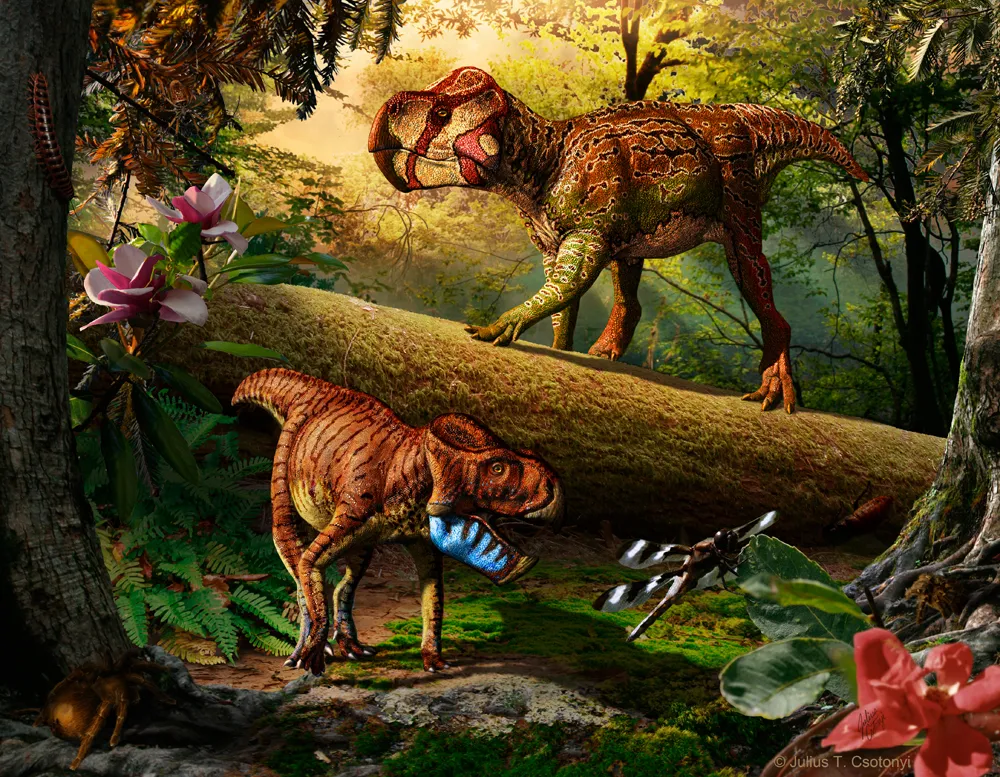
The evolution of new dinosaur species may have surged due to the rise of the Rocky Mountains and the emergence of a prehistoric inner sea in North America, researchers say.
Duck-billed and horned dinosaurs flourished in North America, reaching a peak about 75 million years ago, a time known as the Campanian. For instance, one Campanian region known as the Dinosaur Park formation in what is now Canada saw seven different duck-billed dinosaur species and five horned dinosaur species emerge. A comparable region known as the Hell Creek formation in the United States from the Maastrichtian, the time that led up to the end of the Age of Dinosaurs 65 million years ago, saw only a single duck-billed dinosaur species and maybe three horned dinosaur species at most.
"The reason for this discrepancy in dinosaur diversity has never been adequately explained," said researcher Terry Gates, a vertebrate paleontologist at Ohio University.
Dinosaurs and geology
To help solve the mystery behind this pattern of evolution, Gates and colleagues analyzed the ancient geology of western North America, since environmental alterations often influence evolution. After focusing on trends in mountain and ocean formation 70 million to 80 million years ago, they found the landscape experienced profound changes back then that may have influenced dinosaur evolution.
During the early to middle Cretaceous, geological forces lifted the western United States, creating a huge mountain range known as the Sevier Mountains. This extended in a line from the American southwest through Alberta, Canada. Later, one of the tectonic plates under North America's crust shifted, building another mountain range farther east — the Laramide Orogeny, the infant stage of the modern-day Rocky Mountains. [The World's Tallest Mountains]
The area just to the east of the new Sevier Mountains dipped downward, creating a shallow inner sea known as the Western Interior Seaway that flooded the continent from the Canadian Arctic to the Gulf of Mexico. This seaway divided the continent into three large islands to the north, east and west that were densely populated with dinosaurs.
Get the world’s most fascinating discoveries delivered straight to your inbox.
The wild west
The dinosaurs of the west dwelled on an island called Laramidia. "Western North America has been a hotbed for dinosaur discoveries for more than a century, but the recent explosion of new dinosaur species coming out of Utah is sending waves through the paleontological community and revolutionized our understanding of dinosaur evolution on the continent," researcher Lindsay Zanno said in a statement. Zanno is the director of the Paleontology and Geology Research Laboratory at the Nature Research Center of the North Carolina Museum of Natural Sciences. [The Bones Album: Photos of Dinosaur Fossils]
Specifically, the new finds helped illustrate how dinosaurs evolved on an island with changing geography. The growth of the Sevier Mountains and the Western Interior Seaway caused dinosaur habitat to shrink on Laramidia.
"It appears that geographic as well as probably also ecological barriers created by the rise of mountain ranges and the seaway caused isolation of the northern and southern populations of the crested duck-billed and horned plant-eating dinosaurs," researcher Albert Prieto-Márquez at the Bavarian State Collection for Paleontology and Geology in Munich, Germany, said in a statement. "We hypothesize that such isolation facilitated rapid speciation and increased diversity in these animals."
New species of duck-billed and horned dinosaurs were being born at an explosive rate of every few hundred thousand years during the brief time when the two mountain ranges and the seaway coexisted. Isolated populations often evolve new features more rapidly, Gates said.
Eventually, the continued rise of the Rocky Mountains kept the sea away from the continent's interior. This change opened up a vast territory for these dinosaurs to roam. This, in turn, reduced how fast new species evolved in the region to every few million years, the researchers suggest.
"Our data suggests that changing geography contributed to the pattern we see in western North America," Gates said.
During the times of isolation, a number of species of giant duck-billed dinosaurs "roamed a much smaller area than you might think given that many were larger than elephants," Gates said. It may be possible these dinosaurs evolved to eat specialized plants found only in certain regions, explaining why they lived in relatively tight confines.
Dinosaur diversity dip
Researchers had suggested that dinosaurs were declining before their mass extinction, due to a dip in diversity in the years leading up to the calamity.
"The major question I've been thinking about for 10 years was, 'Were dinosaurs really declining before they went extinct?'" Gates told LiveScience. "It turns out the time period of dinosaur diversity we were looking at, the Campanian, was a bit of an anomaly. It saw three converging geologic structures all coming together to form perfect conditions for a dinosaur species boom. Everyone was using this time as a baseline for dinosaur diversity, when it should have been seen as an anomaly, and the decrease in diversity later on was really a return to the status quo."
The mountain and seaway changes not only influenced dinosaur diversity in North America, but they also may have had effects elsewhere in the world. For instance, the rise of the predecessor to the Rocky Mountains created a barrier, meaning that only species living in the southern part of Laramidia could get to South America, and only species living north of the mountains could reach Asia across modern-day Alaska.
"These giant herbivores were truly invasive species that seemingly came to dominate these other continents," Gates said.
Gates and his colleagues are now exploring the western United States to better understand patterns of dinosaur evolution and diversity there, as well as how other groups of animals, such as mammals and amphibians, might have been affected by these geological changes. They detailed their findings online yesterday (Aug. 2) in the journal PLoS ONE.
Follow LiveScience on Twitter @livescience. We're also on Facebook & Google+.