
 Live Science Plus


Yawning Is Contagious in Wolves (Just Like Humans)

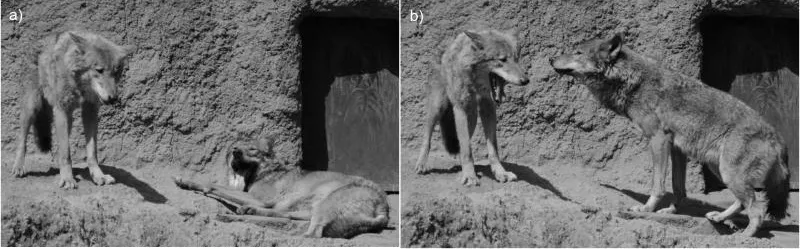
Just as with humans, when wolves see one of their fellow creatures yawn, they do it too, a new study suggests.
"In wolves, as well as in primates and dogs, yawning is contagiousbetween individuals, especially those that are close associates," study co-author Teresa Romero, a researcher from The University of Toyko in Japan, said in a statement.

Yawning is thought to be a social cue that communicates information, often in a group setting. Previous studies of chimpanzees have shown that the act is thought to be an indication of empathy. Domestic dogs have also been known to yawn when they see humans yawn, at least in a scientific setting.
In the study, Romero and her colleagues observed yawning among a pack of 12 wolves at Tama Zoological Park in Toyko over a period of five months under relaxed conditions in which the animals showed no signs of stress. They recorded the time of each yawn, the wolf that initiated the yawn and the identities and positions of nearby wolves.
The researchers found that yawns were contagious among wolves, and pack members who had strong bonds with the yawn instigator yawned more frequently. Also, female wolves reacted more quickly to a yawn than males did, suggesting the females may be more responsive to social stimuli, the researchers said.
The findings are based on a small study, but nevertheless, the researchers said the contagious yawning behavior suggests the wolves may have the capacity for empathy — typically thought of as a human ability.
Interestingly in humans, children with autism, a disorder associated with social impairment and communication problems, don't experience contagious yawns.
The new findings were published today (Aug. 27) in the journal PLOS ONE.
Follow Tanya Lewis on Twitter and Google+. Follow us @livescience, Facebook & Google+. Original article on Live Science.
