















Bizarre Jurassic Parasite Sported Sucker on its Body
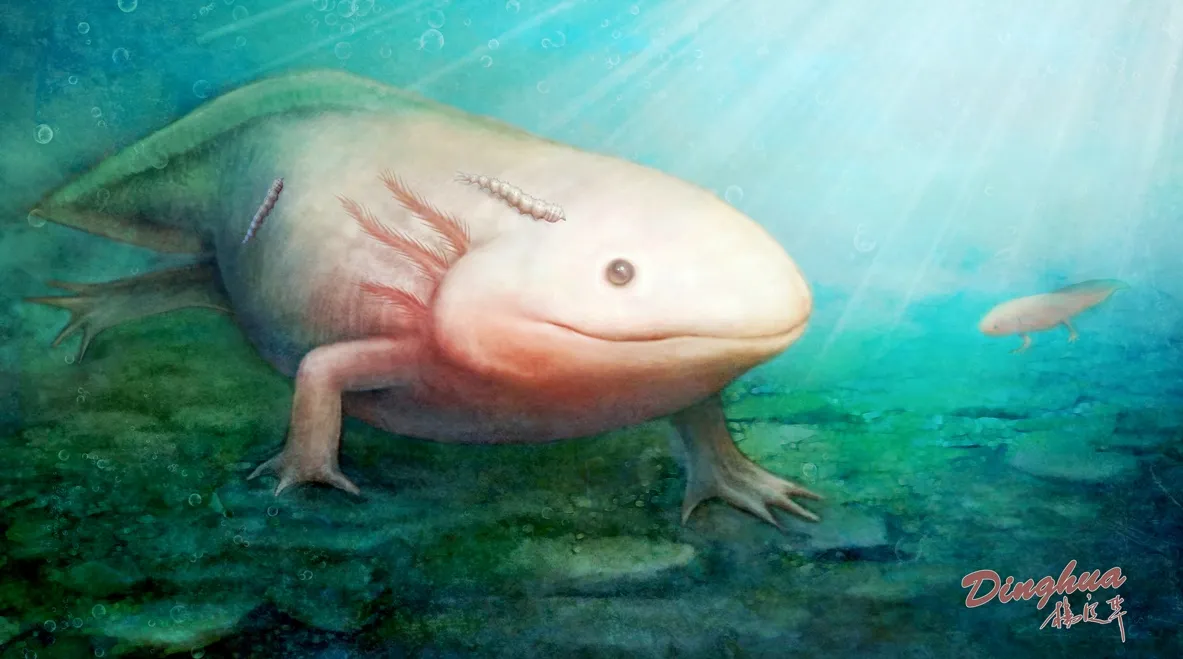
The fossil of a wild-looking parasite with a tiny head and whose midbody evolution transformed into a sucking plate, has been discovered in what is now northeastern China.
Some 165 million years ago, the parasite — a 0.7 inch-long (2 centimeters) fly larva — would've crept onto passing salamanders and other amphibians, latched onto their bodies with a sucker and then used its piercing mouthparts to slurp up the host's blood.
The larva — now called Qiyia jurassica, or "Qiyia," which means "bizarre" in Chinese, and "jurassica," for the time period in which it lived — sported a relatively tiny, tube-shaped head tipped with its blood-sucking mouthparts, a midbody or thorax that worked as a sucker and caterpillarlike hind legs. [See Images of Jurassic Fly Larva & Other Ancient Parasites]
"No insect exists today with a comparable body shape," Bo Wang of the Steinmann-Institute of the University of Bonn said in a statement, referring to the mix of body features of the larva.
The fine-grained mudstone that contained the fossilized larva was found near Ningcheng, in Inner Mongolia. The mudstone helped to preserve many of the organism's physical features, including details of its mouthparts, soft body tissue, the sucking plate and even fine setae (hairlike structures, the researchers said.
"The finer the sediment, the better the details are reproduced in the fossils," study researcher Torsten Wappler of the Steinmann Institute of the University of Bonn wrote in an email to Live Science. He added that conditions of the groundwater also helped to prevent bacterial decomposition of the parasite.
"In general, insect larvae are very rarely found in the fossil record as body remains, partly because they contain relatively few hardened structures," Wappler wrote. "Instead, traces of their activity fossilize more often [are found], such as feeding marks on leaves or larval cases."
Get the world’s most fascinating discoveries delivered straight to your inbox.
The parasite seems to have lived a luxurious existence. While no fossil fish, which would've preyed on the fly larva, have been found in the freshwater lakes of this Jurassic period in China, scientists have discovered loads of fossilized salamanders, the researchers said.
These bloodsucking fly larvae would not have sent their salamander hosts to their deathbeds, however. "A parasite only sometimes kills its host when it has achieved its goal, for example, reproduction or feeding," Wappler noted in the statement.
This isn't the first ancient parasite unearthed. Dubbed Saurophthyrus exquisitus, a fossilized flea that lived some 125 million years ago and sported bristles on its body was unearthed in China and described in 2013 in the journal Current Biology. The oldest known flea, in the genus Pseudopulicidae, lived 165 million years ago and was discovered in sediments in northeastern China. These bloodsuckers were five to 10 times bigger than today's fleas. Their size and tough mouthparts may have allowed the pests to suck the blood of dinosaurs of the time, scientists speculate.
Though the researchers didn't find any adult specimens of the O. jurassica larva, and so don't know what it might've grown up to be, they say it was related to Athericidae, or water snipe flies, which are closely related to horseflies.
"Species of Athericidae are found worldwide. The adults mostly feed on nectar, but some species feed on mammal blood," Wappler said.
Follow Jeanna Bryner on Twitter and Google+. Follow us @livescience, Facebook & Google+. Original article on Live Science.
Jeanna Bryner is managing editor of Scientific American. Previously she was editor in chief of Live Science and, prior to that, an editor at Scholastic's Science World magazine. Bryner has an English degree from Salisbury University, a master's degree in biogeochemistry and environmental sciences from the University of Maryland and a graduate science journalism degree from New York University. She has worked as a biologist in Florida, where she monitored wetlands and did field surveys for endangered species, including the gorgeous Florida Scrub Jay. She also received an ocean sciences journalism fellowship from the Woods Hole Oceanographic Institution. She is a firm believer that science is for everyone and that just about everything can be viewed through the lens of science.