
 Live Science Plus


So Many Arms! How Octopuses Avoid Tying Themselves in Knots

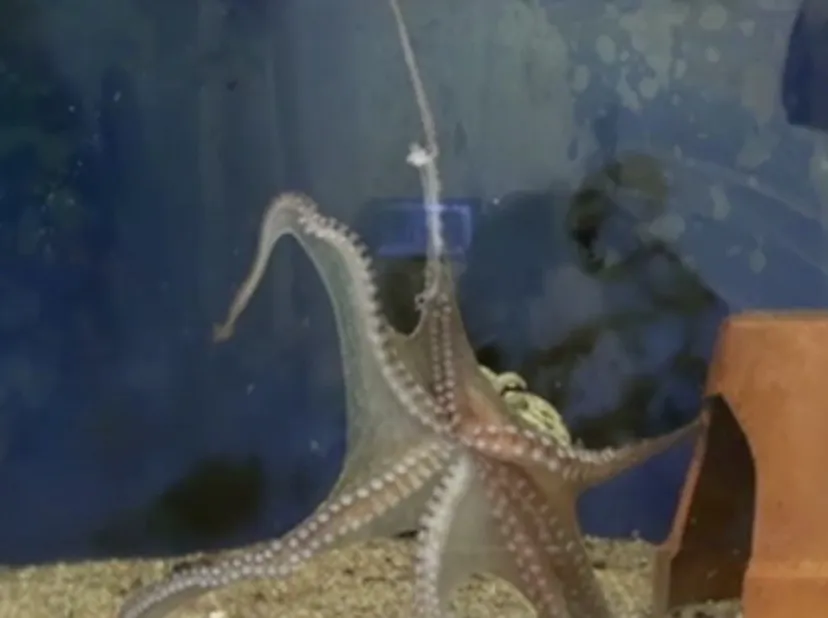
Octopus arms are amazing things. They live on for an hour after being amputated; they move on their own; they sport hundreds of suckers that grasp things reflexively; and they can bend and stretch in seemingly infinite combinations.
But all of those features should mean that octopuses spend most of their time as big, knotted bundles of limbs — after all, imagine how difficult it would be to have eight arms that literally had minds of their own flailing around your body. Now, a new study finds that octopuses solve this independent-arm problem with skin excretions that prevent arms from grabbing one another.
"This is amazing, how evolution found this simple solution to a potentially very, very difficult and maybe even impossible-to-solve problem," study researcher Guy Levy, a doctoral candidate at the Hebrew University of Jerusalem, told Live Science. The findings could inform the engineering of nature-inspired robots, Levy added. [See Video of Octopus Avoiding Arm Skin]
Independent arms
Octopuses are incredibly dexterous. They can twist open screw-top jars, peel apart oysters and otherwise manipulate their environments with their agile arms. These arms have their own mini-nervous systems that can control movement without contacting the octopus brain. Humans also have some motor reflexes that can occur without the brain's input, but these reflexes tend to be simple, like the kneejerk response that happens when a doctor taps your kneecap.
The octopus arm, in comparison, can live on after amputation, crawling around and grasping anything in its path. And amputation is common in the wild — octopus arms regrow after they're lost, and octopuses may even eat their own arms or those lost by others.
Levy, along with his co-author Nir Nesher and doctoral advisor Binyamin Hochner at The Hebrew University and collaborator Frank Grasso at the City University of New York, wanted to find out how these eight semi-autonomous arms avoided grappling with one another.
Get the world’s most fascinating discoveries delivered straight to your inbox.
The researchers first amputated arms from the common octopus (Octopus vulgaris) and let the arms interact. (The octopuses were anesthetized before losing their arms, though the animals are not very bothered by arm amputation, Levy said.) The team found that amputated arms would not grab each other. Nor would they grab octopus-arm skin stretched over a plastic dish. An amputated arm would grasp another arm that had been skinned, however. [8 Crazy Facts About Octopuses]
Strange behavior
Clearly, something about octopus skin was protecting the arms from one another. But what? The researchers suspected some sort of chemical excretion.
To test the idea, Levy and his colleagues used chemicals to extract the substances on octopus skin. They then smeared the extract on plastic dishes and offered them to amputated octopus arms. For comparison purposes, they also offered dishes smeared with fish skin extract and with a neutral gel alone to the octopus arms.
They found that the octopus arms again avoided association with octopus skin. Their grasp on the octopus skin-smeared plastic was 10 times weaker than their grasp on plastic smeared with gel alone, and 20 times weaker than the grasp on fish-smeared plastic. (Yes, octopus arms still grasp for food, even after they're detached.)

Next, the researchers took the study to live octopuses. But here's where things got weird. Sometimes octopuses would eagerly snatch up and eat an amputated arm, Levy said. Other times, they'd dance around the potential meal, rubbing it, but not grabbing it. If they did grab it, they'd cling to the skin-free portion where the octopus arm has been cut from the body, and they'd hold the arm in their beaks gingerly, letting it dangle like a spaghetti noodle. The researchers dubbed this "spaghetti holding."
Self-recognition
In repeated tests, the researchers found that octopuses are more likely to behave strangely over their own arms than those of a stranger. Ninety-five percent of the time, octopuses will use their suckers to grasp another octopus' amputated limb. They'll use their suckers on their own amputated limb less than 40 percent of the time. Likewise, octopuses treated another octopus' arm as food 72 percent of the time, compared with less than 28 percent of the time with their own arms.
Clearly, Levy said, the chemicals used by octopus arms to avoid one another are specific to the individual. The researchers have yet to isolate the precise secretions, but are working on that now, he said.
Self-recognition is common in nature, Levy said. Immune cells, for example, must differentiate between body cells and foreign invaders. But the amazing thing about the octopus find is that the animals use chemical recognition in motor control, he said.
The researchers are part of a team working on building a robotic octopus arm for use in medicine and surgery, because of the arms' amazing flexibility and dexterity. A medical octopus robot arm wouldn't need to avoid grasping other arms, because there would only be one, Levy said. But the same principles could still apply. For example, a robot arm that needed to snake through the intestines to reach a surgical site might be programmed to avoid molecules on the intestinal wall to prevent it grasping the wrong thing.
The researchers report their findings today (May 15) in the journal Current Biology.
Follow Stephanie Pappas on Twitter and Google+. Follow us @livescience, Facebook & Google+. Original article on Live Science.

Stephanie Pappas is a contributing writer for Live Science, covering topics ranging from geoscience to archaeology to the human brain and behavior. She was previously a senior writer for Live Science but is now a freelancer based in Denver, Colorado, and regularly contributes to Scientific American and The Monitor, the monthly magazine of the American Psychological Association. Stephanie received a bachelor's degree in psychology from the University of South Carolina and a graduate certificate in science communication from the University of California, Santa Cruz.