













Chimps Barter for Sex

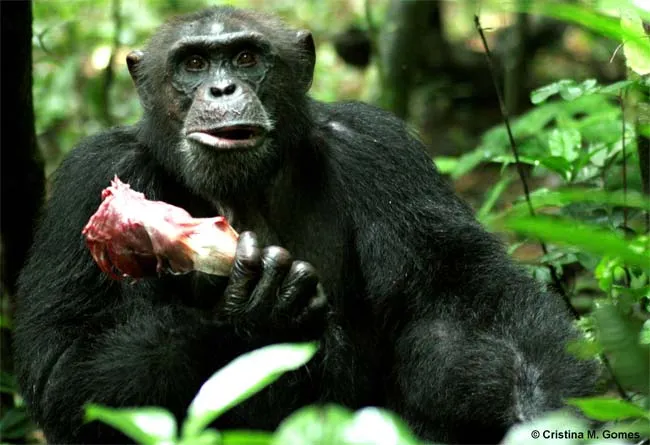
The oldest profession isn't restricted to humans. A new study found that wild chimpanzees exchange meat for sex.
By stealthily following a group of about 20 adult chimpanzees in Côte d’Ivoire's Taï National Park, behavioral ecologists Cristina Gomes and Christophe Boesch of Max Planck Institute for Evolutionary Anthropology in Germany carefully noted which male chimpanzees copulated with which females. The researchers found that she-chimps put out more often for males that shared food with them at least once, compared to stingy males who never offered meat.
Apparently, buying dinner is a good way to improve the chances of getting lucky on a date, even if you're a chimp.
The primates' food-for-sex barter occurs indirectly, over the course of weeks or months, with males seeming to accrue credit with the ladies by plying them with meat killed on a hunt.
"What people have been looking for before is an immediate exchange," Gomes told LiveScience. "I included all interactions between a pair that occurred over several months to see if there was more of a long-term relationship. I suspect this is why I found a correlation that nobody else had found before."
To establish that tit-for-tat was going on, rather than just friendship (which could also explain why one chimp would give another food), the researchers tried to control for other factors. By tracking association patterns between pairs, the scientists found that males didn't just give meat to females they hung around with often. They specifically gifted food to those that they ended up copulating with. Additionally, factors such as rank and age also did not explain the connection between giving away meat and mating success.
Chimpanzees, humans' closest living relatives, are not monogamous. Females try to mate with as many different partners as they can, Gomes said, while males often attempt to monopolize females, preventing them from hooking up with other males. Though males can sometimes get their way by overpowering females with strength, evidence shows that the ladies' choice also plays an important role in determining which two individuals will get together.
Get the world’s most fascinating discoveries delivered straight to your inbox.
The new findings do establish that males can try to improve their chances with gifts of food, though it's not clear whether this is a conscious planning effort, or merely an emotional urge on the males' part.
"They can keep track somehow of what they have received or given in the past," Gomes said. "It doesn't mean they're aware of this. It could be emotional. In humans, you don’t even really know how many coffees someone has bought for you in the past, you just generally feel that this person is nice to you. It creates a positive feeling toward that person."
The results help relate chimp society to human hunter-gatherer societies, in which men who are more successful hunters have more affairs and a larger number of offspring, research has found. Among both chimps and humans, it seems bringing home the bacon can pay off in the bedroom.
The findings are detailed in the April 8 issue of the journal PLoS ONE.
- Top 10 Missing Links
- Science of Sex News and Information
- How Evolution Works
