
 Live Science Plus


Ancient graves

Archaeologists have unearthed graves with hundreds of skeletons at the ancient Egyptian city of Amarna
Strong-willed pharaoh

Around 1350 B.C., the Pharaoh Akhenaten relocated his capital to a new location 218 miles (350 kilometers) south of modern-day Cairo.
Sun god cult

Akhenaten, pictured here as a sphinx, hoped to build a cult of worship to the sun god Aten in an undeveloped site that was uncontaminated by worship of other gods.

Rapid construction

The city was constructed rapidly, and at its peak, 20,000 to 30,000 builders, soldiers, court officials, and servants lived there.
Burial site

Surveyors in the desert near Amarna uncovered a massive cemetery about a decade ago. Unlike most Egyptian tombs unearthed in the past, this site held the bones of lower-class Egyptians.
Ancient protector

The burial revealed several artifacts, like this pendant in the shape of the god Bes, a protector of women and children.
Hippo amulets

The archaeologists also found three hippopotamus amulets in the burial of a woman and child. These grave goods may have been worn during life, but also carried with the owners into the afterlife.
Get the world’s most fascinating discoveries delivered straight to your inbox.
Egyptian eye

The team also unearthed a bead in the shape of the goddess Wedjat's eye. The eye is a symbol of wholeness and protection.
Hard life
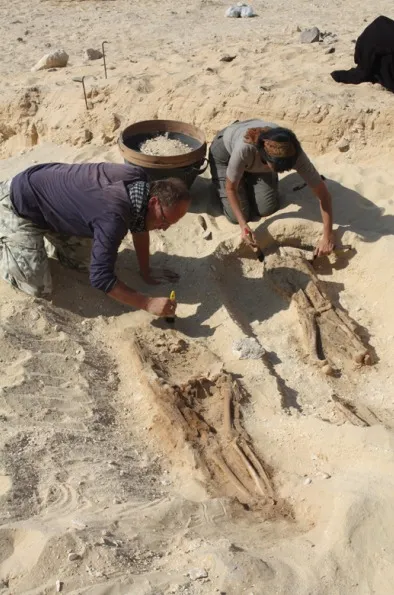
Belying the stele depicting scenes of plenty and ease, the bones showed signs of malnutrition, fractures, and joint degeneration from heavy lifting.
Everyday people

One possibility is that the overnight construction of Akhenaten's capital took an especially hard toll on its everyday citizens.
Ancient inscription

The limestone bricks that make up buildings in the area weighed about 154 pounds (70 kilograms), and the construction workers would have repeatedly lifted those loads. Here, the team unearths ancient hieroglyphics.

Tia is the editor-in-chief (premium) and was formerly managing editor and senior writer for Live Science. Her work has appeared in Scientific American, Wired.com, Science News and other outlets. She holds a master's degree in bioengineering from the University of Washington, a graduate certificate in science writing from UC Santa Cruz and a bachelor's degree in mechanical engineering from the University of Texas at Austin. Tia was part of a team at the Milwaukee Journal Sentinel that published the Empty Cradles series on preterm births, which won multiple awards, including the 2012 Casey Medal for Meritorious Journalism.