













Study: Pollen Counts To More Than Double By 2040

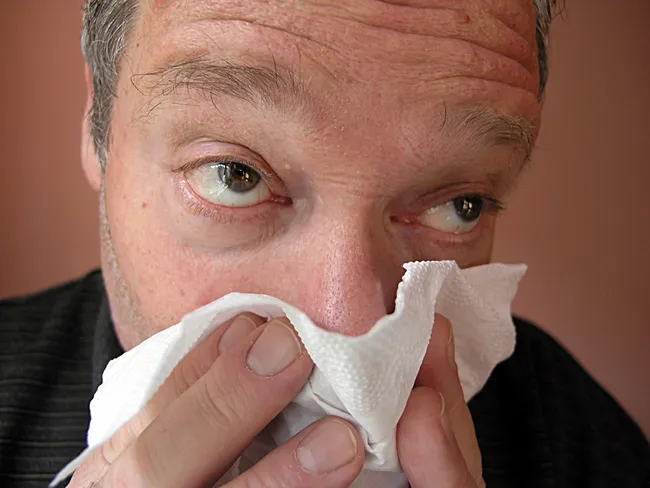
Allergy sufferers may want to stock up on meds. According to new research, America's pollen counts may more than double in the next three decades.
The culprit is climate change, as warmer temperatures lead to longer blooming seasons for allergenic plants such as ragweed, said Leonard Bielory, an immunologist and a visiting researcher at Rutgers University, where he is funded by the Environmental Protection Agency to study likely changes in pollen-producing plants in response to global warming.
Bielory will report his findings this week at the annual meeting of the American College of Allergy, Asthma and Immunology in Anaheim, Calif.
By simulating various temperature and precipitation scenarios that may occur with climate change, Bielory and his colleagues have found that average pollen counts in the United States are likely to reach 21,735 grains per cubic meter of air (or per 35 cubic feet of air) by 2040. In comparison, average pollen counts in the year 2000 hovered around 8,455 grains per cubic meter of air.
Peak sneezing season is likely to shift forward, too. [8 Ways Global Warming is Already Changing the World]
"In 2000, annual pollen production began on April 14, and peaked on May 1," Bielory said in a statement. "Pollen levels are predicted to peak earlier, on April 8, 2040."
Already, ragweed pollen has become more common in the country's midsection over the last 25 years, Bielory has found. Meanwhile, a 2005 report by Harvard Medical School found that asthma and allergies are on the rise, a change not explained by genetics.
Get the world’s most fascinating discoveries delivered straight to your inbox.
"Plants are flowering significantly earlier over time and advancing the [allergy] season by approximately 0.8 days per year," Christine Rogers, a Harvard University researcher, told LiveScience when that report was released.
Likewise, additional air pollution and better diagnosis may contribute to the rise of allergies in America.
Follow Stephanie Pappas on Twitter @sipappas or LiveScience @livescience. We're also on Facebook & Google+.

Stephanie Pappas is a contributing writer for Live Science, covering topics ranging from geoscience to archaeology to the human brain and behavior. She was previously a senior writer for Live Science but is now a freelancer based in Denver, Colorado, and regularly contributes to Scientific American and The Monitor, the monthly magazine of the American Psychological Association. Stephanie received a bachelor's degree in psychology from the University of South Carolina and a graduate certificate in science communication from the University of California, Santa Cruz.