Why Arizona Gets Scorched by Severe Wildfires

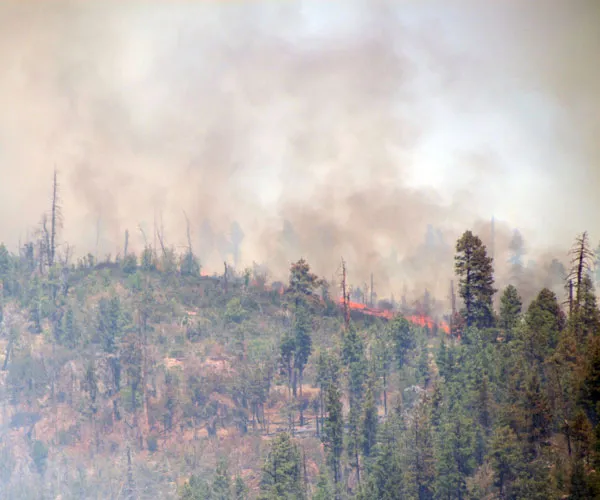
A lightning strike and a house fire that ignited a propane tank are among the immediate causes of the wildfires torching thousands of Arizona acres, media reports say.
But the real culprits behind the devastation increasingly wrought by unnaturally devastating wildfires in western North America are changes to forests, aggravated by the effects of global warming, including increasingly severe droughts, like the one Arizona is currently experiencing, said an expert in forest restoration.
The core problem is too much fuel — trees — resulting from a lack of more frequent, less devastating surface fires. The ponderosa pine forests of Arizona's Mogollon Rim, which form the southern limit of the Colorado Plateau, are the poster child for this phenomenon, Wally Covington, a regents' professor in forest ecology and executive director of The Ecological Restoration Institute at Northern Arizona University, told LiveScience.
Article continues belowThe Mogollun Rim is where the worst of the current fires are burning, as well as the two largest fires in the state's history.
Throughout nearly all of their 70-million-year evolutionary history, the ponderosa forests were burned by surface fires every two to five years. These killed seedlings, but left larger trees intact, Covington said.
"You can think of these frequent fires like wolves or other predators for deer populations," Covington said.
Without predators to keep their numbers in check, deer populations can grow to a degree where they exceed the environment's ability to support them, stripping away vegetation and ultimately starving the animals.
Get the world’s most fascinating discoveries delivered straight to your inbox.
Grazing and fire suppression have prevented the surface fires from clearing out the pines. As a result, trees crowd together much more densely than they once did. Open stands of trees that once held 15 to 40 trees per acre today hold 300 to 900 trees in that area, he said.
When a fire does arrive, it is bigger, climbing up the trees and consuming them. These crown fires kill off the old trees, which would have withstood a surface fire, he said.
The lack of fires has allowed other trees to join the high-elevation ponderosa pine stands, however, these trees are less drought tolerant, and so add more potential fuel for fires. What's more, when crowded together, trees are more vulnerable to bark beetles, and if the beetles kill a tree, it adds all of its highly flammable dead needles to the available fuel.
In general, climate change is expected to bring more wildfires because longer, warmer summers dry out soil and potential fuel, according to the Intergovernmental Panel on Climate Change. [10 Surprising Results of Global Warming]
Like large parts of the southeast and southwest, Arizona is currently in a drought. Here, climate change is making both droughts and wet years more extreme. As a result, increased vegetation growth in the wet years provides more fuel to burn during the dry ones, Covington said.
Springs are arriving earlier, falls later and temperatures are warmer in between. Meanwhile, stronger winds are fanning flames and spreading them, he said. High winds are blamed for spreading last year's more than 500,000-acre Wallow Fire.
"If you want to figure out a way to destroy these ecosystems, this is a pretty good recipe," Covington said.
Since the first crown fires occurred in the 1940s along the Mogollon Rim, they have gotten larger and larger, burning hundreds of thousands of acres since 2000. Due to geographic constraints, they probably can't get any bigger, he said.
The U.S. Forest Service has adopted a restoration approach that uses chain saws or other machines to remove young trees, and after that, controlled burns to clean up debris and recreate the effects of natural fires by preventing seedlings from becoming too abundant. This approach may save a portion of the forest, Covington said.
Editor's Note: This article was updated on May 16 at 11:10 Eastern Time to correct a reference to the other trees that have begun growing in ponderosa pine forests outside their normal ranges. They are native, but are not normally found in these locations. More detail was also added to the description of the Forest Service restoration efforts.
You can follow LiveScience writer Wynne Parry on Twitter @Wynne_Parry. Follow LiveScience for the latest in science news and discoveries on Twitter @livescience and on Facebook.
