















Image Gallery: Medieval Art Tells a Tale

3-D View
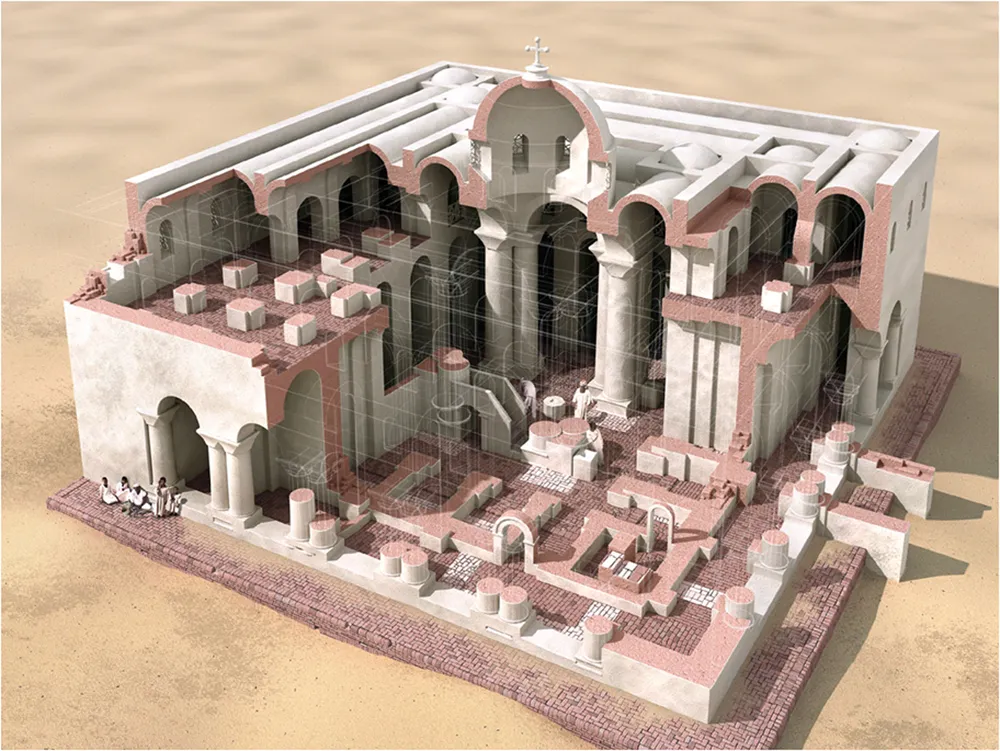
A 3-D reconstruction of the upper church at Banganarti. Built almost 1,000 years ago this medieval church was one of two that archaeologists excavated at the site.
Medieval Church Location

Banganarti and Selib were located in Makuria, a medieval Nubian Christian kingdom that bordered Nobadia, to the north, and Alodia, to the south. Egypt at the time was controlled by the Mamluks.
Banganarti Excavation

In 2001 a research team led by Bogdan Zurawski, a researcher at the Institute of Mediterranean and Oriental Cultures of the Polish Academy of Sciences, began a program of excavation and conservation at the site; it continues to present day. This image was taken in 2004 and shows a team member excavating inside the church.
St. Damianos

The team was struck by the beauty and detail of the medieval art they found. Here a team member shows a portrait of St. Damianos under candlelight.
Saintly Doctors

An up-close view of the image of St. Damianos. He was a third-century doctor in Turkey who, along with his brother Cosmas, healed people for free. When the Roman emperor Diocletian decided to crack down on Christians the brothers were rounded up, tortured and executed.
Upper Church Art

The upper church at Banganarti contained 18 square rooms, organized around a nave. It was a place filled with art. As shown in this re-creation the central chapel has an image of a king (at far right) surrounded by holy figures.
Church Layout

A diagram showing the floor plan of the upper church.
Get the world’s most fascinating discoveries delivered straight to your inbox.
Holy Healing

Pilgrims visited Banganarti in the Middle Ages, often in search of holy healing. We know from the inscriptions left behind that the church was dedicated to archangel Raphael, a patron of the blind.
Ali the Guest

One of those pilgrims was a Muslim man whose name was written down as being Deif Ali, Arabic for "Ali the guest." An image of him was drawn in the western portico, which appears to show him as being blind.
Where Bensec Wrote

Researchers were surprised to find a Catalonian inscription, only four words long, among the nearly 1,000 works of writing found at Banganarti. It was composed by a man named Bensec in the 13th or 14th century. Its location is highlighted in this image.
Homage to Raphael

The inscription reads, "when Benesec came to pay homage to [archangel] Raphael." This dialect of Catalonian was used in southern France and northern Spain indicating that Benesec had gone on a journey of about 2,300 miles to visit Banganarti.
