
 Live Science Plus


Why some physicists really think there's a 'mirror universe' hiding in space-time
What happens if you turn space-time upside-down?


A series of viral articles claimed that NASA had discovered particles from another parallel universe in which time runs backward. These claims were incorrect. The true story is far more exciting and strange, involving a journey into the Big Bang and out the other side.
The sensational headlines had muddled the findings of an obscure 2018 paper, never published in a peer-reviewed journal, which argued that our universe might have a mirror reflection across time, a partner universe that stretches beyond the Big Bang. If that's the case, and a series of other extremely unlikely and outlandish hypotheses turn out to be true, the paper argued, then that in turn could explain a mysterious signal hinting that a completely new particle is flying out of the ice in Antarctica.
Related: The 11 Biggest Unanswered Questions About Dark Matter
The claim that NASA discovered a parallel universe seemed to have been first dreamed up by British tabloid The Daily Star, and the story was then picked up by British and American outlets, including The New York Post.

Screenshots show false "parallel universe" claims in several publications.
Our universe's "mirror"
In order to understand how The Daily Star arrived at its bizarre, viral claim, it's necessary to understand the claims of two separate papers from 2018.
The first paper, by Latham Boyle, a physicist at The Perimeter Institute in Ontario, Canada, and his colleagues, proposed a mirror universe — a reflection of our universe across time. It was published December 2018 in the journal Physical Review Letters (after an appearance on the arXiv server in March that year).
"I think nobody else understands the full sweep of what they have composed," said John Learned, a University of Hawaii astrophysicist and the co-author of a second paper, which builds on Boyle's theory.
Get the world’s most fascinating discoveries delivered straight to your inbox.
Boyle's work is a kind of expansion pack meant to plug holes in the theory that tells the dominant origin story of the universe: Lambda-Cold Dark Matter (ΛCDM).
ΛCDM explains the cosmos using two key ideas: An unknown dark energy causes the universe to expand. Rewind that expansion far enough backward in time and the whole universe occupies a single point in space. Second, an unseen dark matter gravitationally tugs on stuff in the universe, yet emits no light. This dark matter, the idea goes, accounts for the vast majority of the universe's mass.
"ΛCDM is basically the only game in town," Learned said. "It works in many cases, but there are some somewhat disturbing lapses in the modeling."
For instance, measurements of expansion don't line up across time, so that measurements made of this expansion based on data from the early universe don’t jive with measurements using data from the modern universe. In addition, ΛCDM can't explain why matter exists at all, since it predicts that matter and antimatter would have formed at equal rates after the Big Bang, and annihilated each other, leaving nothing behind.
Related: Big Bang to present: Snapshots of our universe through time
Boyle and his colleagues' new universe unwinds the ΛCDM story further back in time, diving into the singularity at the beginning of time and coming out the other side.
Here’s how Boyle’s team sees their theory: Imagine today's universe as a wide, flat circle, sitting on top of yesterday's slightly smaller circle, which sits on top of the yet-smaller circle of the day before that, Boyle said.

Stack up all the circles from today back to the Big Bang, and you'd end up with a cone standing on its point end.

When astronomers look deep into space, they're effectively looking back in time. The most distant galaxy we can see, GN-z11, appears to us as it existed 13.4 billion years ago, or 400 million years after the Big Bang.
Before that, the universe had a "dark age" lasting millions of years, where nothing bright enough for us to see formed. Before that, the universe produced the oldest thing we can see: the Cosmic Microwave Background (CMB), which formed 370,000 years after the Big Bang, as the universe cooled out of a hot, opaque plasma.
Telescopes can't see anything from before the CMB.
Looking back in time like this, Boyle said, is like looking down through the cosmological cone.

Viewed in this way, the ΛCDM story ends with the universe coming together into a single point hidden behind the CMB. Boyle's theory looks at the opaque wall the CMB forms across time and draws a different conclusion about what the CMB hides.
The standard view, he said, is that the first tiny fraction of a second after the Big Bang was more or less a "big mess" that current physics equations struggle to explain. We can't see what happened in that moment, hidden as it is below the CMB from our vantage point on the cone. In ΛCDM cosmology, this first, momentary chapter in the universe's history is chaotic and difficult to understand.
But the CMB isn't that chaotic. Its simple structure, according to ΛCDM, emerged after an intense flattening process that had wiped away that chaos by the end of the universe's first second. The tidy universe thought to have emerged from that brief mess is captured in the CMB.
Related: What's that? Your physics questions answered
"We were interested in exploring a simpler picture where you take the evidence more at face value," he said. "You say 'Okay, we can't see all the way down to the Bang, but we can look darned close, and as close as we look things look super simple. What if we take those observations at face value?'"
This vision of space-time still has a Big Bang hiding behind the CMB, he said.
But "it's much simpler than most of the singularities that arise in Einstein's theory of gravity," he said. "It's a very special type of ultra-simple singularity, where you can follow the solution [to the equations governing space-time] through the singularity."
Whereas observations go no further back than the CMB, normal cosmological models go a bit further back but still tend to come to a hard stop at the Big Bang. Not in Boyle's scheme.
"You find that it extrapolates, it extends — it analytically continues, physicists would say, to this double cone," he said, referring to the second universe extending away from the Big Bang in time

"It just seems to be the natural, simplest extension of the equations that seem to describe the universe as we see it," he said.
This universe that’s inside the “second cone” is too far down space-time for us to see. Time might seem to run backward there from our reference frame, Learned said. But beings in that universe would still see cause coming before effect, just like we do in ours. Time runs away from the Big Bang in that universe, just like it does in ours. "Away from the Big Bang" in that universe is the opposite direction from the direction of time in our universe. but it doesn't run "backward" in the way we might imagine.
Related: 5 reasons we may live in a multiverse
Our universe exists on the other side of that universe's ancient history, and that universe exists on the other side of ours.
The "zero particle state"
We have no evidence that this reflected universe exists, Boyle said.
However, he said, "once you have it, it turns out this universe has an extra symmetry, which you didn't see when you were just looking at the top half of the cone."
Symmetries "ring a loud bell" for physicists, Boyle said. They suggest deeper truth.
And this double-cone universe could, in turn, help restore a crack in a symmetry that has bothered physicists for years.
The symmetry in question, known as Charge, Parity, Time (CPT) symmetry states that if you flip a particle to its antimatter twin — an electron into a positron, say — or make it right-handed instead of left-handed, or move it backward through time instead of forward, that particle should still behave in the same way and obey the same laws as it did before getting flipped. (Right-handed or left-handed refers to a particle's spin and direction of movement.)
"Everybody thought these were fundamental symmetries that could not be escaped," Learned said.
Eventually, in 1956, the Columbia University physicist Chien-Shiun Wu led an experiment that established CPT symmetry wasn't absolute. (The two male colleagues who proposed the underlying idea to Wu won the 1957 Nobel Prize for her discovery, but she was left out.)
Wu's experiment showed that the "C" in CPT symmetry is imperfect. And further experiments showed that some particles break both "C" and "P." But though cracked, most physicists think CPT symmetry still holds in general, and no particle has been found that breaks all three elements of this symmetry. At the particle level, the universe appears CPT symmetric.
But the ΛCDM model of the universe itself lacks CPT symmetry and, as a consequence, its "zero particle state," the nature of space-time when emptied of particles, is uncertain. That means that at the scale of all space, CPT symmetry is violated.
Boyle says that his model preserves the universe's CPT symmetry in a way the ΛCDM cosmology does not. Add a second cone to space-time, and the zero particle state is no longer uncertain. The universe's CPT asymmetry is repaired.
"We thought, 'Wait a minute. It seemed like the universe violated CPT symmetry, but actually we just weren't looking at the whole picture," he said. If the universe really is CPT-symmetric, if it really comprises two space-time cones rather than one, what would that mean for the rest of physics?
The truth behind what those "NASA scientists" really detected
The most practical consequence of the CPT-symmetric universe is a simple explanation for dark matter.
One popular set of theories about the unseen stuff relies on the existence of some undetected, fourth type of neutrino — often termed a sterile neutrino. Boyle's CPT symmetry seems to point in this direction. The three known flavors of neutrino, the electron, muon and tau neutrinos, are all left-handed. That means that they fly around without a matching right-handed partner. The Standard Model assumes that, unlike other particles, neutrinos don't have such partners. But the CPT-symmetric universe disagrees, indicating they should have those partners.
Boyle and his colleagues found that their cosmology implies the existence of a right-handed partner in our universe for every left-handed neutrino in the Standard Model. But, unlike left- and right-handed quarks, these left- and right-handed mirror particles wouldn't stick together.Instead, two of the right-handed partner neutrinos would have long since been lost to space-time, decaying out of our view in the very early universe. A third right-handed partner would have stuck around, however — a consequence of the equations governing the beginning of time.
It's not clear which of the three known neutrinos it would have partnered with, Boyle said. But it would have had a particular energy signature: 480 picoelectronvolts (PeV), a measure of a particle's mass. And that 480PeV neutrino might account for all of that missing dark matter in the universe.
The details of how the CPT-symmetric universe leads to a 480 PeV neutrino are tricky — so tricky, Learned said, that few physicists beyond Boyle and his team understand them at all.
"But these guys are not nutcases," he said. "They're respected members of the field and they know what they're doing. Whether all of that complicated field theory is correct or not, I can't say."
Still, the prediction of a 480 PeV particle jumped out at Learned.
Four years ago, a particle detector hanging from a balloon over Antarctica detected something physics could not explain: Twice, as Live Science previously reported, the Antarctic Impulsive Transient Antenna (ANITA) instrument picked up signals of high-energy particles that seemed to shoot straight up out of the Antarctic ice. (Most researchers involved in ANITA aren't "NASA scientists," but the project does receive NASA funding.)
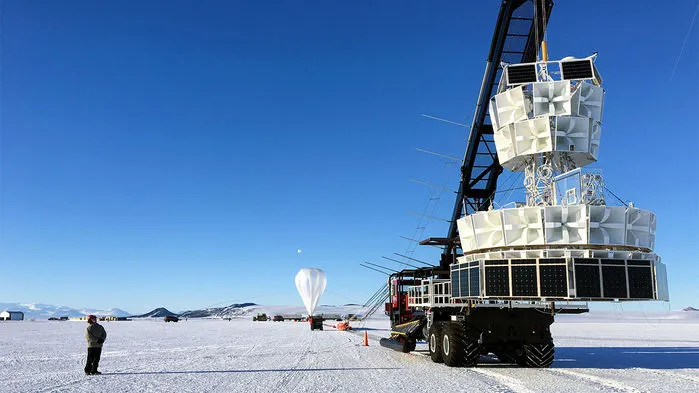
Researchers prepare to launch the Antarctic Impulsive Transient Antenna (ANITA) experiment, which picked up signals of impossible-seeming particles as it dangled from its balloon over Antarctica.
Particles like this shouldn't exist. None of the known Standard Model particles should have been able to fly all the way through the Earth and burst out the other side at such high energies, but that's what ANITA seemed to be detecting.
As of June 2020, the most popular explanation is that ANITA has detected sterile neutrinos. Learned, who was involved in the early days of the ANITA project, realized the 480 PeV figure lined up nicely with the ANITA findings.
If particles really came from space, then plunged through the Earth to produce the anomaly, they must have decayed just under the Antarctic surface, producing a shower of lighter particles that ANITA detected popping up from the ice. Boyle's 480 PeV dark matter neutrino fit squarely in the mass range that could explain ANITA's decaying mystery particle.
Learned and a team of four other researchers cooked up a scheme where this 480 PeV dark matter neutrino might have pulled off this trick, which they wrote up in a 2018 paper titled "Upgoing ANITA events as evidence of the CPT symmetric universe" and published to the arXiv database. This is the paper The Daily Star turned into a confused headline.
If the ANITA particle really did fit Boyle's scheme, that would be a strong weight on the scale in favor of the two-cone cosmos, Learned said. But it's a long shot. The most important problem they had to solve: getting the particle close enough to Antarctica. Models show that dark matter candidate particles like this 480 PeV neutrino would fall to the center of the Earth soon after running into our planet, leaving none close enough to produce the ANITA anomaly.
These researchers argued that perhaps a recent encounter with a huge, unseen disk of dark matter has stirred up the Earth's 480 PeV neutrinos, leaving some wandering around close to our planet’s surface.
It was an exciting idea to play with, Learned said, but even he is not convinced by his own paper.
"That was our feeble excuse, not thinking of any other good way to do the job [of getting Boyle's neutrinos close enough to Antarctica to trip ANITA's sensors]," Learned said.Though Learned and his colleagues worked hard on the paper, he thinks its conclusions are surely wrong, he said.
"Amongst cosmology folks there's … an idea that you get to use a 'tooth fairy' once in your cosmology model but twice is simply not credible," he said. "And I think we needed the tooth fairy two or three times to make this one work, so, oh well."
Boyle agreed. While the idea of using his team's ideas to explain ANITA was appealing, he said the numbers don't quite add up. But he's still confident the underlying idea of a CPT-symmetric universe is sound.
"My personal hunch is that whether or not it's exactly correct, it's on the right track," he said. "I'm very excited about that."
Editor's note: This article was updated June 23, 2020 at 8:40 pm ET to correct the location of the Perimeter Institute, which is in Ontario, Canada and not Alberta. Also, the descriptions of early-universe cosmology and the "zero particle state" were updated with clarifying language.
- The 18 biggest unsolved mysteries in physics
- 5 reasons we may live in a multiverse
- The 11 biggest unanswered questions about dark matter
- Nature's tiniest particles dissected (infographic)
Originally published on Live Science.

OFFER: Save 45% on 'All About Space' 'How it Works' and 'All About History'!
For a limited time, you can take out a digital subscription to any of our best-selling science magazines for just $2.38 per month, or 45% off the standard price for the first three months.
