













The 18 biggest unsolved mysteries in physics


Profound physics

In 1900, the British physicist Lord Kelvin is said to have pronounced: "There is nothing new to be discovered in physics now. All that remains is more and more precise measurement." Within three decades, quantum mechanics and Einstein's theory of relativity had revolutionized the field. Today, no physicist would dare assert that our physical knowledge of the universe is near completion. To the contrary, each new discovery seems to unlock a Pandora's box of even bigger, even deeper physics questions. These are our picks for the most profound open questions of all.
Related: Check out the 14 biggest historical mysteries that may never be solved.
Inside you’ll learn about parallel universes, why time seems to move in one direction only, and why we don’t understand chaos.
What is dark energy?

No matter how astrophysicists crunch the numbers, the universe simply doesn't add up. Even though gravity is pulling inward on space-time — the "fabric" of the cosmos — it keeps expanding outward faster and faster. To account for this, astrophysicists have proposed an invisible agent that counteracts gravity by pushing space-time apart. They call it dark energy. In the most widely accepted model of dark energy, it is a "cosmological constant": an inherent property of space itself, which has "negative pressure" driving space apart. As space expands, more space is created, and with it, more dark energy. Based on the observed rate of expansion, scientists know that the sum of all the dark energy must make up more than 70 percent of the total contents of the universe. But no one knows how to look for it. The best researchers have been able to do in recent years is narrow in a bit on where dark energy might be hiding, which was the topic of a study released in August 2015.
Next Up: Dark matter (scroll up to see the "Next" button)
What is dark matter?

Evidently, about 84 percent of the matter in the universe does not absorb or emit light. "Dark matter," as it is called, cannot be seen directly, and it hasn't yet been detected by indirect means, either. Instead, dark matter's existence and properties are inferred from its gravitational effects on visible matter, radiation and the structure of the universe. This shadowy substance is thought to pervade the outskirts of galaxies, and may be composed of "weakly interacting massive particles," or WIMPs. Worldwide, there are several detectors on the lookout for WIMPs, but so far, not one has been found. One recent study suggests dark mater might form long, fine-grained streams throughout the universe, and that such streams might radiate out from Earth like hairs. [Related: If Not Dark Matter, then What?]
Next Up: Time's arrow
Get the world’s most fascinating discoveries delivered straight to your inbox.
Why is there an arrow of time?

Time moves forward because a property of the universe called "entropy," roughly defined as the level of disorder, only increases, and so there is no way to reverse a rise in entropy after it has occurred. The fact that entropy increases is a matter of logic: There are more disordered arrangements of particles than there are ordered arrangements, and so as things change, they tend to fall into disarray. But the underlying question here is, why was entropy so low in the past? Put differently, why was the universe so ordered at its beginning, when a huge amount of energy was crammed together in a small amount of space? [What's the Total Energy in the Universe?]
Next Up: Parallel universes
Are there parallel universes?

Astrophysical data suggests space-time might be "flat," rather than curved, and thus that it goes on forever. If so, then the region we can see (which we think of as "the universe") is just one patch in an infinitely large "quilted multiverse." At the same time, the laws of quantum mechanics dictate that there are only a finite number of possible particle configurations within each cosmic patch (10^10^122 distinct possibilities). So, with an infinite number of cosmic patches, the particle arrangements within them are forced to repeat — infinitely many times over. This means there are infinitely many parallel universes: cosmic patches exactly the same as ours (containing someone exactly like you), as well as patches that differ by just one particle's position, patches that differ by two particles' positions, and so on down to patches that are totally different from ours.
Is there something wrong with that logic, or is its bizarre outcome true? And if it is true, how might we ever detect the presence of parallel universes? Check out this excellent perspective from 2015 that looks into what "infinite universes" would mean.
Next Up: Matter vs. Antimatter
Why is there more matter than antimatter?

The question of why there is so much more matter than its oppositely-charged and oppositely-spinning twin, antimatter, is actually a question of why anything exists at all. One assumes the universe would treat matter and antimatter symmetrically, and thus that, at the moment of the Big Bang, equal amounts of matter and antimatter should have been produced. But if that had happened, there would have been a total annihilation of both: Protons would have canceled with antiprotons, electrons with anti-electrons (positrons), neutrons with antineutrons, and so on, leaving behind a dull sea of photons in a matterless expanse. For some reason, there was excess matter that didn't get annihilated, and here we are. For this, there is no accepted explanation. The most detailed test to date of the differences between matter and antimatter, announced in August 2015, confirm they are mirror images of each other, providing exactly zero new paths toward understanding the mystery of why matter is far more common.
Next Up: Fate of the universe
What is the fate of the universe?

The fate of the universe strongly depends on a factor of unknown value: Ω, a measure of the density of matter and energy throughout the cosmos. If Ω is greater than 1, then space-time would be "closed" like the surface of an enormous sphere. If there is no dark energy, such a universe would eventually stop expanding and would instead start contracting, eventually collapsing in on itself in an event dubbed the "Big Crunch." If the universe is closed but there is dark energy, the spherical universe would expand forever.
Alternatively, if Ω is less than 1, then the geometry of space would be "open" like the surface of a saddle. In this case, its ultimate fate is the "Big Freeze" followed by the "Big Rip": first, the universe's outward acceleration would tear galaxies and stars apart, leaving all matter frigid and alone. Next, the acceleration would grow so strong that it would overwhelm the effects of the forces that hold atoms together, and everything would be wrenched apart.
If Ω = 1, the universe would be flat, extending like an infinite plane in all directions. If there is no dark energy, such a planar universe would expand forever but at a continually decelerating rate, approaching a standstill. If there is dark energy, the flat universe ultimately would experience runaway expansion leading to the Big Rip. Regardless how it plays out, the universe is dying, a fact discussed in detail by astrophysicist Paul Sutter in the essay from December, 2015.
Que sera, sera.
Next Up: An even stranger concept
How do measurements collapse quantum wavefunctions?

In the strange realm of electrons, photons and the other fundamental particles, quantum mechanics is law. Particles don't behave like tiny balls, but rather like waves that are spread over a large area. Each particle is described by a "wavefunction," or probability distribution, which tells what its location, velocity, and other properties are more likely to be, but not what those properties are. The particle actually has a range of values for all the properties, until you experimentally measure one of them — its location, for example — at which point the particle's wavefunction "collapses" and it adopts just one location. [Newborn Babies Understand Quantum Mechanics]
But how and why does measuring a particle make its wavefunction collapse, producing the concrete reality that we perceive to exist? The issue, known as the measurement problem, may seem esoteric, but our understanding of what reality is, or if it exists at all, hinges upon the answer.
Next Up: String theory
Is string theory correct?

When physicists assume all the elementary particles are actually one-dimensional loops, or "strings," each of which vibrates at a different frequency, physics gets much easier. String theory allows physicists to reconcile the laws governing particles, called quantum mechanics, with the laws governing space-time, called general relativity, and to unify the four fundamental forces of nature into a single framework. But the problem is, string theory can only work in a universe with 10 or 11 dimensions: three large spatial ones, six or seven compacted spatial ones, and a time dimension. The compacted spatial dimensions — as well as the vibrating strings themselves — are about a billionth of a trillionth of the size of an atomic nucleus. There's no conceivable way to detect anything that small, and so there's no known way to experimentally validate or invalidate string theory.
Finally: We end with chaos . . .
Is there order in chaos?

Physicists can't exactly solve the set of equations that describes the behavior of fluids, from water to air to all other liquids and gases. In fact, it isn't known whether a general solution of the so-called Navier-Stokes equations even exists, or, if there is a solution, whether it describes fluids everywhere, or contains inherently unknowable points called singularities. As a consequence, the nature of chaos is not well understood. Physicists and mathematicians wonder, is the weather merely difficult to predict, or inherently unpredictable? Does turbulence transcend mathematical description, or does it all make sense when you tackle it with the right math?
Congratulations on making it through this list of heavy topics. How about something lighter now? 25 Fun Facts in Science & History
Do the universe's forces merge into one?

The universe experiences four fundamental forces: electromagnetism, the strong nuclear force, the weak interaction (also known as the weak nuclear force) and gravity. To date, physicists know that if you turn up the energy enough — for example, inside a particle accelerator — three of those forces "unify" and become a single force. Physicists have run particle accelerators and unified the electromagnetic force and weak interactions, and at higher energies, the same thing should happen with the strong nuclear force and, eventually, gravity.
But even though theories say that should happen, nature doesn't always oblige. So far, no particle accelerator has reached energies high enough to unify the strong force with electromagnetism and the weak interaction. Including gravity would mean yet more energy. It isn't clear whether scientists could even build one that powerful; the Large Hadron Collider (LHC), near Geneva, can send particles crashing into each other with energies in the trillions of electron volts (about 14 tera-electron volts, or TeV). To reach grand unification energies, particles would need at least a trillion times as much, so physicists are left to hunt for indirect evidence of such theories.
Besides the issue of energies, Grand Unified Theories (GUTs) still have some problems because they predict other observations that so far haven't panned out. There are several GUTs that say protons, over immense spans of time (on the order of 10^36 years), should turn into other particles. This has never been observed, so either protons last much longer than anyone thought or they really are stable forever. Another prediction of some types of GUT is the existence of magnetic monopoles — isolated "north" and "south" poles of a magnet — and nobody has seen one of those, either. It's possible we just don't have a powerful enough particle accelerator. Or, physicists could be wrong about how the universe works.
What happens inside a black hole?

What happens to an object's information if it gets sucked into a black hole? According to the current theories, if you were to drop a cube of iron into a black hole, there would be no way to retrieve any of that information. That's because a black hole's gravity is so strong that its escape velocity is faster than light — and light is the fastest thing there is. However, a branch of science called quantum mechanics says that quantum information can't be destroyed. "If you annihilate this information somehow, something goes haywire," said Robert McNees, an associate professor of physics at Loyola University Chicago. [How to Teleoport Info Out of a Black Hole]
Quantum information is a bit different from the information we store as 1s and 0s on a computer, or the stuff in our brains. That's because quantum theories don't provide exact information about, for instance, where an object will be, like calculating the trajectory of a baseball in mechanics. Instead, such theories reveal the most likely location or the most likely result of some action. As a consequence, all of the probabilities of various events should add up to 1, or 100 percent. (For instance, when you roll a six-sided die, the chances of a given face coming up is one-sixth, so the probabilities of all the faces add up to 1, and you can't be more than 100 percent certain something will happen.) Quantum theory is, therefore, called unitary. If you know how a system ends, you can calculate how it began.
To describe a black hole, all you need is mass, angular momentum (if it's spinning) and charge. Nothing comes out of a black hole except a slow trickle of thermal radiation called Hawking radiation. As far as anyone knows, there's no way to do that reverse calculation to figure out what the black hole actually gobbled up. The information is destroyed. However, quantum theory says that information can't be completely out of reach. Therein lies the "information paradox."
McNees said there has been a lot of work on the subject, notably by Stephen Hawking and Stephen Perry, who suggested in 2015 that, rather than being stored within the deep clutches of a black hole, the information remains on its boundary, called the event horizon. Many others have attempted to solve the paradox. Thus far, physicists can't agree on the explanation, and they're likely to disagree for some time.
Do naked singularities exist?
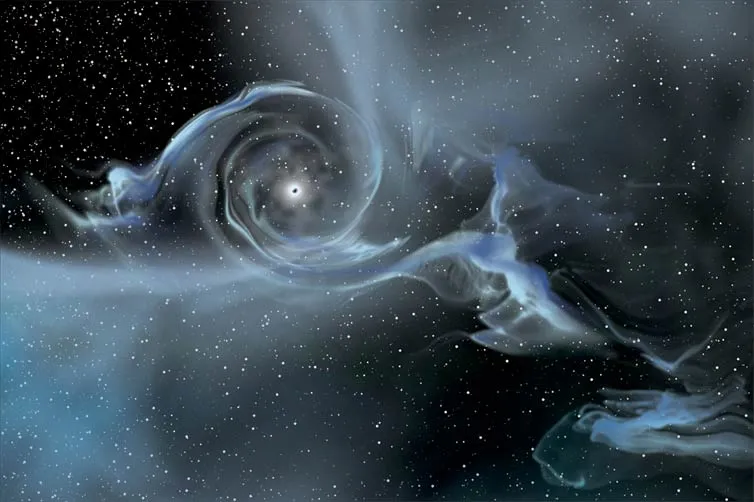
A singularity occurs when some property of a "thing" is infinite, and so the laws of physics as we know them break down. At the center of black holes lies a point that is infinitely teensy and dense (packed with a finite amount of matter) — a point called a singularity. In mathematics, singularities come up all the time — dividing by zero is one instance, and a vertical line on a coordinate plane has an "infinite" slope. In fact, the slope of a vertical line is just undefined. But what would a singularity look like? And how would it interact with the rest of the universe? What does it mean to say that something has no real surface and is infinitely small?
A "naked" singularity is one that can interact with the rest of the universe. Black holes have event horizons — spherical regions from which nothing, not even light, can escape. At first glance, you might think the problem of naked singularities is partly solved for black holes at least, since nothing can get out of the event horizon and the singularity can't affect the rest of the universe. (It is "clothed," so to speak, while a naked singularity is a black hole without an event horizon.)
But whether singularities can form without an event horizon is still an open question. And if they can exist, then Albert Einstein's theory of general relativity will need a revision, because it breaks down when systems are too close to a singularity. Naked singularities might also function as wormholes, which would also be time machines — though there's no evidence for this in nature.
Violating charge-parity symmetry

If you swap a particle with its antimatter sibling, the laws of physics should remain the same. So, for example, the positively charged proton should look the same as a negatively charged antiproton. That's the principle of charge symmetry. If you swap left and right, again, the laws of physics should look the same. That's parity symmetry. Together, the two are called CP symmetry. Most of the time, this physics rule is not violated. However, certain exotic particles violate this symmetry. McNees said that's why it's strange. "There shouldn't be any violations of CP in quantum mechanics," he said. "We don't know why that is."
When sound waves make light

Though particle-physics questions account for many unsolved problems, some mysteries can be observed on a bench-top lab setup. Sonoluminescence is one of those. If you take some water and hit it with sound waves, bubbles will form. Those bubbles are low-pressure regions surrounded by high pressure; the outer pressure pushes in on the lower-pressure air, and the bubbles quickly collapse. When those bubbles collapse, they emit light, in flashes that last trillionths of a second.
The problem is, it's far from clear what the source of the light is. Theories range from tiny nuclear fusion reactions to some type of electrical discharge, or even compression heating of the gases inside the bubbles. Physicists have measured high temperatures inside these bubbles, on the order of tens of thousands of degrees Fahrenheit, and taken numerous pictures of the light they produce. But there's no good explanation of how sound waves create these lights in a bubble.
What lies beyond the Standard Model?

The Standard Model is one of the most successful physical theories ever devised. It's been standing up to experiments to test it for four decades, and new experiments keep showing that it is correct. The Standard Model describes the behavior of the particles that make up everything around us, as well as explaining why, for example, particles have mass. In fact, the discovery of the Higgs boson — a particle that gives matter its mass — in 2012 was a historic milestone because it confirmed the long-standing prediction of its existence.
But the Standard Model doesn't explain everything. The Standard Model has made many successful predictions — for example, the Higgs boson, the W and Z boson (which mediate the weak interactions that govern radioactivity), and quarks among them — so it is difficult to see where physics might go beyond it. That said, most physicists agree that the Standard Model is not complete. There are several contenders for new, more complete models — string theory is one such model — but so far, none of these have been conclusively verified by experiments.
Fundamental constants

Dimensionless constants are numbers that don't have units attached to them. The speed of light, for example, is a fundamental constant measured in units of meters per second (or 186,282 miles per second). Unlike the speed of light, dimensionless constants have no units and they can be measured, but they can't be derived from theories, whereas constants like the speed of light can be.
In his book "Just Six Numbers: The Deep Forces That Shape the Universe" (Basic Books, 2001), astronomer Martin Rees focuses on certain "dimensionless constants" he considers fundamental to physics. In fact, there are many more than six; about 25 exist in the Standard Model. [The 9 Most Massive Numbers in Existence]
For example, the fine structure constant, usually written as alpha, governs the strength of magnetic interactions. It is about 0.007297. What makes this number odd is that if it were any different, stable matter wouldn't exist. Another is the ratio of the masses of many fundamental particles, such as electrons and quarks, to the Planck mass (which is 1.22 ´1019 GeV/c2). Physicists would love to figure out why those particular numbers have the values they do, because if they were very different, the universe's physical laws wouldn't allow for humans to be here. And yet there's still no compelling theoretical explanation for why they have those values.
What the heck is gravity, anyway?

What is gravity, anyway? Other forces are mediated by particles. Electromagnetism, for example, is the exchange of photons. The weak nuclear force is carried by W and Z bosons, and gluons carry the strong nuclear force that holds atomic nuclei together. McNees said all of the other forces can be quantized, meaning they could be expressed as individual particles and have noncontinuous values.
Gravity doesn't seem to be like that. Most physical theories say it should be carried by a hypothetical massless particle called a graviton. The problem is, nobody has found gravitons yet, and it's not clear that any particle detector that could be built could see them, because if gravitons interact with matter, they do it very, very rarely — so seldom that they'd be invisible against the background noise. It isn't even clear that gravitons are massless, though if they have a mass at all, it's very, very small — smaller than that of neutrinos, which are among the lightest particles known. String theory posits that gravitons (and other particles) are closed loops of energy, but the mathematical work hasn't yielded much insight so far.
Because gravitons haven't been observed yet, gravity has resisted attempts to understand it in the way we understand other forces – as an exchange of particles. Some physicists, notably Theodor Kaluza and Oskar Klein, posited that gravity may be operating as a particle in extra dimensions beyond the three of space (length, width, and height) and one of time (duration)we are familiar with, but whether that is true is still unknown.
Do we live in a false vacuum?

The universe seems relatively stable. After all, it's been around for about 13.8 billion years. But what if the whole thing were a massive accident?
It all starts with the Higgs and the universe's vacuum. Vacuum, or empty space, should be the lowest possible energy state, because there's nothing in it. Meanwhile, the Higgs boson — via the so-called Higgs field — gives everything its mass. Writing in the journal Physics, Alexander Kusenko, a professor of physics and astronomy at the University of California, Los Angeles, said the energy state of the vacuum can be calculated from the potential energy of the Higgs field and the masses of the Higgs and top quark (a fundamental particle).
So far, those calculations appear to show that the universe's vacuum might not be in the lowest possible energy state. That would mean it's a false vacuum. If that's true, our universe might not be stable, because a false vacuum can be knocked into a lower energy state by a sufficiently violent and high-energy event. If that were to happen, there would be a phenomenon called bubble nucleation. A sphere of lower-energy vacuum would start growing at the speed of light. Nothing, not even matter itself, would survive. Effectively, we'd be replacing the universe with another one, which might have very different physical laws. [5 Reasons We May Live in a Multiverse]
That sounds scary, but given that the universe is still here, clearly there hasn't been such an event yet, and astronomers have seen gamma-ray bursts, supernovas, and quasars, all of which are pretty energetic. So it's probably unlikely enough that we wouldn't need to worry. That said, the idea of a false vacuum means that our universe might have popped into existence in just that way, when a previous universe's false vacuum was knocked into a lower energy state. Perhaps we were the result of an accident with a particle accelerator.
Editor's note: This list was originally published in 2012. It was updated on Feb. 27, 2017, to include newer information and recent studies.

Natalie Wolchover was a staff writer for Live Science from 2010 to 2012 and is currently a senior physics writer and editor for Quanta Magazine. She holds a bachelor's degree in physics from Tufts University and has studied physics at the University of California, Berkeley. Along with the staff of Quanta, Wolchover won the 2022 Pulitzer Prize for explanatory writing for her work on the building of the James Webb Space Telescope. Her work has also appeared in the The Best American Science and Nature Writing and The Best Writing on Mathematics, Nature, The New Yorker and Popular Science. She was the 2016 winner of the Evert Clark/Seth Payne Award, an annual prize for young science journalists, as well as the winner of the 2017 Science Communication Award for the American Institute of Physics.