













50 million tons of water vapor from Tonga's eruption could warm Earth for years
The explosive event increased atmospheric water vapor by 5%.

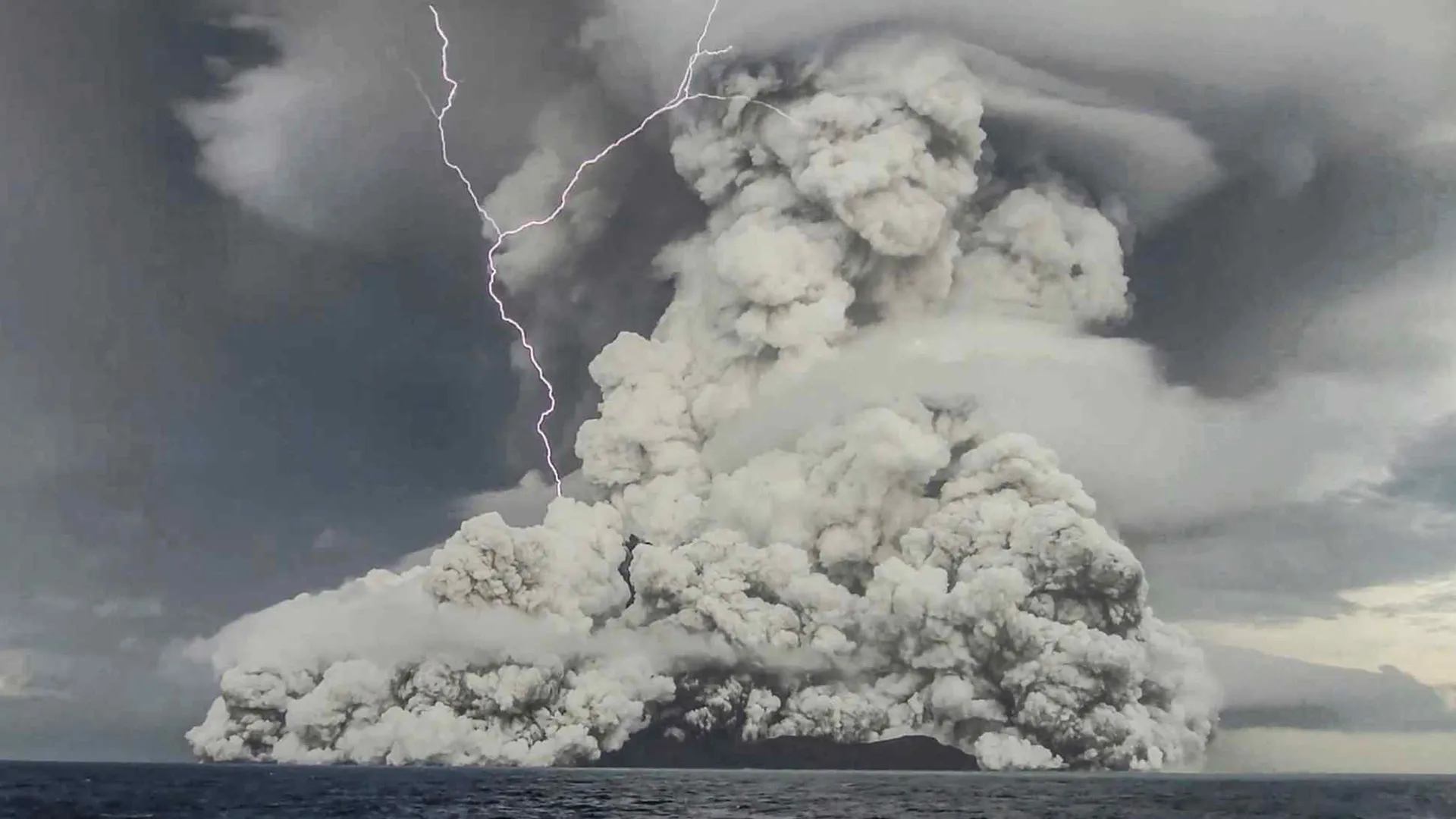
More than eight months after the underwater volcano near Tonga erupted on Jan. 14, scientists are still analyzing the impacts of the violent blast, and they're discovering that it could warm the planet.
Recently, researchers calculated that the eruption of Hunga Tonga-Hunga Ha'apa spewed a staggering 50 million tons (45 million metric tons) of water vapor into the atmosphere, in addition to enormous quantities of ash and volcanic gases. This massive vapor injection increased the amount of moisture in the global stratosphere by about 5%, and could trigger a cycle of stratospheric cooling and surface heating — and these effects may persist for months to come, according to a new study.
Tonga's eruption, which began on Jan. 13 and peaked two days later, was the most powerful witnessed on Earth in decades. The blast extended for 162 miles (260 kilometers) and sent pillars of ash, steam and gas soaring more than 12 miles (20 km) into the air, according to the National Oceanic and Atmospheric Administration (NOAA).
Big volcanic eruptions typically cool down the planet by belching sulfur dioxide into the upper layers of Earth's atmosphere, which filters solar radiation. Particles of rock and ash can also temporarily cool the planet by blocking sunlight, according to the National Science Foundation's University Corporation for Atmospheric Research. In this way, widespread and violent volcanic activity in Earth's distant past may have contributed to global climate change, triggering mass extinctions millions of years ago.
Related: Huge Tonga underwater volcano eruption captured in stunning satellite video
Recent eruptions have also demonstrated volcanoes' planet-cooling powers. In 1991, when Mount Pinatubo in the Philippines blew its top, aerosols spewed by this mighty volcanic blast lowered global temperatures by about 0.9 degrees Fahrenheit (0.5 degrees Celsius) for at least one year, Live Science previously reported.
Tonga expelled approximately 441,000 tons (400,000 metric tons) of sulfur dioxide, about 2% of the amount spewed by Mount Pinatubo during the 1991 eruption. But unlike Pinatubo (and most big volcanic eruptions, which happen on land), underwater Tonga's volcanic plumes sent "substantial amounts of water" into the stratosphere, the zone that extends from around 31 miles (50 km) above Earth's surface down to around 4 to 12 miles (6 to 20 km), according to the National Weather Service (NWS).
Get the world’s most fascinating discoveries delivered straight to your inbox.
In underwater volcanoes, "submarine eruptions can draw large parts of their explosive energy from the interaction of water and hot magma," which propels huge quantities of water and steam into the eruption column, scientists wrote in a new study published Sept. 22 in the journal Science. Within 24 hours after the eruption, the plume extended over 17 miles (28 km) into the atmosphere.
The researchers analyzed the amount of water in the plumes by evaluating data gathered by instruments called radiosondes, which were attached to weather balloons and sent aloft into the volcanic plumes. As these instruments rise through the atmosphere, their sensors measure temperature, air pressure and relative humidity, transmitting that data to a receiver on the ground, according to the NWS.
RELATED STORIES
Atmospheric water vapor absorbs solar radiation and re-emits it as heat; with tens of millions of tons of Tonga's moisture now adrift in the stratosphere, Earth's surface will be heating up — though it's unclear by how much, according to the study. But because the vapor is lighter than other volcanic aerosols and is less affected by gravity's pull, it will take longer for this warming effect to dissipate, and surface warming could continue "over the months to come," the scientists said.
Prior research into the eruption found that Tonga ejected enough water vapor to fill 58,000 Olympic-size swimming pools, and that this prodigious amount of atmospheric moisture could potentially weaken the ozone layer, Live Science previously reported.
In the new study, the scientists also determined that these enormous quantities of water vapor could indeed modify chemical cycles that control stratospheric ozone, "however, detailed studies will be required to quantify the effect on the amount of ozone because other chemical reactions may play a role as well."
Originally published on Live Science.

Mindy Weisberger is a science journalist and author of "Rise of the Zombie Bugs: The Surprising Science of Parasitic Mind-Control" (Hopkins Press). She formerly edited for Scholastic and was a channel editor and senior writer for Live Science. She has reported on general science, covering climate change, paleontology, biology and space. Mindy studied film at Columbia University; prior to LS, she produced, wrote and directed media for the American Museum of Natural History in NYC. Her videos about dinosaurs, astrophysics, biodiversity and evolution appear in museums and science centers worldwide, earning awards such as the CINE Golden Eagle and the Communicator Award of Excellence. Her writing has also appeared in Scientific American, The Washington Post, How It Works Magazine and CNN.