














How Small Volcanic Eruptions Can Affect Global Climate

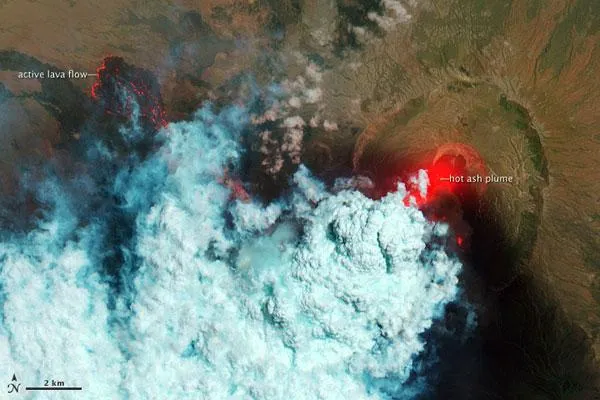
Even small volcanic eruptions could have a big impact on global climate, new research suggests.
A relatively small eruption in the summer of 2011 produced gases such as sulfur dioxide that reached high in the atmosphere and spread throughout the Northern Hemisphere, combining with water vapor and forming particles that reflect light and prevent it from reaching Earth, thus potentially resulting in a cooling effect, according to a study detailed in the July 6 issue of the journal Science.
Previously, only larger, explosive volcanoes — such as the 1991 eruption of Mount Pinatubo — were thought capable of lofting gases into the stratosphere, the layer of Earth's atmosphere that sits above the troposphere, the layer that we dwell in and where most weather occurs. The material spewed out by Pinatubo reduced global temperatures by about 0.9 degrees Fahrenheit (0.5 degrees Celsius) during the following year.
Right time and place
Gases and particles emitted at lower altitudes below the stratosphere are typically quickly cleared out by rain and weather, said study co-author Alan Robock, a researcher at Rutgers University in New Brunswick, N.J. But this is not in the case concerning the eruption of the Nabro Volcano in Eritrea, in northeast Africa, on June 13, 2011. Warm rising air from last summer's Asian monsoon appears to have had the opposite effect: It gave the volcanic fumes a little boost and allowed gases to reach the stratosphere, where they last longer, Robock told OurAmazingPlanet.
"We've shown for the first time that volcanoes don't have to have enough power to pump the gases into the stratosphere directly during the eruption," Robock said. But this wouldn't necessarily be the case for every small eruption; it would take something of a "perfect storm" combination of weather patterns meeting an eruption.
"It has to be at the right time at the right place," Robock said.
Get the world’s most fascinating discoveries delivered straight to your inbox.
Overlooked eruptions
Researchers came to their conclusions by measuring the concentrations of volcanic gases emitted by eruptions using a satellite capable of looking sideways into different layers of the atmosphere and quantifying how much light was reflected, said study author Adam Bourassa, a researcher at the University of Saskatchewan in Canada.
A single eruption of this size will not likely have a measurable effect on climate, but repeated eruptions of this size certainly could, said Hans Graf, a scientist at the University of Cambridge in England who wasn't involved in the research. This study shows that repeated small eruptions should be taken into account when studying past climate variability, he said.
Robock said he believes the effects from this and other small eruptions over the past decade may have tempered the warming of the planet. [Video: Earth's Warming Since 1880]
The researchers calculated that Nabro emitted 1.4 million tons (1.3 billion kilograms) of sulfur dioxide, the largest release since Pinatubo, which spewed more than 10 times that amount, Robock said. But it wasn't a very explosive eruption, and because at first it didn't look like the gases reached the stratosphere, researchers "kind of forgot about it," he said.
Reach Douglas Main at [email protected]. Follow him on Twitter @Douglas_Main. Follow OurAmazingPlanet on Twitter @OAPlanet. We're also on Facebook and Google+.
