














Volcanic Eruptions Alter Rainfall Across Broad Swath of Planet

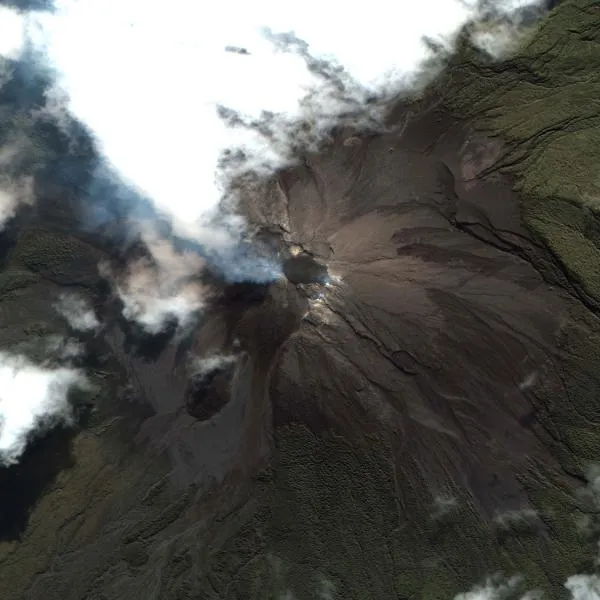
Powerful volcanic eruptions are capable of changing rainfall patterns over large portions of the Earth, soaking some areas while depriving others of essential rain, according to newly emerging data.
Tree-ring researchers at Columbia University's Lamont-Doherty Earth Observatory showed that big eruptions tend to dry up much of central Asia but bring more rain to Southeast Asian countries including Vietnam, Laos, Cambodia, Thailand and Myanmar.
The finding was something of a surprise, since many previous climate models predicted the opposite effect.
The growth rings of some tree species can be correlated with rainfall, and the observatory's Tree Ring Lab used rings from some 300 sites across Asia to measure the effects of 54 eruptions going back about 800 years.
"Volcanoes can be important players in climate over time," said Columbia's Kevin Anchukaitis, lead author of a study now appearing online in the journal Geophysical Research Letters. "We might think of the study of the solid earth and the atmosphere as two different things, but really everything in the system is interconnected."
A mysterious pattern emerges
Large, explosive eruptions fill the atmosphere with tiny sulfate particles that deflect solar radiation. The resulting cooling on Earth's surface can last months or years, sometimes bringing on a "volcanic winter." Some scientists suspect that extended volcanic winters contributed to the demise of the dinosaurs and the Neanderthals.
Get the world’s most fascinating discoveries delivered straight to your inbox.
As for rainfall, in the simplest models, cooler temperatures decrease evaporation of surface water, and less water vapor translates to less rain. But matters are greatly complicated by atmospheric circulation patterns, cyclic changes in temperatures over the oceans, and the shapes of land masses.
Up to now, most climate models incorporating known forces predicted that volcanic explosions would disrupt the monsoon by bringing less rain to Southeast Asia. The tree-ring researchers found the opposite.
"The data only recently became available to test the models," said Rosanne D'Arrigo, one of the study's co-authors.
The researchers studied the effects of notable eruptions in the past centuries. The eruptions or explosions of Peru's Huaynaputina volcano in 1600-1601, Indonesia's Mount Tambora in 1815, Indonesia's Krakatoa in 1883, Mexico's El Chichón in 1982, and the Philippines' Pinatubo in 1991 all produced demonstrable shifts in rainfall. (The largest volcanic explosion of the millennium is thought to be one in 1258, but its exact location remains mysterious.)
The tree rings showed that huge swaths of southern China, Mongolia and surrounding areas consistently dried up in the year or two following big events, while the mainland of Southeast Asia got increased rain. The researchers say many factors are possible and it would be speculative at this point to say exactly why weather patterns work this way.
"It's obvious there's a lot of work to be done to understand how all these different forces interact," D'Arrigo said.
Dangerous interactions
Anchukaitis said that if atmospheric dynamics phenomena such as the El Niño cycle, a global climate pattern that affects everything from ocean temperature to rainfall and volcanic eruptions come together with the right timing, they could reinforce one another, with drastic results for rainfall patterns in Asia.
"Then you get flooding or drought, and neither flooding nor drought is good for the people living in those regions," he said.
The study also raises questions of whether a "geoengineering" scheme to counteract man-made climate change through the huge releases of particulate, in an attempt to mimic volcanic eruptions might have complex unintended consequences.
Ultimately, said Anchukaitis, such studies should help scientists refine models of how natural and man-made forces might act together to shift weather patterns a vital question for all areas of the world.
