
-
 Planet Nine candidate detected deep in our solar system
Researchers have found a candidate for the hypothetical Planet Nine, which could be an undiscovered giant planet way out in our solar system. However, as with all ninth planet research, the new findings were met with some skepticism.
22 Commentsplanets -
 How many planets are in the universe?
We currently know of more than 5,800 planets beyond the solar system, but we've only found the tiniest fraction of the exoplanets that astronomers think lie elsewhere in the universe.
space -
 Jupiter: Facts about the biggest planet in our solar system
Discover interesting facts about Jupiter, its many moons, and whether the gas giant and its moons could host extraterrestrial life
jupiter -
 Solar wind might be making water on the moon, groundbreaking NASA study reveals
Lunar samples show evidence that solar wind could be behind the water molecules on the moon's surface, according to NASA. The results could shine a light on how water ice collects in cold traps formed by patches of permanent darkness at the moon's poles.
astronomy -
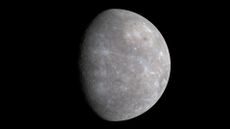 Mercury is weird because of a 'hit-and-run' incident in its youth
"What surprised us, at the end, was how effective this type of impact could be in explaining Mercury's unusual structure without needing to consider multiple collisions or extremely rare conditions."
2 Commentsmercury -
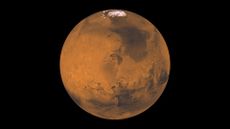 Mars: Facts about the Red Planet, its moons, and possibilities for life
Discover interesting facts about Mars, its moons, its atmosphere, and the possibilities of life.
mars -
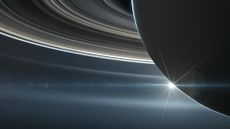 Saturn gains 128 new moons, giving it more than the rest of the solar system combined
Faint signatures detected by the Canada France Hawaii Telescope have revealed 128 new moons around Saturn, making it the indisputable frontrunner for having the most moons in our solar system.
planets -
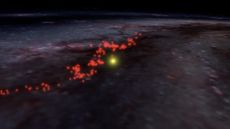 A giant extraterrestrial 'wave' hit Earth 14 million years ago — and may have dramatically altered our planet's climate
Our solar system's journey around the center of the Milky Way takes it through varying galactic environments, and one may have had a lasting impact on Earth's climate, according to a new study.
4 Commentsastronomy -
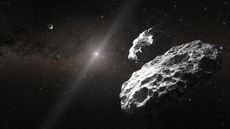 Astronomers identify a celestial '3-body problem' lurking in the outer solar system
New research suggests that a binary pair of Kuiper Belt objects, known as the Altjira system, is actually made up of three separate bodies orbiting one another in a complex triad. This rare orbital configuration is often referred to as the "three-body problem."
astronomy


