
-
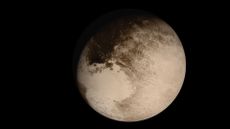 Why is Pluto not considered a planet?
Pluto was demoted from a planet to a dwarf planet in 2006. So why is its status still so controversial today?
planets -
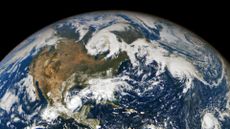 How old is planet Earth?
How old is Earth? Our planet's age is known from a variety of sources, from rocks on our own planet to ones from the moon.
planets -
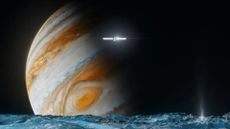 Why NASA is sending the Europa Clipper to search for aliens near Jupiter
In the coming weeks, NASA's Europa Clipper will take off on a long journey to Jupiter's moon Europa. The icy moon could potentially host alien life — and there's only one way to find out.
space-exploration -
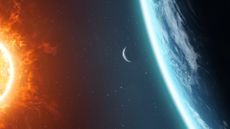 How far away is the moon?
The moon's distance from Earth changes depending on where it is in its elliptical orbit.
the-moon -
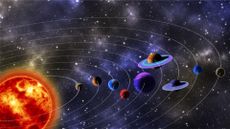 Why is everything in space always moving?
From the moment of the Big Bang, everything in the universe has kept moving, but why is that?
space -
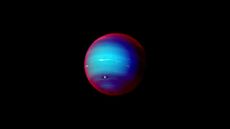 Space photo of the week: 1st-ever close-up of Neptune is Voyager 2's final portrait of a planet
Voyager 2, NASA's longest-running mission, explored Neptune during a historic encounter on Aug. 25, 1989, sending back humanity's first close-ups of the planet.
neptune -
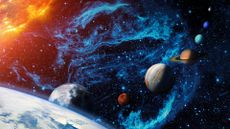 What is the coldest place in the solar system?
What is the solar system's coldest spot and how does the coldest place on Earth compare?
space -
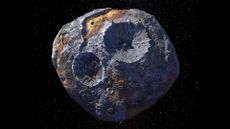 $100,000 quadrillion asteroid Psyche may be rusting, James Webb telescope reveals
A new James Webb Space Telescope analysis of the giant, metal-rich asteroid Psyche reveals signs of hydration in the form of rust. This could help pin down the mysterious rock's origins.
asteroids -
 Over 350 asteroids have hidden moons, Gaia space telescope finds
The European Space Agency's Gaia space telescope has found evidence of more than 350 previously unknown moons orbiting asteroids within our solar system.
asteroids


