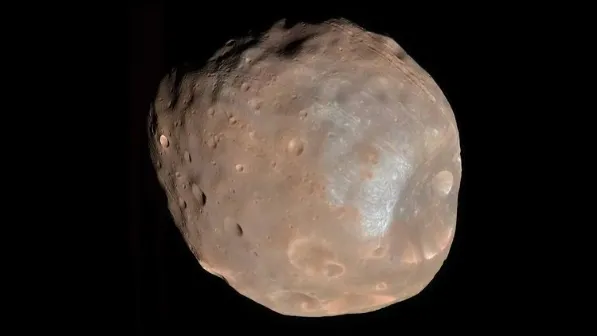
'Space potato' spotted by NASA Mars satellite is actually something much cooler
The starchy-looking moon Phobos, destined to crash into Mars' surface, has been revealed in new detail by NASA's Mars Reconnaissance Orbiter. The 'space potato' image was recently shared on NASA's Instagram.
Get the world’s most fascinating discoveries delivered straight to your inbox.
You are now subscribed
Your newsletter sign-up was successful
Want to add more newsletters?
Delivered Daily
Daily Newsletter
Sign up for the latest discoveries, groundbreaking research and fascinating breakthroughs that impact you and the wider world direct to your inbox.
Once a week
Life's Little Mysteries
Feed your curiosity with an exclusive mystery every week, solved with science and delivered direct to your inbox before it's seen anywhere else.
Once a week
How It Works
Sign up to our free science & technology newsletter for your weekly fix of fascinating articles, quick quizzes, amazing images, and more
Delivered daily
Space.com Newsletter
Breaking space news, the latest updates on rocket launches, skywatching events and more!
Once a month
Watch This Space
Sign up to our monthly entertainment newsletter to keep up with all our coverage of the latest sci-fi and space movies, tv shows, games and books.
Once a week
Night Sky This Week
Discover this week's must-see night sky events, moon phases, and stunning astrophotos. Sign up for our skywatching newsletter and explore the universe with us!
Join the club
Get full access to premium articles, exclusive features and a growing list of member rewards.
NASA has posted a stunning photo of a "space potato" on social media — but it is actually Phobos, the Martian moon that is locked on a slow collision course with the Red Planet.
The space agency imaged the lumpy, starchy-looking moon using the High Resolution Imaging Science Experiment (HiRISE) camera on board NASA's Mars Reconnaissance Orbiter, which has been studying the Red Planet since arriving in its orbit in 2006.
Phobos, named after the Greek god of fear, is roughly 157 times smaller than Earth's moon and is one of Mars' two natural satellites, alongside the even smaller Deimos, whose name comes from the Greek god of dread.
Scientists believe that the brother moons were once roaming rocks and were snared into Mars' orbit by the planet's gravitational field. A recent image analysis of Phobos' craggy yet highly reflective surface suggested the moon was once a comet and came from the asteroid belt located between the Red Planet and Jupiter.
Related: Hundreds of black 'spiders' spotted in mysterious 'Inca City' on Mars in new satellite photos
The two moons' orbits are unstable, and scientists predict that in tens of millions of years Deimos will spin out into space while Phobos will either break up into a ring or slam into the Martian surface.
However, with Phobos drifting only 6 feet (1.8 meters) closer to Mars every hundred years, our solar system's space potato is unlikely to be mashed for another 50 million years, according to NASA.
Get the world’s most fascinating discoveries delivered straight to your inbox.
That leaves us with plenty of time to study and admire the starchy celestial body, whose characteristic features include streaks of white ice and the Stickney Crater — a 6-mile (10 kilometers) indent named after Chloe Angeline Stickney Hall, the mathematician and wife of the two moons' discoverer Asaph Hall, who first oberved them in 1877.


Ben Turner is a U.K. based writer and editor at Live Science. He covers physics and astronomy, tech and climate change. He graduated from University College London with a degree in particle physics before training as a journalist. When he's not writing, Ben enjoys reading literature, playing the guitar and embarrassing himself with chess.