Get the world’s most fascinating discoveries delivered straight to your inbox.
You are now subscribed
Your newsletter sign-up was successful
Want to add more newsletters?
Join the club
Get full access to premium articles, exclusive features and a growing list of member rewards.
An account already exists for this email address, please log in.
Over 350 asteroids have hidden moons, Gaia space telescope finds
The European Space Agency's Gaia space telescope has found evidence of more than 350 previously unknown moons orbiting asteroids within our solar system.
This image shows many looping and overlapping orbits circling the sun, all of different colors (to differentiate between asteroids). The centre of the image – representing an area within the orbit of Jupiter – is very densely packed with orbits, while the outer edges remain clearer, showing the background plane of the Milky Way.
The European Space Agency's (ESA) Gaia space telescope has already proven itself invaluable in tracking billions of stars in the Milky Way, but now it has proved its worth with much smaller bodies, much closer to home.
The Gaia mission has spotted potential moons orbiting over 350 asteroids that were previously predicted to be singletons. Gaia had already been investigating known asteroid binaries, confirming they have companions, but this breakthrough shows the star surveyor is capable of conducting "blind searches" for completely new asteroid-moon partnerships.
If the new observations are confirmed, these 352 binaries will almost double the number of known binary asteroid systems in the solar system.
"Binary asteroids are difficult to find as they are mostly so small and far away from us," Luana Liberato, leader of the team behind the discovery and researcher at the Observatoire de la Côte d’Azur, said in a statement. "Despite us expecting just under one-sixth of asteroids to have a companion, so far, we have only found 500 of the one billion known asteroids to be in binary systems.
"But this discovery shows that there are many asteroid moons out there just waiting to be found."
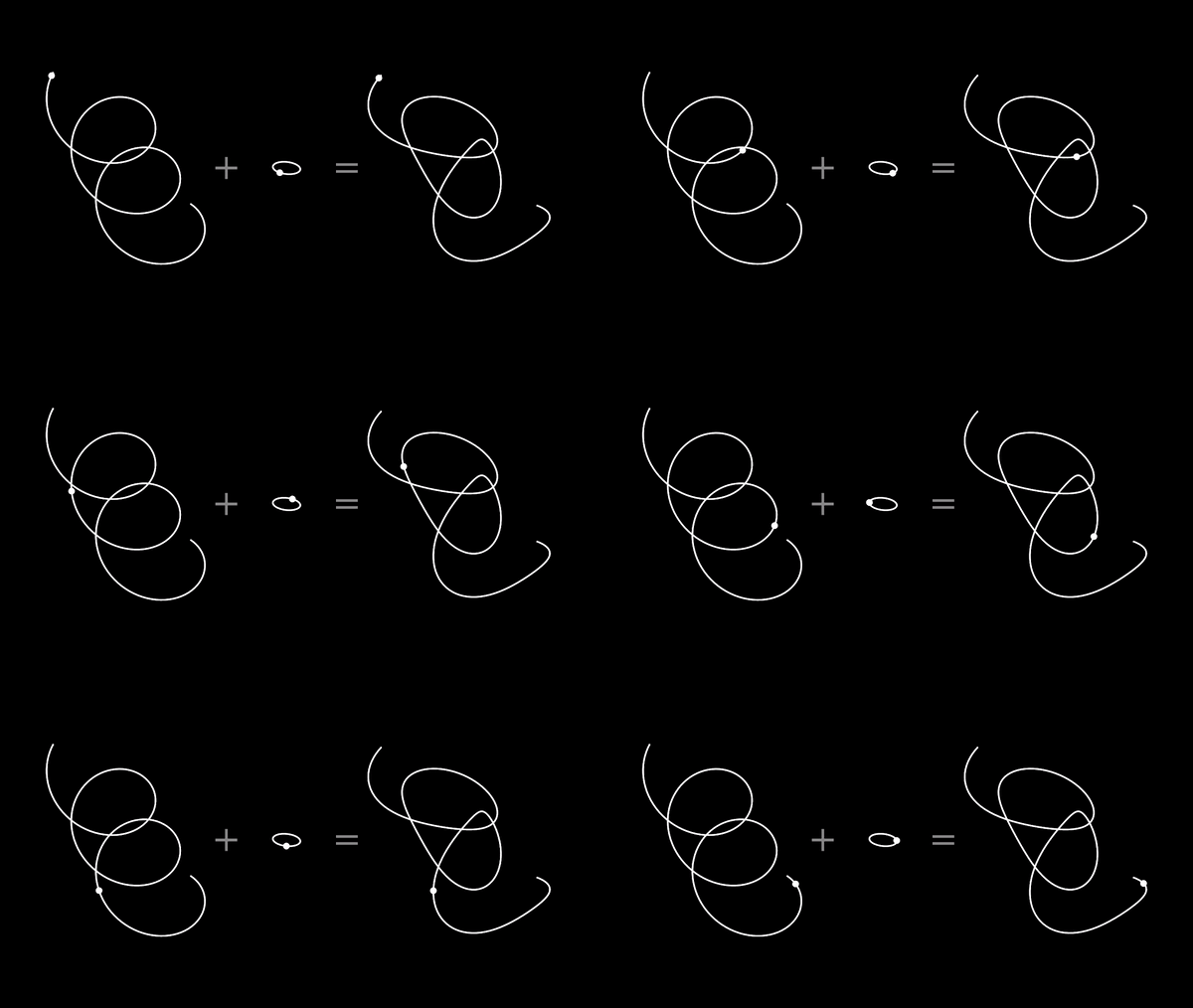
A diagram showing how the Gaia space telescope spotted moons around hundreds of asteroids.
(Image credit: ESA)
Asteroids are the remains of the material that first formed the sun and then birthed the planets of the solar system over 4.6 billion years ago. They are mainly located in the main asteroid belt between Mars and Jupiter, thus receiving little radiation from the sun, which means this early solar system material is mostly "unspoiled" in asteroids.
Sign up for the Live Science daily newsletter now
Get the world’s most fascinating discoveries delivered straight to your inbox.
Thus, by studying asteroids, astronomers get a better picture of what the solar system was like billions of years ago. Additionally, many scientists believe that water and other complex organic molecules, vital ingredients for life, were delivered to Earth by asteroid bombardment.
Studying asteroids could reveal if this theory is correct. But studying binary asteroids, in particular, could reveal even more than this about the infancy of our planetary system.
Studying asteroids could reveal if this theory is correct. But studying binary asteroids, in particular, could reveal even more than this about the infancy of our planetary system.
The early solar system was a turbulent and violent place in which collisions between rocky bodies were extremely common. Binary asteroids can reveal how these collisions proceeded and what happens when rocky bodies interact in the solar system.
A simulation shows the possible paths of moons around their asteroids
(Image credit: ESA)
Gaia has been making important discoveries about asteroids ever since it began scanning our cosmic backyard and the wider Milky Way in 2013. In Gaia's Data Release 3 (DR3), however, the ESA satellite surpassed itself, determining the orbits of over 156,000 asteroids. But it's not all about quantity; the Gaia data has impressive quality, too.
This data was estimated to be 20 times more precise as part of Gaia's Focused Product Release. This meant that Liberato and colleagues were able to observe tiny "wobbles" in the orbit of asteroids that indicate they have a hidden moon companion gravitationally tugging on them.
Image showing the orbits of the more than 150 000 asteroids in Gaia's data release 3, from the inner parts of the solar system to the Trojan asteroids at the distance of Jupiter, with different color codes. The yellow circle at the center represents the sun. Blue represents the inner part of the solar system, where the Near Earth Asteroids, Mars crossers, and terrestrial planets are. The Main Belt, between Mars and Jupter, is green. Jupiter trojans are red.
(Image credit: ESA/Gaia/DPAC; CC BY-SA 3.0 IGO)
"Gaia has proven to be an outstanding asteroid explorer and is hard at work revealing the secrets of the cosmos both within and beyond the solar system," Timo Prusti, Project Scientist for Gaia at ESA, said. "This finding highlights how each Gaia data release is a major step up in data quality and demonstrates the amazing new science made possible by the mission."
Excitingly, the fourth release of data from Gaia, DR4 currently set for mid-2026, will contain even more asteroid orbit data. This promises the discovery of even more asteroid-moon partnerships.
However, Gaia isn't the only ESA mission that investigates binary asteroids.
This October, the space agency will launch Hera, a mission set to investigate the asteroid Didymos and its tiny moon Dimorphos.
If those names sound familiar, that's because Dimorphos was the space rock that NASA slammed with the Double Asteroid Redirection Test (DART) in Sept. 2022. The aim of this was to test if a kinetic impact on an asteroid moon could shift it and its parent body from a collision course with Earth.
Hera will conduct a deep investigation of Dart's impact and its aftereffects to gauge the viability of this method for planetary defense efforts.
Robert Lea is a science journalist in the U.K. who specializes in science, space, physics, astronomy, astrophysics, cosmology, quantum mechanics and technology. Rob's articles have been published in Physics World, New Scientist, Astronomy Magazine, All About Space and ZME Science. He also writes about science communication for Elsevier and the European Journal of Physics. Rob holds a bachelor of science degree in physics and astronomy from the U.K.’s Open University