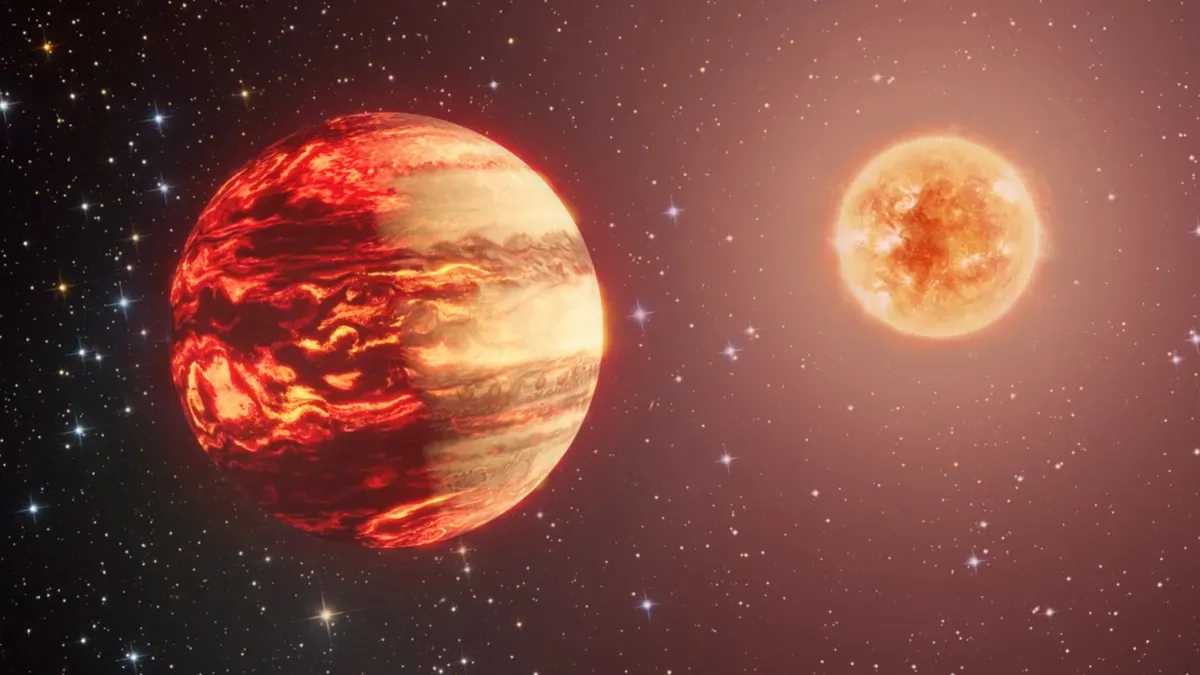
Scientists have directly imaged eight dim objects accompanying very bright stars within the Gaia data catalog, including so-called "failed stars," otherwise known as brown dwarfs.
The stars and their companions were originally identified from millions of stars in the Gaia catalog. They were considered ideal for follow-up investigations with the ground-based GRAVITY instrument, an advanced near-infrared interferometer located at the Very Large Telescope (VLT) on the peak of Cerro Paranal in Chile. By combining infrared light from multiple telescopes, a process called interferometry, GRAVITY has already achieved the first direct observation of an extrasolar planet, or "exoplanet."
Following up on Gaia observations, GRAVITY directly spotted light signals from companions around the eight bright stars, seven of which were theorized objects, undiscovered until now.
Three of the companion objects are small and faint stars, and the other five are brown dwarfs. The latter form like stars and have more mass than gas giant planets, but don't have enough mass to trigger the fusion of hydrogen to helium in their cores like main-sequence stars do. That's where their nickname "failed stars" comes from.
One of the brown dwarfs spotted by GRAVITY orbits its parent star at a distance about equal to the distance between Earth and the sun. This marks the first time one of these failed stars has been directly seen so close to its host star. "We have demonstrated that it is possible to capture an image of a faint companion, even when it orbits very close to its bright host," team leader and European Southern Observatory (ESO) scientist Thomas Winterhalder said in a statement. "This achievement highlights the remarkable synergy between Gaia and GRAVITY. Only Gaia can identify such tight systems hosting a star and a 'hidden' companion, and then GRAVITY can take over to image the smaller and fainter object with unprecedented accuracy."
A firefly on a lighthouse
Directly observing dim objects like small, faint stars or brown dwarfs around bright stars is no mean feat. In fact, spotting their light signals is akin to seeing the light of a firefly sitting on a shining lighthouse. Understandably, any attempt to image the firefly's light is washed out by the brighter light of the lighthouse, and the same is true for bright stars and their dim companions.
Sign up for the Live Science daily newsletter now
Get the world’s most fascinating discoveries delivered straight to your inbox.
While Gaia can't directly spot the dim companions of these stars, the space telescope was able to infer their presence. This is because when a brown dwarf, or small star in general, orbits a larger, brighter star, its gravity tugs on the parent star and this causes a "wobble" in the larger, brighter star's motion.
As that star "wobbles" away from Earth (and Gaia), the wavelength of light stretches, shifting it toward the red end of the electromagnetic spectrum. Conversely, when it wobbles toward Earth, the wavelengths of light are shortened, shifting the light toward the blue end of the electromagnetic spectrum.
This redshift and blueshift effect is analogous to the Doppler shift, the phenomenon that affects soundwaves on Earth. For instance, as an ambulance races toward you with its siren blaring, the soundwaves are compressed, and the siren is higher pitched, akin to blueshift. As the ambulance passes you, the wavelengths of sound stretch out, and the siren is low-pitched, just like the redshift of the light from the star as it moves away.
An illustration showing the Doppler effect. As the ambulance speeds away from the pedestrian the sound is stretched and is low frequency. As it approaches the soundwaves are compressed and the siren is high-frequency
(Image credit: Robert Lea (created with Canva))
This redshift and blueshift effect is tiny, but Gaia is sensitive enough to spot it. The small companions of these stars in the Gaia sample lie at tiny separation angles from their bright stellar parents of a few dozen milliarcseconds, which is about the size of a quarter viewed from a distance of around 62 miles (100 kilometers) away.
"In our observations, Gaia data act as a kind of signpost," Thomas explained. "The part of the sky that we can see with GRAVITY is very small, so we need to know where to look. Gaia's unparalleled precise measurements of the movements and positions of stars are essential to point our instrument to the right direction in the sky."
The collaboration of Gaia and GRAVITY helped the team go beyond the mere detection of these companions. The two datasets also enabled the team to separate out the masses of the stars and the masses of the companions. Additionally, measuring the differences in wavelengths of light from the stars and their companion bodies, as well as combining this information with those aforementioned mass estimates, allowed the team to infer the ages of the companions.
This revealed that the brown dwarfs were less luminous than expected at the observed ages and masses, which implies these bodies themselves could be orbited by another smaller and even dimmer companion, maybe even elusive exomoons.
The power of the Gaia-GRAVITY tag team means scientists could soon use these two instruments to image smaller companions around bright stars, namely exoplanets.
"The ability to tease out the tiny motions of close-by pairs in the sky is unique to the Gaia mission. The next catalog, to be made available as part of the fourth data release (DR4), will contain an even richer collection of stars with potentially smaller companions," European Space Agency (ESA) Gaia scientist Johannes Sahlmann said. "This result breaks new ground in the hunt for planets in our galaxy and promises us glimpses of new distant worlds."
The team's research was published on June 10 in the journal Astronomy and Astrophysics.
Robert Lea is a science journalist in the U.K. who specializes in science, space, physics, astronomy, astrophysics, cosmology, quantum mechanics and technology. Rob's articles have been published in Physics World, New Scientist, Astronomy Magazine, All About Space and ZME Science. He also writes about science communication for Elsevier and the European Journal of Physics. Rob holds a bachelor of science degree in physics and astronomy from the U.K.’s Open University