













Astronomers want to change how we define a planet — again
Astronomers are proposing a new, more quantitative definition of what makes a planet. The new definition looks more directly at the object's mass — but it would still leave Pluto out of the running.

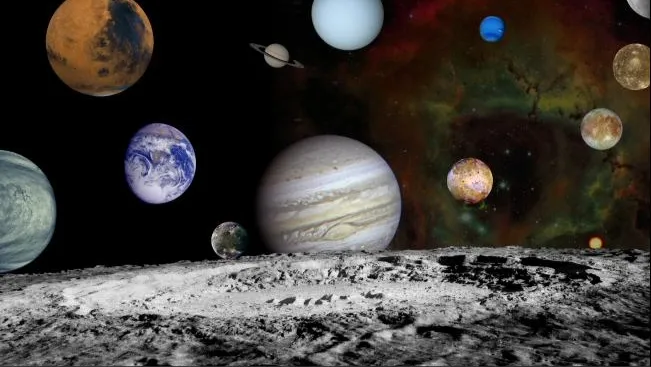
Astronomers are proposing a new definition of a planet, nearly two decades after a previous such change led to Pluto's demotion. The new definition would add measurable criteria, including considerations of the planet's mass — and it would still leave Pluto with its dwarf planet status.
Currently, the International Astronomical Union (IAU) defines a planet as a celestial body with three characteristics: It orbits the sun, it's big enough for gravity to mold it into a roundish shape, and it has cleared away any smaller objects, other than moons and other satellites, surrounding its orbit.
"The problem in the past was, you had a word 'planet' but you didn't have a quantitative definition of it," Brett Gladman, an astronomer at the University of British Columbia who, along with colleagues, proposed the new definition, told Live Science. The proposal was outlined in a paper published July 17 in The Planetary Science Journal and is scheduled to be presented at the IAU General Assembly in August.
Without a quantitative point of reference, the current definition runs into many issues, Gladman said. Namely, the criteria are vague; it's unclear how large these bodies need to be, or "how clear" their orbits should be, to be considered planets. For example, Earth and Jupiter have asteroids that regularly cross their paths, raising the question of whether the planets truly have clear orbital paths. The current definition also fails to consider objects that orbit stars other than the sun, such as the more than 5,500 exoplanets that have been detected beyond our solar system.
But "the most problematic by far is the roundness criterion," Jean-Luc Margot, an astronomer at UCLA and lead author of the paper, told Live Science. "Roundness is simply not observable. We do not have the technology, and we will not have the technology anytime soon."
Related: Enormous planet discovered around tiny star could break our understanding of solar system formation
Instead of focusing on the planets' roundness and orbital paths, the new definition emphasizes a measurable quantity: the object's mass. This new definition describes a planet as a celestial object that meets the following criteria:
Get the world’s most fascinating discoveries delivered straight to your inbox.
To ensure that their classification framework would be logical and unbiased, the scientists used a method called unsupervised clustering, an algorithm that groups similar objects. This technique also successfully grouped the eight planets in the solar system.
"No matter how many criticisms you can lodge at the current IAU definition, you can at least be satisfied that the outcome, the eight planets, is the reasonable classification," he said.
The astronomers argued that the ability to clear the orbital paths, known as dynamical dominance, can be determined by the planet's mass. Only objects of a sufficiently high mass, including the eight planets (Mercury, Venus, Earth, Mars, Jupiter, Saturn, Uranus and Neptune), are capable of dynamical dominance.
The dynamical dominance also sets a lower mass limit on what qualifies as a planet. However, Pluto, which has a mass of only 2.88 x 10^22 pounds (1.31 x 10^22 kg), will still not qualify as a planet under the new definition.
With regard to roundness, the mass of a celestial object larger than 10^21 kg is typically spherical due to gravitational pull. In this way, the new definition does not really contradict the current definition but rather adds specificity to it, Margot said.
RELATED STORIES
"Humans are very tied to language and names and classification, because that's how we think about the world," Gladman added. "That's how we sort out the complexity of the world. We want to give names to things and put them in classes. And scientists want to do that, too. We just want to do it precisely."
There is always a possibility of pushback. Margot will present the proposal at the IAU General Assembly in August, but he is not expecting a consensus to be made then. Instead, he hopes that through the presentation, the team will identify individuals who are interested in the idea and continue the discussion.
The proposal was written out of "conviction that we can do better as a community," Margot said. "We owe it to ourselves and to the public to come up with better definitions for these important astrophysical terms."
Editor's note: This article was updated on July 18 to correct information regarding the masses of the eight planets compared to dwarf planets. We have also added a link to the peer-reviewed version of the study, published July 17.

Kristel is a science writer based in the U.S. with a doctorate in chemistry from the University of New South Wales, Australia. She holds a master's degree in science communication from the University of California, Santa Cruz. Her work has appeared in Drug Discovery News, Science, Eos and Mongabay, among other outlets. She received the 2022 Eric and Wendy Schmidt Awards for Excellence in Science Communications.