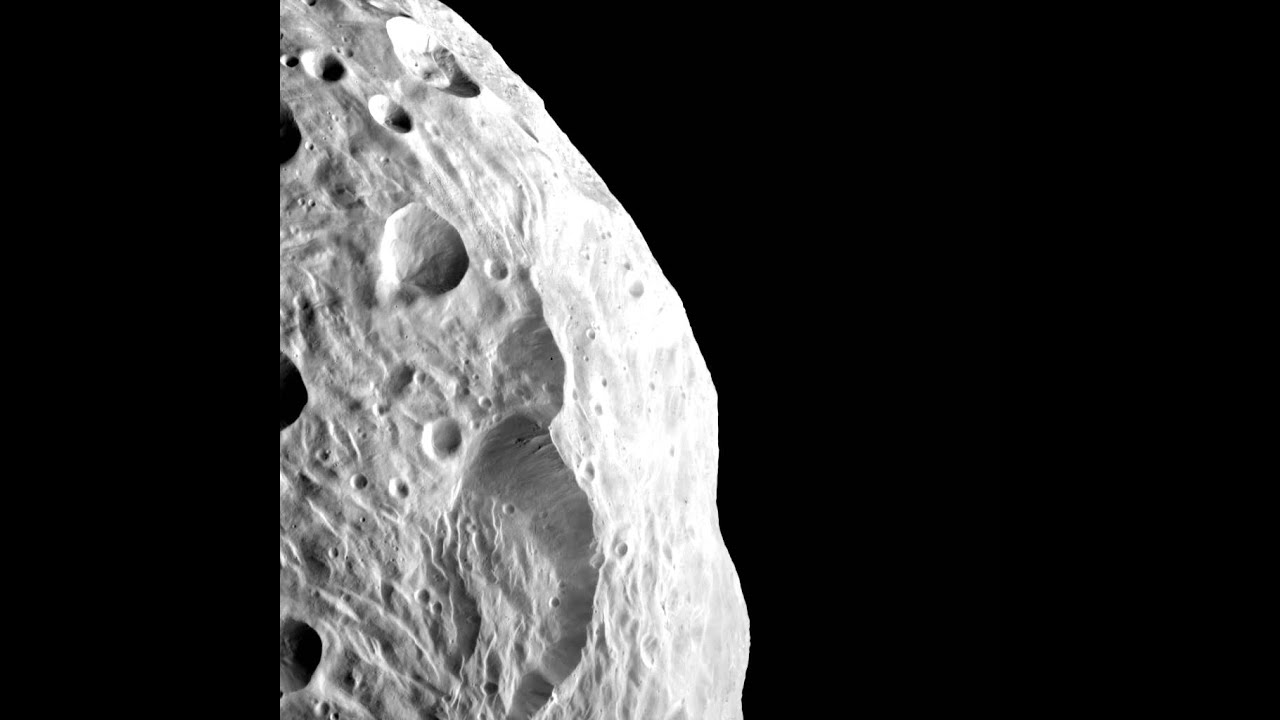
For decades, scientists thought that Vesta was a protoplanet rather than an asteroid. NASA's Dawn mission seemed to confirm that, but new research is calling it into question.
As the second-largest object in the main asteroid belt, Vesta attracts a healthy amount of scientific interest. While smaller asteroids in the belt are considered fragments of collisions, scientists think Vesta and the other three large objects in the belt are likely primordial and have survived for billions of years. They believe that Vesta was on its way to becoming a planet and that the Solar System's rocky planets likely began as protoplanets just like it. But new research is casting doubt on that conclusion.
One of the defining features of rocky planets is differentiation. They have a core, a mantle, and a crust that form when the planet is molten. During this molten phase, material separates by density, with heavier elements sinking to the center. This explains why Earth has a dense iron and nickel core, while the crust features ample oxygen and silica.
For a long time, scientists believed this was true of Vesta. The idea that Vesta had a core, mantle, and crust was widely accepted. New research based on data from NASA's Dawn mission suggests that the body is more uniform than thought.
"Our findings show Vesta's history is far more complex than previously believed, shaped by unique processes like interrupted planetary differentation and late-stage collisions." - Ryan Park, NASA/JPL
Dawn visited Vesta for 14 months beginning in July 2011, before continuing its mission by visiting Ceres. By visiting these protoplanets, the mission hoped to understand conditions in the very early Solar System. It measured the abundances of rock-forming elements like oxygen, magnesium, aluminum, silicon, calcium, titanium, and iron.
Sign up for the Live Science daily newsletter now
Get the world’s most fascinating discoveries delivered straight to your inbox.
This artist's illustration shows Dawn approaching Vesta, with its telltale ion engine.
(Image credit: Northrop Grumman)
Vesta is approximately 525 km in diameter, and initial research based on Dawn's data showed that it had an iron-rich core. A 2012 paper said its "average core size (equivalent spherical core size) has a radius of 107 to 113 km." The same paper also explained that "Dawn's exploration has confirmed that Vesta is a surviving protoplanet ... that appears to have accreted early and differentiated, forming an iron core that may have sustained a magnetic dynamo."
This new research contradicts that conclusion.
"Vesta's large-scale interior structure had previously been constrained primarily using the gravity and shape data from the Dawn mission," Park and co-authors write in their paper. "However, these data alone still allow a wide range of possibilities for the differentiation state of the body."
The authors explain that the moment of inertia is critical in determining Vesta's interior. The moment of inertia is a foundational idea in physics that measures how an object resists rotation. As an object rotates on its axis, different parts of the object are at various distances from the axis. When measuring Vesta's moment of inertia, scientists are measuring how mass is distributed from the core to the surface.
This new research presents an updated measurement of Vesta's moment of inertia, which indicates that the body is not as differentiated as thought and may not have a well-defined core. The new data "suggests that Vesta's interior has limited density stratification beneath its howardite—eucrite—diogenite-dominated crust," the authors write. They found that Vesta's mantle density is higher than thought, and there's only a limited contrast between the density of the mantle and the core. Effectively, this means there's no core, or at most, a very small one.
Example image sequence of Vesta from Dawn spacecraft - YouTube
Paper co-author Seth Jacobson, an Assistant Professor in Earth and Environmental Sciences at Michigan State University, said in a press release, "The lack of a core was very surprising. It's a really different way of thinking about Vesta."
This casts doubt on Vesta's true nature. The researchers propose two hypotheses to explain the object's nature.
The first is that Vesta was on its way to becoming fully differentiated, but the process stalled. It started to melt and differentiation began, but it cooled before completion. Vesta's surface is covered in basaltic lava rock, indicating it went through a melting process leading to some differentiation. That's in contrast to most asteroids, which have more gravel-like surfaces.
In this scenario, "Vesta's interior did not undergo full differentiation due to late accretion," the authors write in their paper.
The second is that Vesta is a broken-off chunk of a growing planet in the Solar System. Jacobson suggested this idea at a conference in the past because he wanted other researchers to consider the idea that some meteorites are pieces of debris from collisions during the era of planet formation in the Solar System.
"This idea went from a somewhat silly suggestion to a hypothesis that we're now taking seriously due to this re-analysis of NASA Dawn mission data," Jacobson said.
As time passed since the Dawn mission data was collected, scientists improved the data's calibration. Lead author Park, co-author Jacobson, and the other co-authors decided to reevaluate and reprocess Vesta's measurements.
"For years, conflicting gravity data from Dawn's observations of Vesta created puzzles," Park said. "After nearly a decade of refining our calibration and processing techniques, we achieved remarkable alignment between Dawn's Deep Space Network radiometric data and onboard imaging data. We were thrilled to confirm the data's strength in revealing Vesta's deep interior. Our findings show Vesta's history is far more complex than previously believed, shaped by unique processes like interrupted planetary differentiation and late-stage collisions."
It's unclear which hypothesis is accurate; only more research can solve the puzzle. Some of the uncertainty comes from a type of meteorite called HED meteorites that scientists think came from Vesta, which doesn't seem to have undergone incomplete differentiation. "We're really confident these meteorites came from Vesta," Jacobson said. "And these don't show obvious evidence of incomplete differentiation."
The alternate hypothesis that Vesta is a chunk of a differentiated planet from early in the Solar System is also unproven. Scientists think collisions were plentiful in the Solar System as the rocky planets formed, allowing material to accrete into larger and larger bodies. But not always. Some of the collisions could've broken off chunks from still-forming planets that were still undergoing differentiation. "Vesta could be the ejecta product of a catastrophic impact event on a differentiated precursor body," the paper states.
While the researchers can't prove anything concretely at this point, they've introduced doubt into previously comfortable ideas. The established idea that Vesta is a planetary core that never grew very large has been turned on its head.
"No longer is the Vesta meteorite collection a sample of a body in space that failed to make it as a planet," Jacobson said in a press release. "These could be pieces of an ancient planet before it grew to full completion. We just don't know which planet that is yet."
Evan Gough is a science communicator who organizes and produce content that helps readers discover the fascinating planet, solar system, galaxy and universe we inhabit. He cover everything from the scientific triumphs of Mars rovers, to getting humans back to the Moon, to the mysterious nature of black holes.
You must confirm your public display name before commenting
Please logout and then login again, you will then be prompted to enter your display name.