A rare lunar meteorite that fell to Earth holds evidence of a previously unknown "impact event" that rocked the moon roughly 3.5 billion years ago, researchers say. Studying this ancient impact provides fresh insight into how the solar system was behaving in those early days — about the same time life on Earth began to appear.
In the new study, scientists looked at a lunar meteorite found in northwest Africa. The meteorite, called NWA 12593, contains information about three separate lunar impacts, but the researchers focused on the earliest of these crashes, the team reported in the journal Geology.
"On Earth, the first fossil evidence of life shows up around 3.5 billion years ago, meaning that life is emerging and evolving before then, " Carolyn Crow, first author of the study and a planetary scientist at the University of Colorado Boulder, said in a statement. "The question that we often have, even going back further, is what was the impact record when life was emerging? It is important for understanding how life is taking hold… The cadence of these catastrophic events is an important part of the equation."
In the study, the scientists used radiometric dating on the meteorite. This method charts the decay rate of radioactive materials in the sample, allowing the team to estimate the first impact at 3.5 billion years ago — roughly 1 billion years after the solar system formed.
The meteorite contained cubic zirconia, best known on Earth for its resemblance to diamond. But in the ancient meteorite, this material tells a different story: that the moon's surface became molten through the impact, because cubic zirconia forms only at extremely high temperatures. While the material dissipates at the ultracold temperatures found on the moon, the scientists found its presence through traces of its recrystallized products.
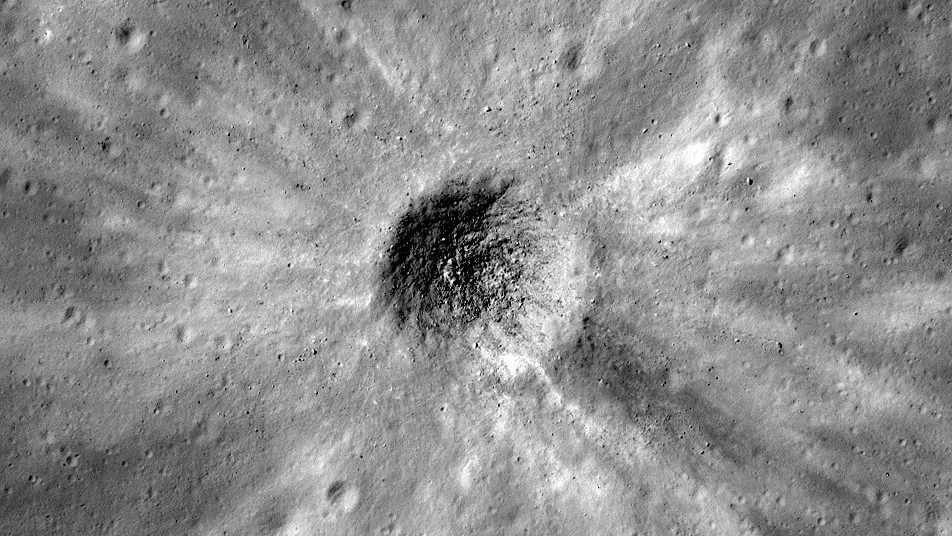
A large lunar impact crater snapped by NASA’s Lunar Reconnaissance Orbiter.
(Image credit: NASA/GSFC/Arizona State University)
The impact occurred at roughly the same time as other huge impacts, both on Earth and on a very large asteroid called Vesta, that have been identified in independent research. To find three impacts on three different worlds so long ago is rare, because erosion and other processes tend to erase the evidence.
"It's not very common, which is why we're very excited about it," Crow said. "It's pretty rare to have all three records line up like this." The team expects that making deeper comparisons between the impacts will show more about how the solar system was changing 3.5 billion years ago, as the number of asteroids in the neighborhood diminished along with impacts.
Sign up for the Live Science daily newsletter now
Get the world’s most fascinating discoveries delivered straight to your inbox.
Scientists often say the early solar system was a collection of gas and dust that gradually grew into smaller, comet-like and asteroid-like bodies. Over time, a subset of those bodies got even larger (through collisions and accretions) to become today's planets and moons.
The other two impacts on the meteorite were a breccia (rock melt) formed after the big collision 3.5 billion years ago and a third collision that sent the meteorite blasting off the moon and into an Earthbound trajectory.
Article Sources
Crow, C. A., Erickson, T. M., Economos, R., Lehman-Franco, K., Boyce, J. W., Richards, A. M., Diaz, C. A., Flowers, R. M., Brounce, M., Schoene, B., & Benowitz, J. A. (2026). Three-body evidence of ca. 3.7 Ga to 3.2 Ga bombardment across the inner solar system. Geology. https://doi.org/10.1130/g54386.1
How much do you know about the moon? Test your lunar smarts with our moon quiz!
Elizabeth Howell was staff reporter at Space.com between 2022 and 2024 and a regular contributor to Live Science and Space.com between 2012 and 2022. Elizabeth's reporting includes multiple exclusives with the White House, speaking several times with the International Space Station, witnessing five human spaceflight launches on two continents, flying parabolic, working inside a spacesuit, and participating in a simulated Mars mission. Her latest book, "Why Am I Taller?" (ECW Press, 2022) is co-written with astronaut Dave Williams.
You must confirm your public display name before commenting
Please logout and then login again, you will then be prompted to enter your display name.