Get the world’s most fascinating discoveries delivered straight to your inbox.
You are now subscribed
Your newsletter sign-up was successful
Want to add more newsletters?
Join the club
Get full access to premium articles, exclusive features and a growing list of member rewards.
An account already exists for this email address, please log in.
Farting comet seen reversing its spin for the first time ever — and it may soon 'self-destruct'
A new analysis of archival Hubble Space Telescope photos reveals that a peculiar comet slowed its spin before fully reversing its rotational direction via "outgassing" during a flyby of Earth in 2017.
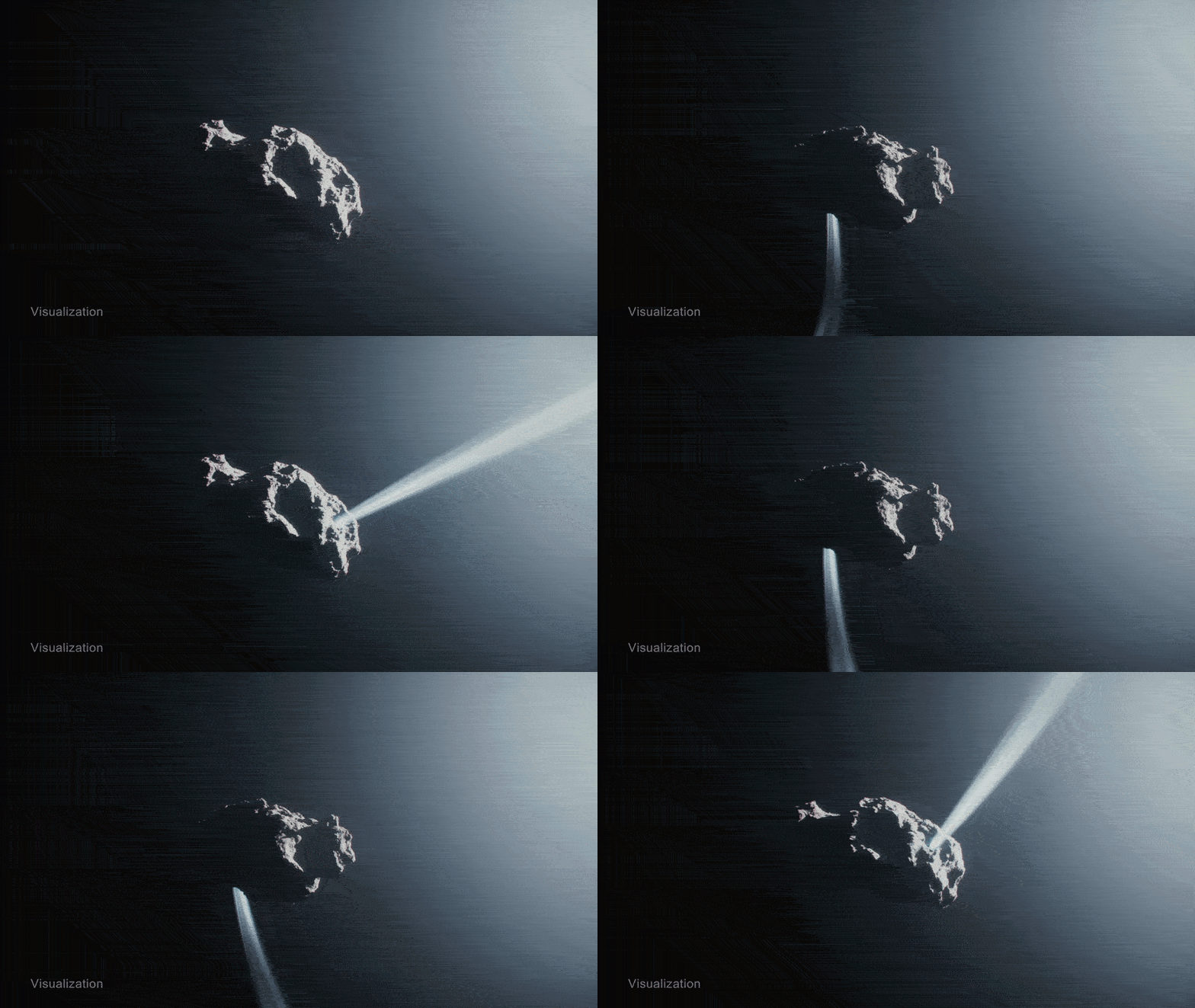
Archival images from the Hubble Space Telescope have revealed a comet that mysteriously reversed its spin during a close flyby of Earth in 2017. This artist's illustration shows how a giant "outgassing" jet that may have caused this unusual behavior.
(Image credit: NASA, ESA, CSA, Ralf Crawford (STScI))
For the first time ever, an astronomer has witnessed a comet changing the speed and direction of its own spin, thanks to newly analyzed Hubble Space Telescope photos. The unexpected reversal was triggered by "outgassing" jets that shot an icy mix of gas and dust into the solar system, according to a new study.
The comet, dubbed 41P Tuttle-Giacobini-Kresák (41P for short), was discovered by American astronomer Horace Parnell Tuttle in 1858, before being rediscovered by French astronomer Michel Giacobini in 1907 and again by Slovak scientist L'ubor Kresák in 1951 (hence its lengthy name). Comet 41P likely originates from the Kuiper Belt — the ring of asteroids, comets and dwarf planets beyond the orbit of Neptune — and likely spent the majority of its long life circling the sun on a timescale of decades to centuries.
But around 1,500 years ago, 41P was tugged off its usual course by a close interaction with Jupiter. Now, it is locked in a much tighter orbit, circling our home star every 5.4 years. As the comet reaches its closest point to the sun, known as perihelion, it also passes by Earth and becomes clearly visible with a telescope. Its last flyby of the sun occurred in 2022, but it was also studied extensively in 2001, 2006, 2011 and 2017.
During the 2017 flyby, astronomers noticed that 41P's rate of rotation slowed significantly as the comet shot past Earth — which scientists had previously attributed to a standard outgassing event. Hubble also captured extensive photos of the flyby. However, these images were filed away and had not been studied properly.
Now, in the new study published March 26 in The Astronomical Journal, an astronomer has analyzed the Hubble images from 2017 and discovered that the sudden slowdown was followed by a previously unrecognized acceleration event.
41P orbits the sun every 5.4 years and spends this time slowly drifting between the orbits of Jupiter and Earth.
By comparing the Hubble images to data collected by ground-based telescopes, study author David Jewitt, an astronomer at UCLA, estimated the changes in 41P's rotation throughout 2017. He found that by May of that year, the comet's spin had slowed to around one rotation every 46 to 60 hours, which was around three times slower than it was spinning in March 2017. But by December 2017, the comet was completing a rotation once every 14 hours, which was a much quicker return to form than previously realized, according to Live Science's sister site Space.com.
But if outgassing had slowed the comet's spin, how could it speed it up again so quickly? The only thing that makes sense, Jewitt argues, is if the direction of the comet's spin was completely reversed.
Sign up for the Live Science daily newsletter now
Get the world’s most fascinating discoveries delivered straight to your inbox.
"It's like pushing a merry-go-round," he said in a statement. "If it's turning in one direction, and then you push against that, you can slow it and reverse it."
With the Hubble data, Jewitt also constrained the true size of 41P's nucleus, which is approximately 0.6 miles (1 kilometer) across — around three times wider than Paris' Eiffel Tower is tall. That might sound impressive, but it is actually quite small for a comet. And its diminutive size may prove key in explaining its unusual behavior.
41P become bright enough to be seen with a telescope during its flybys of Earth. In this photo, the comet, which is giving off a green glow, can be seen alongside stars , nebulae and distant galaxies during its 207 flyby.
(Image credit: Kees Scherer/Wikimedia)
Passing gas
Almost all known comets have been observed "outgassing" at some point in their lifetimes. This phenomenon occurs when ice, gas and dust from the comet's interior shoots out of small cracks that appear in its nucleus — normally due to an increased proximity to the sun, which allows solar radiation to sublimate the comet's innards and crack its icy shell.
This animation shows how a single massive jet of outflowing gas could have slowed, stopped and then reversed the spin of Comet 41P.
(Image credit: NASA, ESA, CSA, Ralf Crawford (STScI))
Scientists previously knew that outgassing could alter the spin of a comet, but most of these objects are too large for an outflowing jet to make much of a difference before it fades away. However, 41P's relatively small size likely enabled the comet's jets to make a greater impact.
"Jets of gas streaming off the surface can act like small thrusters," Jewitt said in the statement. "If those jets are unevenly distributed, they can dramatically change how a comet, especially a small one, rotates."
Experts are unsure if 41P's extreme outgassing event was caused by multiple jets or a single massive outflow. But if repeated events occur over the comet's next few perihelia, the icy ball could end up ripping itself apart, similar to Comet C/2025 K1 (ATLAS), which spectacularly broke apart in late 2025.
"I expect this nucleus [41P] will very quickly self-destruct," Jewitt said.
Harry is a U.K.-based senior staff writer at Live Science. He studied marine biology at the University of Exeter before training to become a journalist. He covers a wide range of topics including space exploration, planetary science, space weather, climate change, animal behavior and paleontology. His recent work on the solar maximum won "best space submission" at the 2024 Aerospace Media Awards and was shortlisted in the "top scoop" category at the NCTJ Awards for Excellence in 2023. He also writes Live Science's weekly Earth from space series.
You must confirm your public display name before commenting
Please logout and then login again, you will then be prompted to enter your display name.