Get the world’s most fascinating discoveries delivered straight to your inbox.
You are now subscribed
Your newsletter sign-up was successful
Want to add more newsletters?
Join the club
Get full access to premium articles, exclusive features and a growing list of member rewards.
An account already exists for this email address, please log in.
'RIP, Comet MAPS': Watch the superbright sungrazer become a 'headless wonder' after being ripped apart by the sun
New images show the sungrazer comet C/2026 A1 (MAPS) did not survive its close approach to our home star. Instead, the celestial object briefly turned into a "headless wonder" before fully disintegrating.
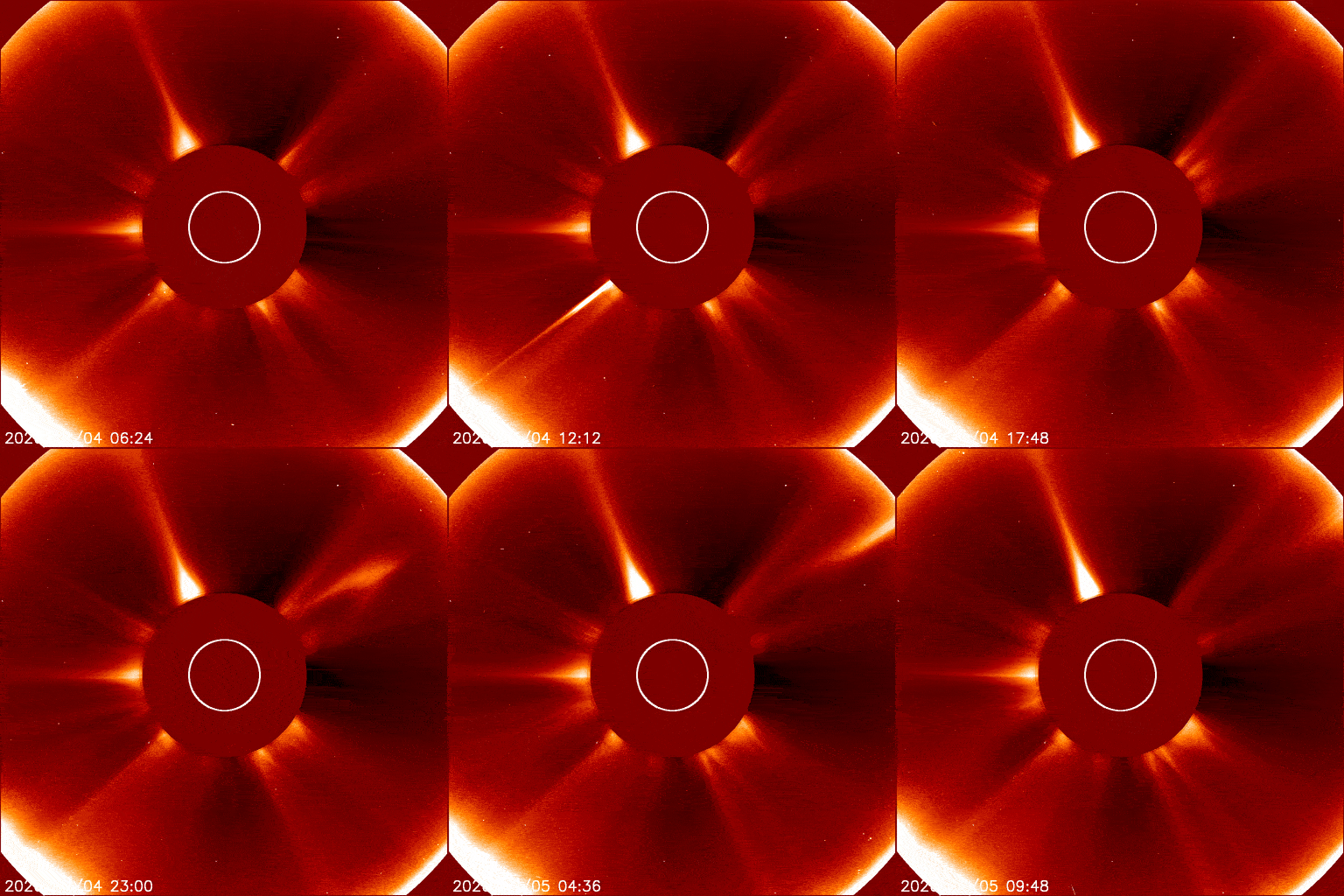
A highly anticipated "sungrazer" comet is no more. Many experts expected the comet to shine so brightly that it could be seen in the daytime sky. Instead, the unfortunate object was ripped apart by a superclose "death dive" with our home star, which briefly transformed it into a "headless wonder" — a comet with no body, just a ghostly tail — stunning footage reveals.
The comet, dubbed C/2026 A1 (MAPS), was a member of the Kreutz sungrazers — a group of comets, likely leftover fragments from a massive exploded comet, that pass extremely close around the sun. Scientists discovered the comet in January and initially believed it was around 1.5 miles (2.4 kilometers) wide, but subsequent photos captured by the James Webb Space Telescope revealed that it was only around 0.25 miles (0.4 km) across.
For months, experts have been guessing how bright comet MAPS might become if it survived its solar slingshot. Most agreed that it would put on a spectacular show, like other previous sungrazer comets, such as comet Lovejoy, which lit up the night sky in 2011. Others even speculated that it could become so bright that it would become visible to the naked eye during the day.
On Saturday (April 4), comet MAPS reached its closest point to the sun, or perihelion, where it dipped into the sun's outer atmosphere, or corona, at a distance of just 100,000 miles (160,000 km) from the solar surface — around half the distance between Earth and the moon. The close encounter was not visible to astrophotographers, thanks to the comet's close proximity to our home star. But several space-based observatories captured the solar flyby.
It quickly became clear that comet MAPS did not survive its solar slingshot. Time-lapse images captured by the Solar and Heliospheric Observatory (SOHO) show the bright comet streaking toward the sun and then emerging from the obscured solar disk as a plume of dust and gas — essentially, nothing but a tail.
Comet MAPS reached its closest point to the sun, or perihelion, on April 4 and came within 100,000 miles (160,000 km) of the solar surface.
The comet was likely destroyed by the intense thermal stress placed on its icy shell, or nucleus, as well as the high gravitational forces on the comet as it traveled at around 1 million mph (1.6 million km/h), according to Spaceweather.com.
"The comet went in, but only a cloud of debris came out," Spaceweather.com representatives wrote about the SOHO video footage. "RIP, comet MAPS."
Sign up for the Live Science daily newsletter now
Get the world’s most fascinating discoveries delivered straight to your inbox.
The debris trails left over from comet MAPS, known as striae, briefly shone as a headless wonder. However, the debris quickly scattered, and there is now nothing left to see of comet MAPS, Live Science's sister site Space.com reported.
Experts had hoped comet MAPS would put on a spectacular post-perihelion display, similar to Comet Lovejoy (photographed) in 2011.
(Image credit: Alan Dyer /VW PICS/Universal Images Group via Getty Images)
Luckily, comet MAPS is not the only highly anticipated comet that could be visible in April.
Later this month, another comet, C/2025 R3 (PanSTARRS), will shine brightly as it reaches its perihelion on April 19. But unlike comet MAPS, this object will pass much farther from the sun — around 46.4 million miles (74.6 million km) — making it a much more reliable target for skywatchers armed with a decent telescope or a pair of stargazing binoculars. The best time to see it will be a few days before its close approach to the sun, when the new moon guarantees a dark sky.
Several experts previously predicted that comet PanSTARRS could be the "Great Comet of 2026." And given the death of comet MAPS, this suggestion now seems more likely to be correct.
Harry is a U.K.-based senior staff writer at Live Science. He studied marine biology at the University of Exeter before training to become a journalist. He covers a wide range of topics including space exploration, planetary science, space weather, climate change, animal behavior and paleontology. His recent work on the solar maximum won "best space submission" at the 2024 Aerospace Media Awards and was shortlisted in the "top scoop" category at the NCTJ Awards for Excellence in 2023. He also writes Live Science's weekly Earth from space series.
You must confirm your public display name before commenting
Please logout and then login again, you will then be prompted to enter your display name.