














US Representatives worry Trump's NASA budget plan will make it harder to track dangerous asteroids
During a House Committee on Space, Science and Technology hearing, experts discussed the state of NASA's planetary defense capabilities.


On Thursday (May 15), the U.S. House Committee on Space, Science and Technology convened with scientists to discuss a rather exciting topic: What can NASA do if we identify a dangerous asteroid on a collision course with Earth? It was an especially prudent subject given all the recent fuss about asteroid 2024 YR4, which had a notable chance of hitting our planet before scientists refined its position and deemed it harmless.
Most of Thursday's conversation surrounded the agency's highly anticipated Near-Earth Object (NEO) Surveyor mission, which should greatly improve hazardous asteroid detection capabilities as a whole. However, there were also many efforts to address the elephant in the room: the Trump administration's recently announced intention to slash NASA's top-line funding by 24% for the upcoming fiscal year. The proposed cut to the agency's science programs — which includes its planetary defense work — is even deeper, at 47%.
Outlined in the White House's "skinny budget proposal," as it's called, the top-line reduction would be the "largest single-year cut to NASA in American history."
"If enacted, the Trump administration's skinny budget proposal risks putting NASA on a path to irrelevance," Rep. Valerie Foushee (D-North Carolina) said during the hearing. "It threatens our economic and national security, surrenders U.S. leadership and space to our adversaries, and jeopardizes our competitiveness and standing on the world stage. That's a strategic posture I simply cannot accept."
What is NEO Surveyor?
The NEO Surveyor mission is the first space telescope that'll be dedicated to locating asteroids that could threaten Earth, NASA says. It's the agency's next big step in upping the nation's planetary defense game, which was really brought to the forefront for the public in 2022 with the DART mission.
Related: 'Planet killer' asteroids are hiding in the sun's glare. Can we stop them in time?
DART, which stands for Double Asteroid Redirection Test, sent a spacecraft to smash into an asteroid called Dimorpohos. Dimorphos orbits a larger asteroid, called Didymos. Neither threatened us, to be clear, as this was just a proof-of-concept mission. The goal was to see whether this impact would adjust Dimorphos' trajectory around Didymos; if so, it would suggest that a spacecraft can one day be sent to an actually threatening asteroid to knock it off a potential collision course with Earth. DART worked beautifully, but it could use a little help.
Get the world’s most fascinating discoveries delivered straight to your inbox.
NEO Surveyor is more of a prophylactic measure for planetary defense. It'll be the thing that spots the asteroid we may want to smash a future DART craft into.
"We do not know of any sizable object that has a significant risk of impacting Earth in the next 100 years — however, there are a lot more to be found," Nicola Fox, the associate administrator for NASA's Science Mission Directorate, said during the hearing.
"The mission will improve NASA's ability to discover and then define the sizes and the orbits of the NEOs to understand the hazard they actually pose to us," she added. "Finding those potentially hazardous asteroids remains a top priority for NASA's planetary defense program."
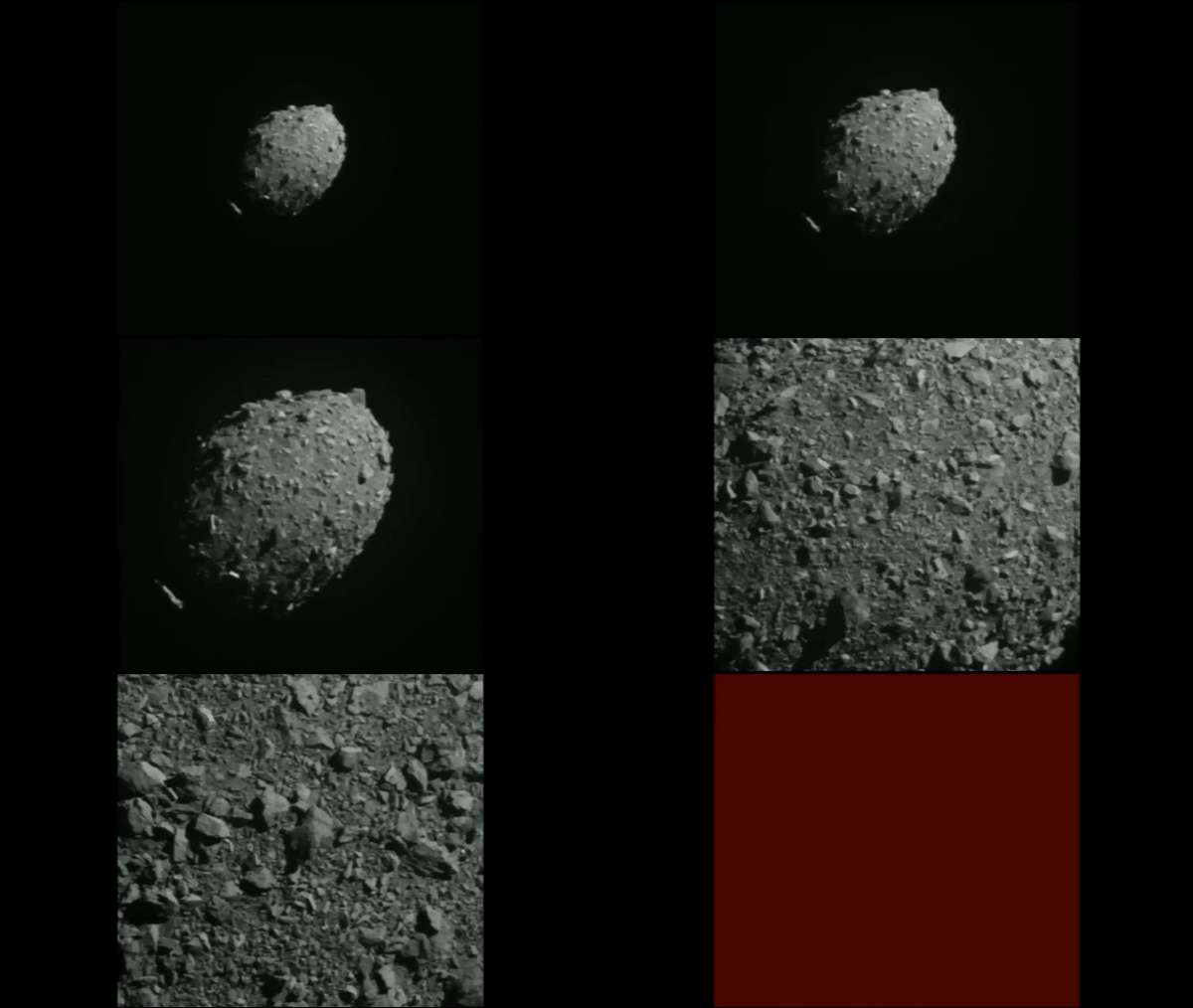
A series of images captured by the DART spacecraft as it sped to impact the asteroid Dimorphos on Sept. 26, 2022.
One of the most promising aspects of NEO Surveyor is the fact that it'll be able to pinpoint NEOs by way of infrared detection. Infrared wavelengths aren't visible to human eyes and most human technology; they're usually thought of as heat signatures. Firefighters, for instance, can use infrared wavelengths to understand fire distribution in a burning building.
This detection strategy should yield a higher target hit rate when compared to traditional methods, which are usually based on whether sunlight reflects off an NEO. In fact, an issue with relying purely on sunlight for NEO hunting was illustrated with the Chelyabinsk asteroid that exploded over Russia in 2013, which damaged many buildings and injured over 1,000 people.
"The blast released energy equivalent to about 440 kilotons of TNT, more than 30 times the force of the Hiroshima bomb, shattering windows, injuring thousands and causing millions of dollars in property damage in Russia. Because the asteroid approached from the direction of the sun, it was undetectable by ground-based telescopes and went untracked," Rep. Brian Babin (R-Texas), who currently serves as the chairman of the House Committee on Space, Science and Technology, said during the hearing.
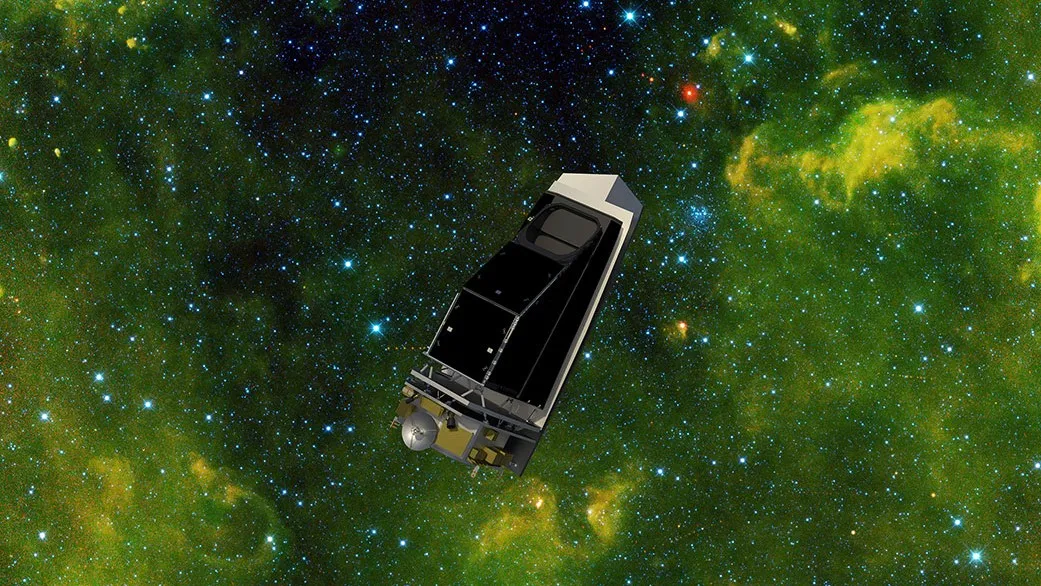
An artist's depiction of NASA's NEO Surveyor telescope looking for asteroids.
Though NEO Surveyor still won't be able to detect a possibly hazardous asteroid coming straight from the direction of the sun, it'll enable observations of NEOs super-close to our star, Fox said.
"It'll help us find the objects, including the dark fraction of the population, which we think is sort of roughly 35 to 40% or so of the population," Amy Mainzer, principal investigator for the NEO Surveyor mission and a professor at the University of California, Los Angeles, said during the hearing. "It will also help us measure the sizes, because we can quickly convert the infrared fluxes into a diameter as soon as we get an orbit from the Minor Planet Center … That's such an important component to the impact energy."
"We track the orbits of all 38,000 currently known NEOs, including the more than two and a half thousand potentially hazardous ones, and an impact by any one of those would be devastating," Matthew Payne, director of the Minor Planet Center, said during the hearing.
Fox said that NEO Surveyor should be ready to launch by 2028, perhaps sooner, but that is of course assuming the mission gets the funding it needs.
What happens next?
"Passback documents" — a sort of preview of the White House's 2026 budget request— suggested that the proposed cuts could lead to the closure of NASA's Goddard Space Flight Center in Maryland. The prospect of shutting down such a key agency research facility worries scientists, and it came up during the hearing.
Fox was asked, theoretically, what would happen if NASA's Ames Research Center in Silicon Valley, which plays a vital role in planetary defense, were to be shut down.
"If [NASA Ames] were no longer able to do the the the assessment, what we would lose is really the ability to give our sort of early expert advice to [the Federal Emergency Management Agency], which is then responsible for deciding where the perimeter is and what the response is to protect as much human life as possible," Fox said.
Payne said that, at present, the Minor Planet Center hasn't been affected by the proposed cuts; Mainzer said she's uncertain how the cuts might affect NEO Surveyor's operations. She also emphasized how expensive it can be to train scientists like herself to lead such an important mission.
"We really do have to have the investment and the time that it takes to learn the science, to be able to do it well," Mainzer said.
Fox echoed the uncertainty, responding to nearly all questions concerning Trump's skinny budget with the answer that she needs to see the finalized budget before coming to conclusions. "We await the full president's budget so we can see the priorities in the direction on which missions may be supported or not supported," she said.
"It's clear that planetary defense leverages many of our federal [science and technology] agencies. Now, whether that federal agency continues — whether that expertise continues — I think, is now in question," Rep. Zoe Lofgren (D-California) said during the hearing. Other Trump-instigated orders, like widespread layoffs of probationary employees and deferred resignation programs, are creating a "brain drain," she added.
Recent executive orders, for instance, have seen the rapid federal layoffs of over 800 workers at the National Oceanic and Atmospheric Administration (NOAA) who monitor natural disasters such as hurricanes and forecast daily weather patterns. The deferred resignation program is a sort of roundabout way of laying off employees, offering them payment through a certain month if they leave of their own accord.
"A very reasonable question is whether NASA should, in fact, be spending more money on asteroid monitoring and defense given the catastrophic risk to our country and civilization," Rep. George Whitesides (D-California), who used to work at NASA in a leadership position, said during the hearing. "As several members have mentioned already, our leadership in this area, like so many areas of space and Earth science, are under threat now from the proposed cuts to NASA's budget, as well as the budgets of other science agencies."
"We're talking about impacts that can actually wipe out an entire region, lay waste to a country or devastate the planet. And, you know, this is something that we can do something about. Actually, this is a natural disaster that is 100% preventable if we do our homework," Payne said.
RELATED STORIES
Of note, Rep. Foushee asked both Payne and Mainzer how much NEO tracking could improve if artificial intelligence could be implemented in the workflow. Both agreed that training systems with AI would lead to more accurate and more rapid results, but when Foushee inquired how much funding would be necessary to realistically perform such AI implementation, the question was deferred to Fox. "Adequate funding is certainly a major thing," Fox said.
Exactly how our planetary defense strategies may be affected hinges on the details of Trump's budget, which have not yet been released. (And Congress still has to enact a budget, which remains a proposal until that happens.) If the White House indeed cuts back on funding for these efforts, Fox said NASA may be able to rely on global partners for hazardous NEO tracking.
"If we can't all unite on a large chunk hurtling towards the planet, what are we going to unite on?" Fox said.
This article was originally published on Space.com.

Monisha Ravisetti is Space.com's Astronomy Editor. She covers black holes, star explosions, gravitational waves, exoplanet discoveries and other enigmas hidden across the fabric of space and time. Previously, she was a science writer at CNET, and before that, reported for The Academic Times. Prior to becoming a writer, she was an immunology researcher at Weill Cornell Medical Center in New York. She graduated from New York University in 2018 with a B.A. in philosophy, physics and chemistry. She spends too much time playing online chess. Her favorite planet is Earth.