













Scientists are 'gobsmacked' by strange reversals in deep-ocean currents
The speed and direction of deep currents off Mozambique’s coast are more subject to change than scientists expected.
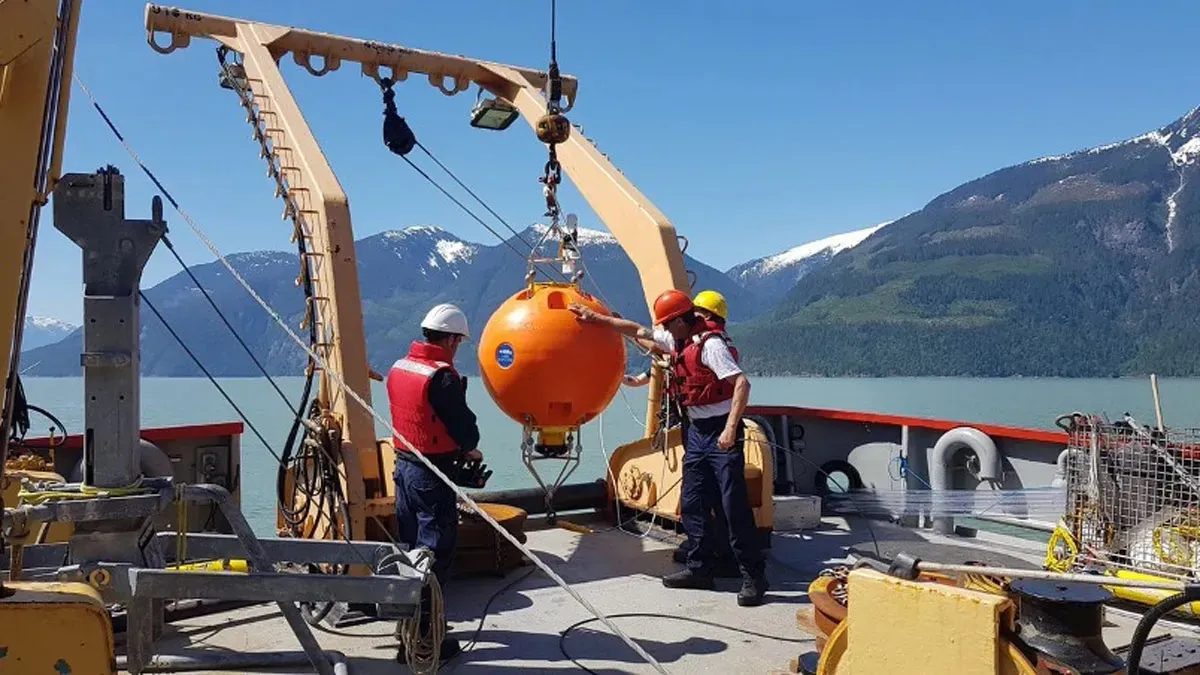
Large-scale currents are the conveyor belts of the ocean, transporting water and nutrients and controlling Earth's climate. Surface currents are relatively easy to measure and track. But those in the deep ocean are mostly a mystery. Now, a new study published in Nature Geoscience unveiled the biggest data set to date on the speed and direction of currents that flow near the seafloor, and it's nothing like what the scientists anticipated.
Previously, seafloor currents were believed to be steady and, in the region off the coast of Mozambique that the authors studied, to flow from south to north. However, the results revealed that deep-sea currents are far more dynamic than previously known. The findings suggest that current simulations used to track the flow of sediment and pollutants in the deep sea and reconstruct ancient ocean conditions need an update.
"These conveyor belts of currents that operate the whole way around our planet are going to be far more complicated than the textbook models suggest," said Mike Clare, a National Oceanography Centre sedimentologist and senior author of the study. "They really do warrant very careful investigation."
Related: Where did ocean currents come from?
Measuring complex currents
Scientists can measure deep-sea currents using sensors called acoustic Doppler current profilers (ADCPs) secured to the seafloor. But deploying and managing these moorings are challenging and expensive, so many studies have used them sparingly for short time periods.
Fortuitously, an Italian oil and gas company called Eni deployed an unprecedented array of 34 ADCPs for industrial purposes over roughly 2,500 square kilometers (965 square miles) in the Mozambique Channel, just off the coast. The company shared the data, giving scientists a unique and detailed view of the seafloor. The instruments measured the speed and direction of currents every 10 minutes for 4 years. "The thing that's unique about the study is the long time series that they have of near-bottom currents," said Jacob Wenegrat, a physical oceanographer at the University of Maryland who wasn't involved in the study.
When Lewis Bailey, a geoscientist now at the University of Calgary, started analyzing the mountain of data from the ADCPs, the results looked so different from the expected trend of consistent northward currents that he wondered whether he'd made a mistake. "The first thing I thought was, 'This can't be right,'" he said.
Get the world’s most fascinating discoveries delivered straight to your inbox.
But after crunching all the numbers, the researchers discovered that seafloor currents often sped up, slowed down, and even reversed direction. "We were very surprised to see how variable all the currents were even between moorings that were fairly close together," Bailey said.
"All the geologists who were involved in this project were absolutely gobsmacked by the variability," Clare said.
The researchers looked into what might have caused the variations. "It was almost like detective work," Bailey said. The currents varied among seasons and throughout tidal cycles. The ADCPs and patterns in scoured seabed revealed that currents on open seafloor slopes generally flow northward on average. But within submarine canyons, which are oriented roughly east–west, the current often reverses direction, flowing up or down their length.
The scientists speculate that the tides and seafloor topography are largely responsible for the character of the currents.
Well-studied surface currents are often variable in their speed and direction, but Wenegrat said there's been a recent increase in interest among physical oceanographers to study the waters near the seafloor. "A lot of the things that are happening in the surface ocean are also happening down there," he said. "It's exciting to see a nice record of all of the temporal and spatial variability," Wenegrat said about the new study.
Clare noted that the limited studies of deep-sea currents have sometimes contradicted each other, but the differences are likely based on when and where the measurements were taken. "I think these different camps that have been disagreeing with each other are all right," he said.
Where Do Sediments Settle Out?
Scientists rely on simulations of ocean currents and limited seafloor core samples to study the transport and deposition of sediments and pollutants such as microplastics and how these might affect deep-sea ecosystems. They also use similar methods to reconstruct ancient ocean conditions.
The new study's authors suggested these simulations might be oversimplified.
RELATED STORIES
Given the variability in currents among sites in the study, a single core sample might be too limited to characterize the sediments in a region, Clare said. "It's made me realize that we need to think very carefully about the placement of instruments, and not to go in with a priori assumptions that this is just a continuous, unidirectional current."
The researchers acknowledged that the study took place in only one zone of the world's oceans, and more data in other areas will be invaluable to building better simulations.
This article was originally published on Eos.org. Read the original article.
Andrew Chapman is a freelance science journalist based in Truckee, California. I write about life sciences and the environment. My work has appeared in Scientific American, Science Magazine, Eos, and Hakai Magazine, amongst others.