Get the world’s most fascinating discoveries delivered straight to your inbox.
You are now subscribed
Your newsletter sign-up was successful
Want to add more newsletters?
Join the club
Get full access to premium articles, exclusive features and a growing list of member rewards.
An account already exists for this email address, please log in.
The Gulf Stream stopped pumping nutrients during the last ice age — and the same could be happening now
Atlantic currents slowed dramatically during the Younger Dryas period. By reconstructing those ancient ocean conditions, scientists think they can forecast changes over the next century.
NASA visualization showing the Gulf Stream as it unfurls from the Florida Straits across the North Atlantic Ocean. The current is colored according to sea surface temperature. Red is equivalent to around 90 degrees Fahrenheit (32 degrees Celsius) while green is equivalent to roughly 55 F (13 C).
(Image credit: NASA/Goddard Space Flight Center Scientific Visualization Studio)
The Gulf Stream slowed dramatically at the end of the last ice age with dire effects on organisms in the Atlantic, scientists have found. This discovery could help researchers forecast how Atlantic currents will change in response to climate change today.
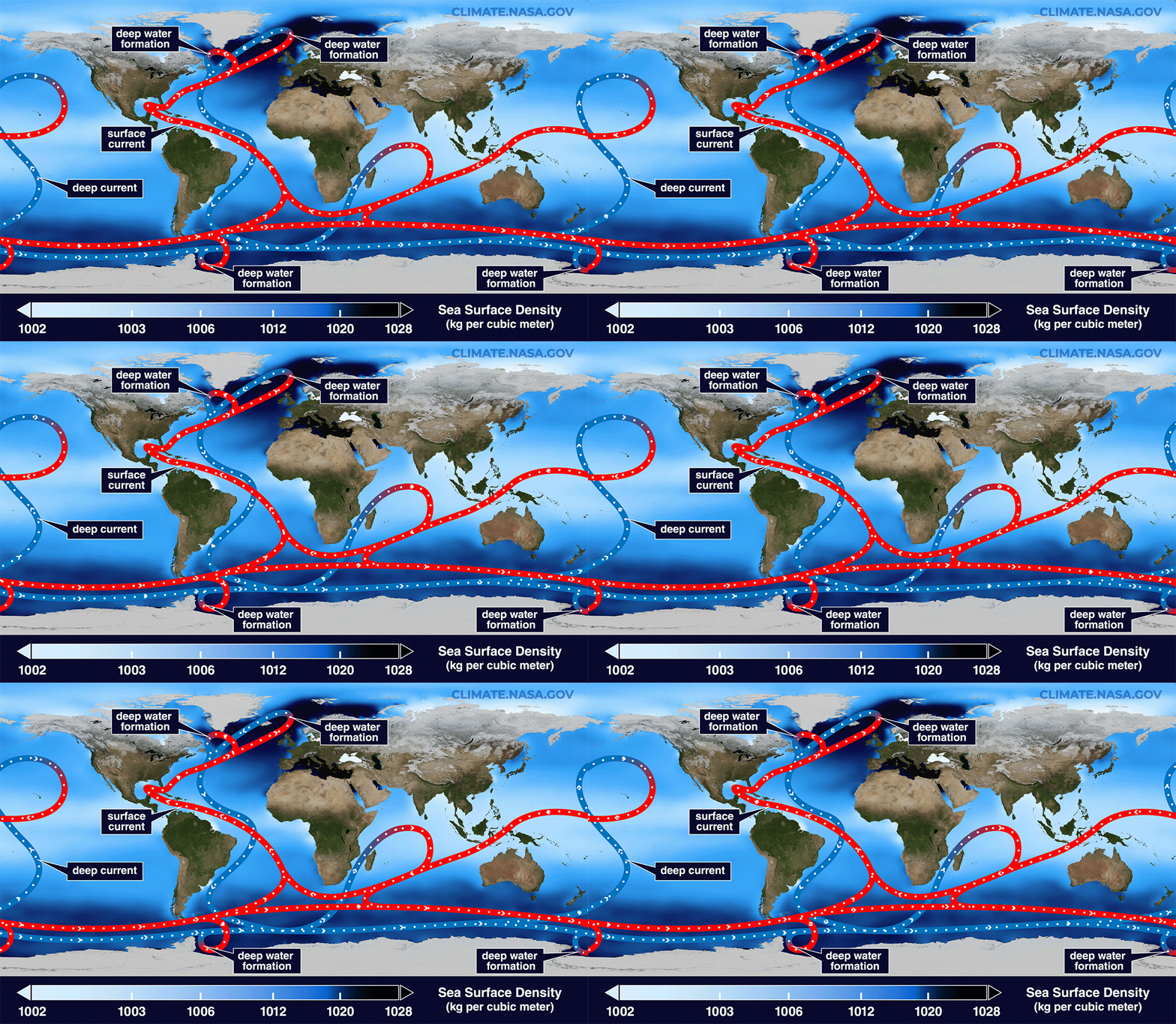
The Gulf Stream is a warm ocean current that originates in the Florida Straits between Florida and Cuba, before skirting the U.S. East Coast and Canada and crossing the North Atlantic to Europe. The heat it carries maintains temperate conditions in Europe and to some extent North America. The current forms part of the Atlantic Meridional Overturning Circulation (AMOC), which transports balmy waters from the Southern Hemisphere to the north and then back down toward Antarctica in a giant loop.
Previous models showed the Gulf Stream is weakening and the AMOC may be close to collapse, with grave implications for the climate. Now, a new study published Thursday (May 9) in the journal Science has found that a decline in the Gulf Stream potentially spells trouble for ocean critters that depend on the nutrients the current transports from the tropics to the North Atlantic.
The authors based their conclusions on fossil and sediment records from a brief cooling event between 12,900 and 11,700 years ago, known as the Younger Dryas. The cold snap temporarily reversed a period of global warming during the transition from the Pleistocene epoch to the current Holocene epoch.
"There are multiple lines of evidence that the AMOC weakened during the Younger Dryas cold interval that punctuated the transition out of the last ice age," the researchers wrote in the study. "Although the details of the background climate state and timescale of change differ from those of the present day, this past climate event provides an opportunity to test the mechanisms that have been identified in the climate models."
To reconstruct the conditions that prevailed in the Gulf Stream during the Younger Dryas, the researchers examined the nutrient content of microscopic fossils and sediment cores from the Florida Straits. The team found that nutrient content dropped during the Younger Dryas compared with the millennia immediately before and afterward. This starved photosynthetic organisms in the North Atlantic that convert these nutrients and sunlight into organic matter. Their decline likely sent ripples through the food chain, affecting populations of fish and other sea creatures.
Sign up for the Live Science daily newsletter now
Get the world’s most fascinating discoveries delivered straight to your inbox.
A simplified animation of the global conveyor belt of ocean currents, including the Atlantic Meridional Overturning Circulation (AMOC) in the Atlantic Ocean.
(Image credit: NASA/Goddard Space Flight Center Scientific Visualization Studio)
"In this simulation, as the AMOC and nutrient stream weaken, the nutrient content of the upper North Atlantic and primary productivity both decline," the researchers wrote in the study. The drop in nutrient content at the base of the Gulf Stream was linked to stagnating currents in the Southern Hemisphere, where the AMOC usually picks up nutrient-rich waters and whips them northward.
This snapshot from the Younger Dryas bolsters current climate models that predict nutrient transport to the North Atlantic Ocean will nosedive if the AMOC and Gulf Stream continue to slow, according to the study. The resulting decline in primary productivity would affect crucial North Atlantic fisheries and may also limit how much CO2 the oceans can take up, the researchers wrote.
Sascha is a U.K.-based staff writer at Live Science. She holds a bachelor’s degree in biology from the University of Southampton in England and a master’s degree in science communication from Imperial College London. Her work has appeared in The Guardian and the health website Zoe. Besides writing, she enjoys playing tennis, bread-making and browsing second-hand shops for hidden gems.