















500 million-year-old, bug-like fossils have stunningly preserved nervous systems
The organisms may be related to modern arachnids, scientists say.

Two tiny fossils, each smaller than an aspirin pill, contain fossilized nerve tissue from 508 million years ago. The bug-like Cambrian creatures could help scientists piece together the evolutionary history of modern-day spiders and scorpions.
Still, it's not clear exactly where these fossils — both specimens of the species Mollisonia symmetrica — fit on the arthropod evolutionary tree, said Nicholas Strausfeld, a regents professor in the Department of Neuroscience at the University of Arizona, who was not involved in the study.
That's because some features, like the animals' eyes and nerve cords, can be clearly identified in the fossils, but other parts of the nervous system cannot be so easily spotted. In particular, it's unclear whether or not the animals carry a brain-like bundle of nerves called a synganglion, and without this key piece of evidence, their relation to other animals remains fuzzy, Strausfeld said.
Related: From dino brains to thought control — 10 fascinating brain findings
Where the synganglion would sit, instead there's "this mess in the middle of the head," said first author Javier Ortega-Hernández, an invertebrate paleobiologist at Harvard University and curator of the Harvard Museum of Comparative Zoology. The researchers can tell that this mess is nerve tissue, but they can't discern its exact organization.
"It is … true that we do not have every single characteristic of the nervous system of this animal mapped out, because the fossils only tell us so much," Ortega-Hernández said. The researchers acknowledge this uncertainty in their new report, published Jan. 20 in the journal Nature Communications, and present a few different ideas as to how these fossils relate to ancient and modern-day critters. If more fossilized M. symmetrica are uncovered in the future, the species' place on the tree of life may eventually be resolved.
'A stroke of luck'
Finding fossilized nerve tissue from the Cambrian period, which took place between about 543 million and 490 million years ago, is a "rarity," Ortega-Hernández said. "It's really a stroke of luck."
Get the world’s most fascinating discoveries delivered straight to your inbox.
Scientists uncovered the first evidence of a fossilized arthropod brain from the Cambrian period about a decade ago, according to a 2012 report in the journal Nature Communications; arthropods are invertebrate animals in the phylum Arthropoda, a group that includes modern insects, crustaceans and arachnids, like spiders. Since that initial discovery 10 years ago, preserved nerve tissue has been found in more than a dozen Cambrian fossils, most of them arthropods, Ortega-Hernández said.
The fossils featured in the new study were found not at a field site, but in the depths of the museum collections at the Harvard University Museum of Comparative Zoology in Cambridge, Massachusetts, and the Smithsonian Institution in Washington, D.C. Both specimens were discovered in mid-Cambrian Burgess Shale deposits from British Columbia.
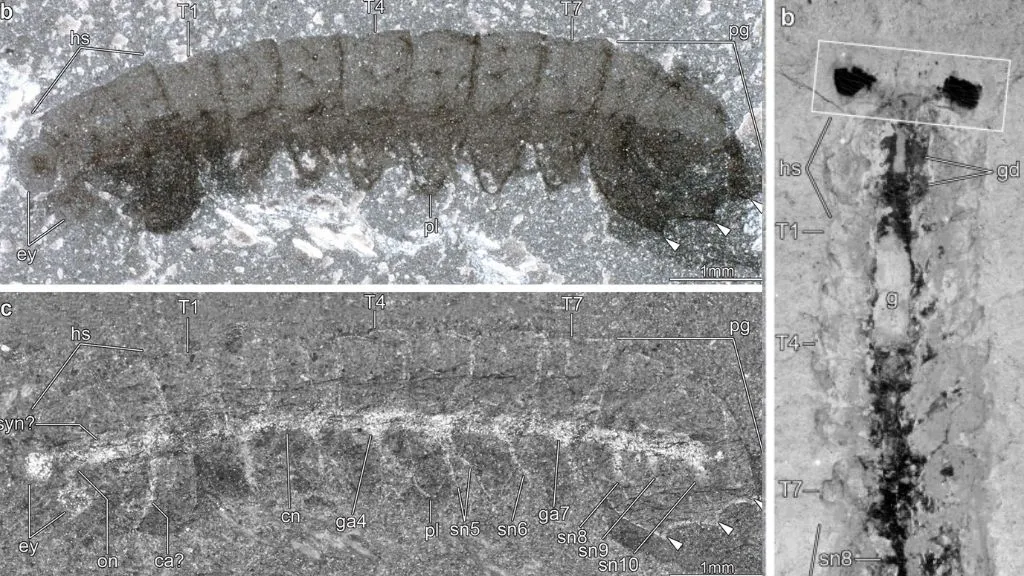
The Harvard fossil measures about 0.5 inches (13 millimeters) long and 0.1 inches (3.5 mm) wide at its widest point; the fossil is oriented such that you're looking down at the arthropod from above. The Smithsonian fossil, on the other hand, offers a side-view of M. symmetrica; this specimen measures only 0.3 inches (7.5 mm) long and 0.06 inches (1.7 mm) tall.
Related: Ancient footprints to tiny 'vampires': 8 rare and unusual fossils

The fossil from the Smithsonian shows a lateral view of M. symmetrica.
To the naked eye, neither fossil looks particularly exciting, Ortega-Hernández said. Regarding the miniscule Smithsonian fossil, in particular, "superficially, it is extremely unremarkable," he said. M. symmetrica has a simple exoskeleton, consisting of a head shield, segmented trunk and posterior shield — somewhat like the exoskeleton of a pillbug, but long and skinny.
The researchers suspect that the arthropod also had seven pairs of tiny appendages, two fangs and six pairs of little limbs; that's based on a 2019 study, published in the journal Nature, that described a fossil from a different species in the Mollisonia genus that bore such appendages. However, it's highly unusual to find Mollisonia fossils with intact limbs, and both fossils used in the new study lack appendages, Ortega-Hernández noted.
Despite the fossils' lack-luster appearance, when he placed the Smithsonian M. symmetrica fossil under a microscope, he spotted something intriguing, Ortega-Hernández said. "I realized, 'Ooh, there's something funky inside of this animal, inside of this fossil,'" he said. He found that locked inside both of these inconspicuous arthropods were well-preserved nervous systems. The fossilized nerves look like inky black splotches, because the fossilization process transformed the tissue into organic carbon films.
In the Smithsonian fossil, a bulbous eye can be seen in the arthropod's head and a nerve cord can be clearly seen running down the length of its belly, with some nerves jutting out from its underside. In the Harvard specimen, one can see two huge, orb-like eyes on the head, and a bit of the nerve cord peeking out from beneath the animal's digestive tract, which obscures the rest of the cord.
In both fossils, the study authors reported seeing optic nerves that run from the arthropods' eyes into the main body, but Strausfeld said the evidence for these nerves is "ambiguous," and ideally, these features would be clearer. And in both specimens, the authors noted that there's some sort of nerve tissue present in the head, but it's unclear whether this structure is a brain-like synganglion or something else entirely.
"We can see there's something in there, but we don't have enough resolution to be able to say, 'Oh, it's definitely organized in this way or that way,'" Ortega-Hernández said.
Uncertainty in the data

The Harvard fossil shows a top-down view of M. symmetrica.
This uncertainty in the fossil record means the precise relationship of M. symmetrica to other animals also remains murky, Ortega-Hernández said. But based on the features present in the arthropods, the team constructed two evolutionary trees.
Both trees indicate that M. symmetrica and modern chelicerates share a common ancestor, suggesting that the ancient animal's relatively simple nervous system gave rise to the highly condensed brain seen in modern-day members of this group, such as scorpions, spiders, horseshoe crabs and ticks. However, the trees differ in where they position other important arthropod groups from the Cambrian, including one known as the megacheirans; these groups have similar nervous systems to modern chelicerates.
RELATED CONTENT
Depending on where these various groups sit on their evolutionary tree, their placement either shows that chelicerate-like brains evolved in a stepwise manner through time, or it hints that such nervous systems evolved independently and at different times in some Cambrian arthropods and modern chelicerates, through convergent evolution, Ortega-Hernández said.
With the data at hand, Strausfeld said he would be "cautious" about attempting to place M. symmetrica anywhere on an evolutionary tree. In order to do so, he said he'd need clearer evidence of how the arthropods' optic nerves and synganglion (or lack thereof) are structured, as well as evidence of nerves extending out to the roots of the animal's limbs.
"I think one needs a better preparation, a better specimen" than the ones examined so far, Strausfeld said. "Maybe there's another specimen lying around somewhere in a museum."
Originally published on Live Science.

Nicoletta Lanese is the health channel editor at Live Science and was previously a news editor and staff writer at the site. She is a recipient of the 2026 AHCJ International Health Study Fellowship, with a project focused on antibiotic stewardship practices in Japan and the U.S. They hold a graduate certificate in science communication from UC Santa Cruz and degrees in neuroscience and dance from the University of Florida. Beyond Live Science, Lanese's work has appeared in The Scientist, Science News, the Mercury News, Mongabay and Stanford Medicine Magazine, among other outlets. Based in NYC, she also remains involved in dance and performs in local choreographers' work.